
Catalogue Search | MBRL


Are you sure you want to remove the book from the shelf?

{{itemTitle}}
1,027
result(s) for
"Spain Colonies"
Sort by:

How the Spanish empire was built : a 400 year history
\"The untold story of the engineering behind the empire, showing how imperial Spain built upon existing infrastructure and hierarchies of the Inca, Aztec, and more, to further its growth. Sixteenth-century Spain was small, poor, disunited, and sparsely populated. Yet the Spaniards and their allies built the largest empire the world had ever seen. How did they achieve this? Felipe Fernández-Armesto and Manuel Lucena Giraldo argue that Spain's engineers were critical to this venture. The Spanish invested in infrastructure to the advantage of local power brokers, enhancing the abilities of incumbent elites to grow wealthy on trade, and widening the arc of Spanish influence. Bringing to life stories of engineers, prospectors, soldiers, and priests, the authors paint a vivid portrait of Spanish America in the age of conquest. This is a dazzling new history of the Spanish Empire, and a new understanding of empire itself, as a venture marked as much by collaboration as oppression\"-- Provided by publisher.
Book

Counter-Hispanization in the Colonial Philippines
In Counter-Hispanization in the Colonial Philippines , the author analyzes the literature and politics of 'spiritual conquest' in order to demonstrate how it reflected the contribution of religious ministers to a protracted period of social anomie throughout the mission provinces between the sixteenth-eighteenth centuries. By tracking the prose of spiritual conquest with the history of the mission in official documents, religious correspondence, and public controversies, the author shows how, contrary to the general consensus in Philippine historiography, the literature and pastoral politics of spiritual conquest reinforced the frontier character of the religious provinces outside Manila in the Americas as well as the Philippines, by supplanting the (absence of) law in the name of supplementing or completing it. This frontier character accounts for the modern reinvention of native custom as well as the birth of literature and theater in the Tagalog vernacular.
eBook

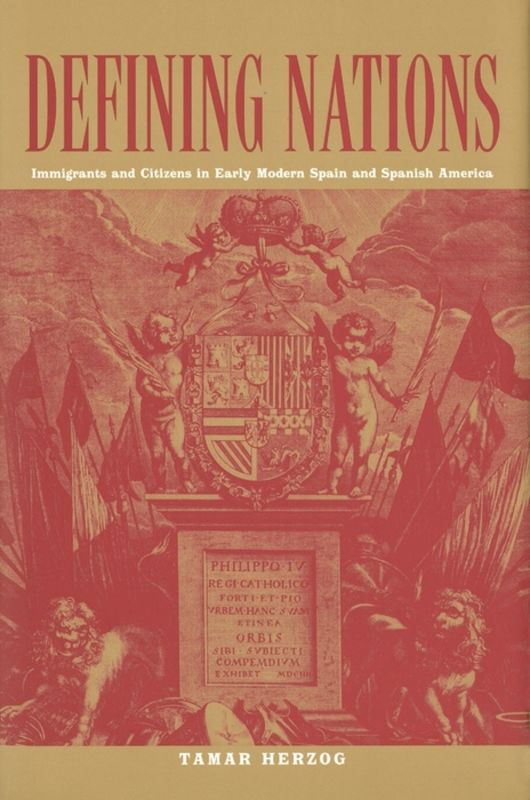
Defining Nations
In this book Tamar Herzog explores the emergence of a specifically Spanish concept of community in both Spain and Spanish America in the eighteenth century. Challenging the assumption that communities were the natural result of common factors such as language or religion, or that they were artificially imagined, Herzog reexamines early modern categories of belonging. She argues that the distinction between those who were Spaniards and those who were foreigners came about as local communities distinguished between immigrants who were judged to be willing to take on the rights and duties of membership in that community and those who were not.
eBook

Colour of paradise : the emerald in the age of gunpowder empires
Among the magnificent gems and jewels left behind by the great Islamic empires, emeralds stand out for their size and prominence. For the Mughals, Ottomans, and Safavids green was—as it remains for all Muslims—the color of Paradise, reserved for the Prophet Muhammad and his descendants. Tapping a wide range of sources, Kris Lane traces the complex web of global trading networks that funneled emeralds from backland South America to populous Asian capitals between the sixteenth and the eighteenth centuries. Lane reveals the bloody conquest wars and forced labor regimes that accompanied their production. It is a story of trade, but also of transformations—how members of profoundly different societies at opposite ends of the globe assigned value to a few thousand pounds of imperfectly shiny green rocks.
eBook

Corruption in the Iberian empires : greed, custom, and colonial networks
\"This book provides new perspectives into a subject that historians have largely overlooked. The contributors use fresh archival research from Spain, Portugal, Brazil, Bolivia, Mexico, and the Philippines to examine the lives of slaves and farmworkers as well as self-serving magistrates, bishops, and traders in contraband. The authors show that corruption was a powerful discourse in the Atlantic world. Investigative judges could dismiss culprits, jail them, or, sometimes, have them 'garroted and their corpses publicly displayed'\"--Provided by publisher.
Book

Disorientations
This book explores from a new perspective the fraught processes of Spaniards' efforts to formulate a national identity, from the Enlightenment to the present day. Focusing on the nation's Islamic-African legacy, Susan Martin-Márquez disputes received wisdom that Spain has consistently rejected its historical relationship to Muslims and Africans. Instead, she argues, Spaniards have sometimes denied and sometimes embraced this legacy, and that vacillation has served to destabilize presumably fixed borders between Europe and the Muslim world and between Europe and Africa.
Martin-Márquez analyzes a wealth of texts produced by Spaniards as well as by Africans and Afro-Spaniards from the early nineteenth century forward. She illuminates the complexities and disorientations of Spanish identity and shows how its evolution has important implications for current debates not only in Spanish culture but also in other countries involved in negotiating a modern identity.
eBook


Experiencing nature : the Spanish American empire and the early scientific revolution
“A very significant contribution. . . . This book tells a story that is usually left out of the master narrative of the history of exploration. . . . Moreover, it tells a story based on real expeditions and experiences, and it quotes liberally and effectively from engaging reports and sixteenth-century treatises, so it should appeal to general readers as well.” -Carla Rahn Phillips, Union Pacific Professor in Comparative Early Modern History, University of Minnesota As Spain colonized the Americas during the sixteenth century, Spanish soldiers, bureaucrats, merchants, adventurers, physicians, ship pilots, and friars explored the natural world, gathered data, drew maps, and sent home specimens of America's vast resources of animals, plants, and minerals. This amassing of empirical knowledge about Spain's American possessions had two far-reaching effects. It overturned the medieval understanding of nature derived from Classical texts and helped initiate the modern scientific revolution. And it allowed Spain to commodify and control the natural resources upon which it built its American empire. In this book, Antonio Barrera-Osorio investigates how Spain's need for accurate information about its American colonies gave rise to empirical scientific practices and their institutionalization, which, he asserts, was Spain's chief contribution to the early scientific revolution. He also conclusively links empiricism to empire-building as he focuses on five areas of Spanish activity in America: the search for commodities in, and the ecological transformation of, the New World; the institutionalization of navigational and information-gathering practices at the Spanish Casa de la Contratación (House of Trade); the development of instruments and technologies for exploiting the natural resources of the Americas; the use of reports and questionnaires for gathering information; and the writing of natural histories about the Americas.
eBook