
Catalogue Search | MBRL


Are you sure you want to remove the book from the shelf?

{{itemTitle}}
6
result(s) for
"Spain History Civil War, 1936-1939 Atrocities."
Sort by:

The Spanish holocaust : inquisition and extermination in twentieth-century Spain
Long neglected by European historians, the unspeakable atrocities of Franco's Spain are finally brought to tragic light in this definitive work by Paul Preston, the world's foremost historian of 20th-century Spain.
BOOK

Paracuellos
This book examines the most polemical atrocity of the Spanish Civil War: the massacre of 2,500 political prisoners by Republican security forces in the villages of Paracuellos and Torrejâon de Ardoz near Madrid in November/December 1936. The atrocity took place while Santiago Carrillo -- later Communist Party leader in the 1970s -- was responsible for public order. Although Carrillo played a key role in the transition to democracy after Franco's death in 1975, he passed away at the age of 97 in 2012 still denying any involvement in 'Paracuellos' (the generic term for the massacres). The issue of Carrillo's responsibility has been the focus of much historical research. Julius Ruiz places Paracuellos in the wider context of the 'Red Terror' in Madrid, where a minimum of 8,000 'fascists' were murdered after the failure of military rebellion in July 1936. He rejects both 'revisionist' right-wing writers such as Cesar Vidal who cite Paracuellos as evidence that the Republic committed Soviet-style genocide and left-wing historians such as Paul Preston, who in his Spanish Holocaust argues that the massacres were primarily the responsibility of the Soviet secret police, the NKVD. The book argues that Republican actions influenced the Soviets, not the other way round: Paracuellos intensified Stalin's fears of a 'Fifth Column' within the USSR that facilitated the Great Terror of 1937-38. It concludes that the perpetrators were primarily members of the Provincial Committee of Public Investigation (CPIP), a murderous all-leftist revolutionary tribunal created in August 1936, and that its work of eliminating the 'Fifth Column' (an imaginary clandestine Francoist organisation) was supported not just by Carrillo, but also by the Republican government. In Autumn 2015 the book was serialised in El Mundo, Spain's second largest selling daily, to great acclaim.
eBook

Exhuming Loss
This book examines the contested representations of those murdered during the Spanish Civil War of the 1930s in two small rural communities as they undergo the experience of exhumation, identification, and reburial from nearby mass graves. Based on interviews with relatives of the dead, community members and forensic archaeologists, it pays close attention to the role of excavated objects and images in breaking the pact of silence that surrounded the memory of these painful events for decades afterward. It also assesses the significance of archaeological and forensic practices in changing relationships between the living and dead. The exposure of graves has opened up a discursive space in Spanish society for multiple representations to be made of the war dead and of Spain's traumatic past.
eBook
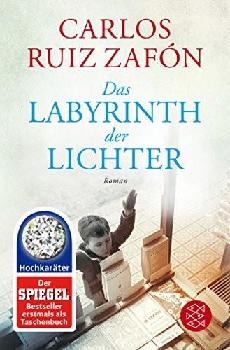
Das Labyrinth der Lichter : roman
\"Nine-year-old Alicia lost her parents during the Spanish Civil War when the Nacionales (the fascists) savagely bombed Barcelona in 1938. It is twenty years later. Tired of her work as investigator for Spain's secret police in Madrid, a job she has held for more than a decade, the twenty-nine-year old plans to quit. At the insistence of her boss, she remains to solve one last case: the mysterious disappearance of Spain's Minister of Culture, Mauricio Valls. With her partner, the intimidating policeman Juan Manuel Vargas, Alicia discovers a possible clue - a rare book by the author Victor Mataix hidden in Valls' office in his Madrid mansion. As Alicia and Vargas come closer to finding Valls, they uncover a tangled web of kidnappings and murders tied to the Franco regime, whose corruption is more widespread and horrifying than anyone imagined. Now Alicia's life is in danger.\" -- abridgment of a summary on goodreads.com
BOOK
