
Catalogue Search | MBRL


Are you sure you want to remove the book from the shelf?

{{itemTitle}}
819
result(s) for
"Spaniards"
Sort by:

The farthest home is in an empire of fire : a Tejano elegy
In his 1999 memoir Places Left Unfinished at the Time of Creation, John Phillip Santos told the story of one Mexican family--his father's--set within the larger story of Mexico itself. In this new book, he tells of how another family--this time, his mother's--erased and forgot, over time, their ancient origins in Spain. Every family has a forgotten tale of where it came from. Who is driven to tell it and why? Weaving together a highly original mix of autobiography, conquest history, elegy, travel, family remembrance, and time-traveling narration, Santos describes a lifelong quest to find the missing chronicle of his mother's family, one that takes him from South Texas and Mexico to Spain and ultimately to the Middle East. He raises profound questions about whether we can ever find our true homeland and what we can learn from our treasured, shared cultural legacies.--From publisher description.
Book

Empires of the Atlantic World
This epic history compares the empires built by Spain and Britain in the Americas, from Columbus's arrival in the New World to the end of Spanish colonial rule in the early nineteenth century. J. H. Elliott, one of the most distinguished and versatile historians working today, offers us history on a grand scale, contrasting the worlds built by Britain and by Spain on the ruins of the civilizations they encountered and destroyed in North and South America.Elliott identifies and explains both the similarities and differences in the two empires' processes of colonization, the character of their colonial societies, their distinctive styles of imperial government, and the independence movements mounted against them. Based on wide reading in the history of the two great Atlantic civilizations, the book sets the Spanish and British colonial empires in the context of their own times and offers us insights into aspects of this dual history that still influence the Americas.
eBook

The Mark of Zorro
Timid Don Diego Vega grows faint at even the mention of bloodshed and would rather read poetry than defend his own honor. No one suspects that the effete aristocrat is living a double life as Zorro the fox, bold fighter of injustice, whose sword is ever ready to defend the poor and oppressed against a corrupt governor and his merciless army. Zorro's charade fools even the spirited Lolita Pulido, whose father forces her to endure the listless wooing of Don Diego while her heart belongs to the masked hero who laughs in the face of danger. This lighthearted tale of the Robin Hood of Old California unfolds as a suspenseful romp across Los Angeles of the 1820s. Loaded with colorful characters and historic atmosphere, recounted in direct and unpretentious prose, the pulp adventure offers a winning balance of action, comedy, and romance. This edition reprints the original 1919 story, published serially as \"The Curse of Capistrano,\" which launched the Zorro legend. Scores of sequels followed, along with movie and television versions, all inspired by this swashbuckling classic.
Book
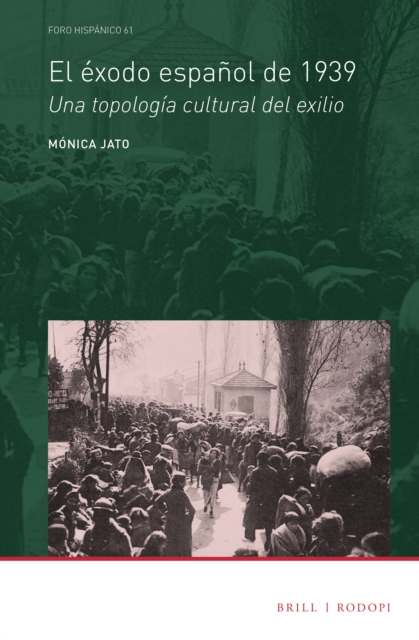
El âexodo espaänol de 1939: una topologâia cultural del exilio
Read an interview with Mónica Jato.El éxodo español de 1939: Una topologìa cultural del exilio explores the cultural strategies employed by Spanish Republican refugees in adapting to radical changes in their environment and transforming the new spaces into habitable places. Thus the monograph highlights the centrality of the concept of place in the reconstruction of the lost home by analysing the various stages of the relocation of culture in exile: from French internment camps, on board ships, and finally to residence in Mexico. Adopting an interdisciplinary approach, Jato contends that the experience of space in exile is relational, and that the staging posts described in each chapter have no meaning unless they are interconnected as integral parts of a cultural topology. En El éxodo español de 1939: Una topologìa cultural del exilio Mónica Jato da cuenta de las variadas estrategias culturales empleadas por los refugiados republicanos españoles para adaptarse a las condiciones de sus nuevos entornos con el fin de transformarlos en lugares habitables. El libro indaga asì la centralidad del concepto de lugar en la reconstrucción del hogar perdido y lo hace a través de sus diferentes etapas: en los campos de internamiento franceses, en los barcos rumbo a América y durante el asentamiento en tierras mexicanas.La experiencia del exilio es abordada aquì desde una perspectiva interdisciplinaria que pone de manifiesto el aspecto relacional de estas pausas espaciales cuya interconexión define esta particular topologìa cultural.
eBook


The Search for Mabila
One of the most profound events in sixteenth-century North
America was a ferocious battle between the Spanish army of
Hernando de Soto and a larger force of Indian warriors under the
leadership of a feared chieftain named Tascalusa. The site of
this battle was a small fortified border town within an Indian
province known as Mabila. Although the Indians were defeated, the
battle was a decisive blow to Spanish plans for the conquest and
settlement of what is now the southeastern United States. For in
that battle, De Soto’s army lost its baggage, including all
proofs of the richness of the land—proofs that would be
necessary to attract future colonists. Facing such a severe
setback, De Soto led his army once more into the interior of the
continent, where he was not to survive. The ragtag remnants of
his once-mighty expedition limped into Mexico some three years
later, thankful to be alive. The clear message of their ordeal
was that this new land, then known as La Florida, could not be
easily subjugated. But where, exactly, did this decisive battle
of Mabila take place? The accounts left by the Spanish
chroniclers provide clues, but they are vague, so lacking in
corroboration that without additional supporting evidence, it is
impossible to trace De Soto’s trail on a modern map with
any degree of certainty. Within this volume, 17
scholars—specialists in history, folklore, geography,
geology, and archaeology—provide a new and encouragingly
fresh perspective on the current status of the search for Mabila.
Although there is a widespread consensus that the event took
place in the southern part of what is now Alabama, the truth is
that to this day, nobody knows where Mabila is—neither the
contributors to this volume, nor any of the historians and
archaeologists, amateur and professional, who have long sought
it. One can rightfully say that the lost battle site of Mabila is
the predominant historical mystery of the Deep South.
eBook

The Spanish frontier in North America
From the Publisher: In 1513, when Ponce de Leon stepped ashore on a beach of what is now Florida, Spain gained its first foothold in North America. For the next three hundred years, Spaniards ranged through the continent building forts to defend strategic places, missions to proselytize Indians, and farms, ranches, and towns to reconstruct a familiar Iberian world. This engagingly written and well-illustrated book presents an up-to-date overview of the Spanish colonial period in North America. It provides a sweeping account not only of the Spaniards' impact on the lives, institutions, and environments of the native peoples but also of the effect of native North Americans on the societies and cultures of the Spanish settlers. With apt quotations and colorful detail, David J. Weber evokes the dramatic era of the first Spanish-Indian contact in North America, describes the establishment, expansion, and retraction of the Spanish frontier, and recounts the forging of a Hispanic empire that ranged from Florida to California. Weber refutes the common assumption that while the English and French came to the New World to settle or engage in honest trade, the Spaniards came simply to plunder. The Spanish missionaries, soldiers, and traders who lived in America were influenced by diverse motives, and Weber shows that their behavior must be viewed in the context of their own time and within their own frame of reference. Throughout his book Weber deals with many other interesting issues, including the difference between English, French, and Spanish treatment of Indians, the social and economic integration of Indian women into Hispanic society, and the reasons why Spanish communities in North America failed to develop at the rate that the English settlements did. His magisterial work broadens our understanding of the American past by illuminating a neglected but integral part of the nation's heritage.
Book

Prevalence of mental disorders in elderly people: The European MentDis_ICF65+ study
Except for dementia and depression, little is known about common mental disorders in elderly people.
To estimate current, 12-month and lifetime prevalence rates of mental disorders in different European and associated countries using a standardised diagnostic interview adapted to measure the cognitive needs of elderly people.
The MentDis_ICF65+ study is based on an age-stratified, random sample of 3142 older men and women (65-84 years) living in selected catchment community areas of participating countries.
One in two individuals had experienced a mental disorder in their lifetime, one in three within the past year and nearly one in four currently had a mental disorder. The most prevalent disorders were anxiety disorders, followed by affective and substance-related disorders.
Compared with previous studies we found substantially higher prevalence rates for most mental disorders. These findings underscore the need for improving diagnostic assessments adapted to the cognitive capacity of elderly people. There is a need to raise awareness of psychosocial problems in elderly people and to deliver high-quality mental health services to these individuals.
Journal Article

Conquistadora : a novel
Drawn to the exotic island of Puerto Rico by the diaries of an ancestor who traveled there with Ponce de Leâon, Ana Cubillas becomes involved with enamored twin brothers Ramâon and Inocente before convincing them to claim a sugar plantation they have inherited.
Book

Peace Came in the Form of a Woman
Revising the standard narrative of European-Indian relations in America, Juliana Barr reconstructs a world in which Indians were the dominant power and Europeans were the ones forced to accommodate, resist, and persevere. She demonstrates that between the 1690s and 1780s, Indian peoples including Caddos, Apaches, Payayas, Karankawas, Wichitas, and Comanches formed relationships with Spaniards in Texas that refuted European claims of imperial control.Barr argues that Indians not only retained control over their territories but also imposed control over Spaniards. Instead of being defined in racial terms, as was often the case with European constructions of power, diplomatic relations between the Indians and Spaniards in the region were dictated by Indian expressions of power, grounded in gendered terms of kinship. By examining six realms of encounter--first contact, settlement and intermarriage, mission life, warfare, diplomacy, and captivity--Barr shows that native categories of gender provided the political structure of Indian-Spanish relations by defining people's identity, status, and obligations vis-a-vis others. Because native systems of kin-based social and political order predominated, argues Barr, Indian concepts of gender cut across European perceptions of racial difference.
eBook