
Catalogue Search | MBRL


Are you sure you want to remove the book from the shelf?

{{itemTitle}}
118,730
result(s) for
"Spanish "
Sort by:

Converting Words
This pathbreaking synthesis of history, anthropology, and linguistics gives an unprecedented view of the first two hundred years of the Spanish colonization of the Yucatec Maya. Drawing on an extraordinary range and depth of sources, William F. Hanks documents for the first time the crucial role played by language in cultural conquest: how colonial Mayan emerged in the age of the cross, how it was taken up by native writers to become the language of indigenous literature, and how it ultimately became the language of rebellion against the system that produced it. Converting Words includes original analyses of the linguistic practices of both missionaries and Mayas-as found in bilingual dictionaries, grammars, catechisms, land documents, native chronicles, petitions, and the forbidden Maya Books of Chilam Balam. Lucidly written and vividly detailed, this important work presents a new approach to the study of religious and cultural conversion that will illuminate the history of Latin America and beyond, and will be essential reading across disciplinary boundaries.
eBook

Seamos pragmâaticos : introducciâon a la pragmâatica espaنnola
\"Seamos pragmâaticos fills a void in the growing field of Spanish pragmatics. As more courses at the undergraduate level are being added to university Spanish programs, this practical text is specifically tailored for advanced undergraduate and graduate students with little or no background in linguistics. It is also the first of its kind in the U.S. written entirely in Spanish. This innovative book will be accompanied by an ancillary Web site with additional exercises for students\"-- Provided by publisher.
Book

The Spanish Arcadia
Irigoyen-García provides incisive new ideas about the social and ethnocentric uses of the genre, as well as its interrelation with ideas of race, animal husbandry, and nation building in early modern Spain.
eBook

Dialects from tropical islands : Caribbean Spanish in the United States
\"Dialects from Tropical Islands: Caribbean Spanish in the United States provides a comprehensive account of current research on Caribbean Spanish in the US from different theoretical perspectives and linguistic areas. This edited volume highlights current scholarship and linguistic analyses in four major areas relative to Caribbean Spanish in the United States: phonological and phonetic variation, morphosyntactic approaches, sociolinguistic perspectives, and heritage language acquisition. This volume will be of interest to linguists and philologists who specialize in Spanish, Caribbean Spanish, Spanish in the United States, or in Romance languages in general\"-- Provided by publisher.
Book

Immaculate Conceptions
Immaculate Conceptions examines devotional writings, religious and literary texts, and visual art that feature the mystery of the immaculacy of the Virgin Mary in the culture of early modern Spain. The author’s analysis is motivated by the complexity and multivalent capacity of the doctrine and its icon at a time when the debates around Mary’s conception imbued all levels of religious and social life. She considers the many interests – political, doctrinal, artistic, and gender-driven – that intersect and compete in the exegesis and textual and visual representations of the Immaculate Conception. She argues that the Immaculate Conception of Mary proved to be a fertile conceptual and ideological field wherein the identities of the Spanish state, local communities, and individuals were negotiated, variously defined, and contested.
The study’s broader aim is to delineate a speculative category, the religious imagination, defined as a spiritual, intellectual, or artistic pursuit in which the individual is committed to sacred truth yet articulates this truth through contingent, partial, and contextually determined theological propositions. The representational status of the image and its relationship to theories of physical sight and spiritual vision are central to the author’s formulation of this category.
eBook

A Political History of Spanish
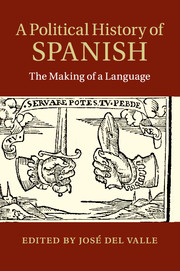
Spanish is spoken as a first language by almost 400 million people in approximately 60 countries, and has been the subject of numerous political processes and debates since it began to spread globally from Iberia in the thirteenth century. A Political History of Spanish brings together a team of experts to analyze the metalinguistic origins of Spanish and evaluate it as a discursively constructed artefact; that is to say, as a language which contains traces of the society in which it is produced, and of the discursive traditions that are often involved and invoked in its creation. This is a comprehensive and provocative new work which takes a fresh look at Spanish from specific political and historical perspectives, combining the traditional chronological organization of linguistic history and spatial categories such as Iberia, Latin America and the US, whilst simultaneously identifying the limits of these organizational principles.
eBook

Colloquial Spanish of Latin America 2 : the next step in language learning
Do you know Latin American Spanish already and want to go a stage further? If you're planning a visit to South America, need to brush up your Latin American Spanish for work, or are simply doing a course, Colloquial Spanish of Latin America 2 is the ideal way to refresh your knowledge of the language and extend your skills. Colloquial Spanish of Latin America 2 is designed to help those involved in self-study. Structured to give you the opportunity to listen to and read lots of modern, everyday Latin American Spanish, it has been developed to work systematically on reinforcing and extending your grasp of the grammar and vocabulary. Key features of Colloquial Spanish of Latin America 2 include: ¨ Revision material to help consolidate and build up your basics ¨ Lots of spoken and written exercises in each unit ¨ A grammar reference and detailed answer keys ¨ Extensive Spanish/English and English/Spanish glossaries ¨ Supplementary exercises and Latin American Spanish web-links at routledge.com/colloquials/spanishlatinamerica.
Book

The Latin American Literary Boom and U.S. Nationalism during the Cold War
During the 1960s and 1970s, when writers such as Julio Cortazar,
Carlos Fuentes, Gabriel Garcia Marquez, and Mario Vargas Llosa
entered the international literary mainstream, Cold War cultural
politics played an active role in disseminating their work in the
United States. Deborah Cohn documents how U.S. universities, book
and journal publishers, philanthropic organizations, cultural
centers, and authors coordinated their efforts to bring Latin
American literature to a U.S. reading public during this period,
when interest in the region was heightened by the Cuban Revolution.
She also traces the connections between the endeavors of private
organizations and official foreign policy goals.
The high level of interest in Latin America paradoxically led
the U.S. government to restrict these authors' physical presence in
the United States through the McCarranWalter Act's immigration
blacklist, even as cultural organizations cultivated the exchange
of ideas with writers and sought to market translations of their
work for the U.S. market.
eBook