
Catalogue Search | MBRL


Are you sure you want to remove the book from the shelf?

{{itemTitle}}
4,327
result(s) for
"Spanish language media"
Sort by:

Critical terms in Caribbean and Latin American thought : historical and institutional trajectories
\"This volume is a collection of critical essays on twelve keywords central in Latin American and Caribbean Studies: indigenismo, Americanism, colonialism, criollismo, race, transculturation, modernity, nation, gender, sexuality, testimonio, and popular culture. Each one of these keywords is conceived in conversation with a broader cluster of terms The central question motivating our work is how can we think--epistemologically and pedagogically--about Latin American Studies as a field that has taken different historical and institutional trajectories across the Caribbean, Latin America, and the United States. Each keyword is presented in the anthology through a lead essay that reflects on a notion in conversation with other terms that are either derived, related, or posed as potential responses, subversions, or interrogations of the original keyword. The response essays supplement the lead essay by exploring the debate from a different disciplinary perspective or field (including discussions in Latin American, American, Caribbean, Ethnic and Latino, and Women and Gender Studies), or exploring an angle or aspect of the concept that was not necessarily discussed in the lead essay. The lead essay and response format encourages further debate around each specific term, highlighting North-South, South-South and South-North approaches to each critical term\"-- Provided by publisher.
Book
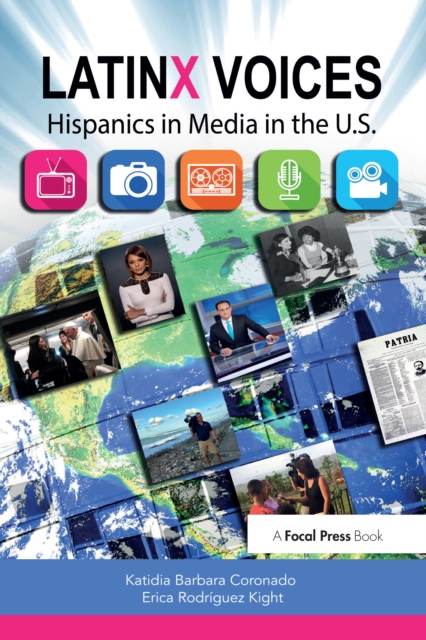
LatinX Voices
LatinX Voices: Hispanics in Media in the U.S. is the first undergraduate textbook to pro vide an overview of Hispanic/LatinX Media in the U.S., with chapters written by top scholars and professionals, giving readers an understanding of how the LatinX audience has transformed media in the United States. Editors Katidia Barbara Coronado and Erica Rodríguez Kight cover this evolving industry with years of professional and research experience, as well as years of teaching broadcast media courses in the classroom. Students will discover unique perspectives on topics related to Latin American areas of interest. With chapters from professionals who have left their mark in print, radio, television, film, and new media, this volume brings together expert voices in Hispanic/LatinX media from across the U.S., and explains the impact of this population on the media industry today.
eBook

Analyzing Spanish-Language YouTube Discourse During the 2025 Iberian Peninsula Blackout
This study investigates Spanish-language public discourse on YouTube following the unprecedented Iberian Peninsula blackout of 28 April 2025. Leveraging comments extracted via the YouTube Data API and analyzed with the OpenAI GPT-4o-mini model, it systematically examined 76,398 comments from 360 of the most relevant videos posted on the day of the event. The analysis explored emotional responses, sentiment trends, misinformation prevalence, civic engagement, and attributions of blame within the immediate aftermath of the blackout. The results reveal a discourse dominated by negativity and anger, with 43% of comments classified as angry and an overall negative sentiment trend. Misinformation was pervasive, present in 46% of comments, with most falsehoods going unchallenged. The majority of users attributed the blackout to government or political failures rather than technical causes, reflecting a profound distrust in institutions. Notably, while one in five comments included a call to action, only a minority offered constructive solutions, focusing mainly on infrastructure and energy reform. These findings highlight the crucial role of multilingual, real-time crisis communication and the unique information needs of Spanish-speaking populations during emergencies. By illuminating how rumors, emotions, and calls for accountability manifest in digital spaces, this study contributes to the literature on crisis informatics, digital resilience, and inclusive sustainability policy.
Journal Article

Gender and Race Portrayals on Spanish-Language Television
Gender and racial stereotypes continue to permeate our society and one context in which these stereotypes are perpetuated are the media. Although we have a history of content analysis of gender and racial portrayals on English-language television aired in the U.S., few systematic analyses have been conducted on Spanish-language television that airs in the same country. Our team of coders analyzed 466 characters and 481 2-minute intervals on 19 episodes of Spanish-language soap operas or
telenovelas
that aired in the Los Angeles broadcast area of the U.S. in the summer of 2002. Telenovelas were the programming type selected as they make up the bulk of Spanish-language network television in the U.S. The programs were coded in terms of how gender and race are presented on these programs by first coding the characteristics of speaking characters (including their race and gender) and then coding what actions these characters displayed in 2-minute intervals. Although females and males were represented in equal numbers, gender stereotypes abound. Physical appearance and nurturing roles were more likely to be the focus for female characters while occupational roles were more likely to be the focus for male characters. In terms of race, the overwhelming majority of characters were light-skinned and characters with darker skin were portrayed in extremes and more sexualized. These representations replicate some of the same stereotypes found on English-language television with some notable differences in terms of number of women represented.
Journal Article

Grupo Prisa
In one of the first English-language studies of Grupo Prisa, this book delivers a comprehensive and concise approach to the political, economic, and social-cultural profile of one of the leading cross-media conglomerates in Europe, tracing its development from a single newspaper publisher in 1972.
Prisa is now the world's leading Spanish- and Portuguese-language media group in the creation and distribution of content in the fields of culture, education, and information, producing content for more than 20 countries with global brands like El País (newspaper), Los 40 (radio), and Santillana (education). Using a critical political economy approach, the authors track Prisa's journey to becoming a cross-media conglomerate and examine how it mirrors the recent history of the economic and political developments in Spain.
This concise and highly contemporary volume is ideal for students, scholars, and researchers looking to further their understanding of a growing Spanish-language media power or more generally interested in international communication and media industries.
eBook

Four major disaster occurrences and the Spanish language media: a lack of risk communication
Purpose
– The Hispanic community is the fastest growing ethnic group in the USA and is currently the largest minority group with tremendous buying power. This trend has seen a significant growth with respect to the Spanish-language media in recent years. Along with the media
'
s ability to entertain, comes the responsibility to educate and warn its audiences of eminent threats and disasters. The aim of this paper is to look at the Spanish-language media
'
s efforts to warn and prepare its listeners for local and national emergencies.
Design/methodology/approach
– Using descriptive and explanatory methods the author looks at the failures of the Spanish language media to communicate emergency warnings in both the Saragosa, Texas tornado and in the case of hurricane Katrina.
Findings
– Research indicated that pressure from constituents, however, forced a change on the Spanish language industry.
Research limitations/implications
– The research was limited by not having first hand contact with the Spanish language media.
Practical implications
– The practical implication of this research which has social overtones is that providing disaster warnings to the non-English speaking population in the USA is achievable. Emergency managers and first responders need to be aware of issues regarding non-English speakers.
Social implications
– The implications for this research is that all individuals will be notified of emergencies even non-English speakers.
Originality/value
– The issues on non-English speakers in emergency situations have come up before. Nevertheless, this work identifies a practical solution by involving the Spanish language media in emergency alerts. It is essential that this tremendous resource be involved in emergency alerts.
Journal Article

Politicized Immigrant Identity, Spanish-Language Media, and Political Mobilization in 2012
Social identity theorists have long studied identity as one of the prime determinants of behavior. However, political scientists have had a hard time identifying consistent patterns between ethnic identity and political participation, especially among immigrants. In this paper, we take a more complex approach and explore whether a sense of immigrant linked fate is salient in explaining political participation among immigrants and, further, what may have caused immigrant identity to become so politicized. Specifically, we look at the issue of immigration reform in 2011 and 2012, and the manner in which both positive and negative messages were a catalyst for a politicized immigrant identity, and the resulting mobilizing effects. Using the 2012 Latino Immigrant National Election Study data, we argue that exposure to Spanish-language news media and feelings of immigrant-linked fate created a politicized immigrant identity among Latino immigrants, which resulted in greater political participation and civic engagement. Rather than seeing immigrants as low-resourced and unengaged in American politics, our theory of politicized immigrant identity explains that Latino immigrants draw on their identity as immigrants and as Americans to participate in their new homeland.
Journal Article

Social hierarchy in local Spanish-language print media
This study critically examines the discursive construction of social hierarchy in local Spanish-language print media with the goal of determining the extent to which these representations challenge those found in the mainstream media. It focuses on the ways in which four linguistic and two sociosemantic constructs represent Latino social actors in local Spanish-language print media. It finds two patterns in the representation of Latino social actors, each of which leads to the establishment of a particular social hierarchy. The first pattern reifies a traditional Us/Them hierarchy by representing Latinos as subordinate social actors to Anglo Americans. The second pattern represents Latinos as equal or dominant to Anglo Americans and thus levels or reverses the traditional Us/Them hierarchy. The latter pattern is indicative of the potential for local Spanish-language print media to challenge the putative subordinate position of Latinos in the United States.
Journal Article

Linguistic Imperialism: Who Owns Global Spanish?
This chapter contains sections titled:
Introduction
What is “linguistic imperialism?”
Globalization, linguistic imperialism and the Spanish language
Conclusions
References
Book Chapter