
Catalogue Search | MBRL


Are you sure you want to remove the book from the shelf?

{{itemTitle}}
169
result(s) for
"Spanish-speaking countries."
Sort by:


Linguistic Landscape in the Spanish-speaking World
Linguistic Landscape in the Spanish-speaking World is the first book dedicated to languages in the urban space of the Spanish-speaking world filling a gap in the extensive research that highlights the richness and complexity of Spanish Linguistic Landscapes.
eBook

Bilingualism in the Spanish-speaking world : linguistic and cognitive perspectives
\"Bilingualism has given rise to significant changes in Spanish-speaking countries. In the US, the increasing importance of Spanish has engendered an English-only movement; in Peru, contact between Spanish and Quechua has brought about language change; and in Iberia, speakers of Basque, Galician and Catalan have made their languages a compulsory part of school curricula and local government. This book provides an introduction to bilingualism in the Spanish-speaking world, looking at topics such as language contact, bilingual societies, bilingualism in schools, code-switching, language transfer, the emergence of new varieties of Spanish, and language choice - and how all of these phenomena affect the linguistic and cognitive development of the speaker. Using examples and case studies drawn primarily from Spanish/English bilinguals in the US, Spanish/Quechua bilinguals in Peru and Spanish/Basque bilinguals in Spain, it provides diverse perspectives on the experience of being bilingual in distinct cultural, political and socioeconomic contexts\"-- Provided by publisher.
Book
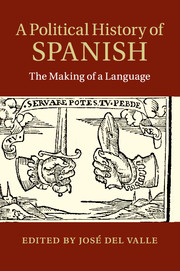
A Political History of Spanish
Spanish is spoken as a first language by almost 400 million people in approximately 60 countries, and has been the subject of numerous political processes and debates since it began to spread globally from Iberia in the thirteenth century. A Political History of Spanish brings together a team of experts to analyze the metalinguistic origins of Spanish and evaluate it as a discursively constructed artefact; that is to say, as a language which contains traces of the society in which it is produced, and of the discursive traditions that are often involved and invoked in its creation. This is a comprehensive and provocative new work which takes a fresh look at Spanish from specific political and historical perspectives, combining the traditional chronological organization of linguistic history and spatial categories such as Iberia, Latin America and the US, whilst simultaneously identifying the limits of these organizational principles.
eBook

Transatlantic studies : Latin America, Iberia, and Africa
Emerges from, and performs, an ongoing debate concerning the role of transatlantic approaches in the fields of Iberian, Latin American, African, and Luso-Brazilian studies. The innovative research and discussions contained in this volume's 35 essays by leading scholars in the field reframe the intertwined cultural histories of the diverse transnational spaces encompassed by the former Spanish and Portuguese empires. An emerging field, Transatlantic Studies seeks to provoke a discussion and a reconfiguration of the traditional academic notions of area studies, while critically engaging the concepts of national cultures and postcolonial relations among Spain, Portugal and their former colonies. Crucially, Transatlantic Studies transgresses national boundaries without dehistoricizing or decontextualizing the texts it seeks to incorporate within this new framework.
Book

The Noughties in the Hispanic and Lusophone World
While the fin de siècle has received considerable attention as a critical concept, the first decade of a new century has been less well studied. The chapters in this volume consider the distinctive cultural significance of the 'noughties' in the Hispanic and Lusophone world, looking at the specific cultural, political and economic circumstances of the decade, and in some cases proposing notions of an identifiable 'noughties sensibility' or 'noughties generation' which may flow out of, or stand in reaction against, the malaise of the fin de siècle.Drawing on specialist, area-specific knowledge, the authors consider the significance of the noughties across different eras. The contributions include chapters on how Brazil is negotiating the complicated terrain of digital literacy; the painful re-examination of the civil war that is taking place in Spain; and the negative effects of the economy on women's lives in Argentina. The chapters examine film, digital media, theatre, fiction, the economy and history, all taking the noughties as a focal point. The multiple perspectives will reveal the commonalities of experiences that a particular period brings about as well as showing up the distinctive local differences.
eBook


Efficacy of Emotionally Focused Therapy among Spanish-speaking couples: study protocol of a randomized clinical trial in Argentina, Costa Rica, Guatemala, Mexico, and Spain
Background
Couple relationship distress is common and associated with poor physical, psychological, and relational outcomes for both partners. Emotionally Focused Therapy for couples (EFT) is a short-term structured approach based on attachment theory that integrates a humanistic, experiential approach to restructuring emotional experience and a systemic structural approach to restructuring interactions. This model has been shown to be an effective treatment for couple distress. The supporting research, however, has only been conducted with English-speaking couples. Despite Spanish being the second-most spoken language and meaningful cultural differences between English- and Spanish-speaking countries, the efficacy of EFT has not been examined in this cultural context. This study will examine the efficacy of EFT in this particular context and advance the understanding of potential mechanisms of change.
Methods
We will use a multicenter randomized wait-list controlled design to examine the efficacy of EFT in a Spanish-speaking sample of moderately distressed couples. One hundred forty individuals in 70 couples in Argentina, Costa Rica, Guatemala, Mexico, and Spain will be randomly assigned to receive 19–21 sessions of EFT or be placed on a waitlist. Outcomes on a range of relational and individual mental health variables will be assessed prior to random assignment, throughout treatment, and at the conclusion of treatment. Primary outcomes will include dyadic adjustment, couple satisfaction, and attachment. Secondary variables, such as loneliness, parenting, affective communication, and sexual satisfaction, will be included as potential mediators of the treatment effect. Couples in the treatment group will also be assessed at 3-, 6-, 12-, 18-, and 24-month follow-ups. Process variables such as the therapeutic alliance will also be assessed routinely in couples assigned to the treatment group. Couples in the waitlist will receive a psycho-educational program based on EFT after completing the study.
Discussion
This study will be the first RCT of Emotionally Focused Therapy in a Spanish-speaking context. The results of the study will inform researchers interested in whether treatments developed and tested in the USA and Canada can be effective in differing cultural contexts. It may also point researchers and clinicians to areas where cultural adaptation is needed to improve efficacy.
Trial registration
ClinicalTrials.gov NCT04277325. Registered on February 20, 2020
Journal Article
Learners in the loop: hidden human skills in machine intelligence
Today's artificial intelligence, largely based on data-intensive machine learning algorithms, relies heavily on the digital labour of invisibilized and precarized humans-in-the-loop who perform multiple functions of data preparation, verification of results, and even impersonation when algorithms fail. Using original quantitative and qualitative data, the present article shows that these workers are highly educated, engage significant (sometimes advanced) skills in their activity, and earnestly learn alongside machines. However, the loop is one in which human workers are at a disadvantage as they experience systematic misrecognition of the value of their competencies and of their contributions to technology, the economy, and ultimately society. This situation hinders negotiations with companies, shifts power away from workers, and challenges the traditional balancing role of the salary institution.
Paper

Ariel Dorfman: The Trajectory of a Transnational Jewish Intellectual
Over the course of his lengthy career, Dorfman (1942) has pursued a transnational intellectual path, participating in Spanish American social criticism, cultural analysis, and literature while also becoming increasingly a part of English-language U.S. culture. Until well into middle age, he refrained from discussing his Jewish family background and current identity, attempting to remain within an ethnically unmarked tradition of progressive social thought. In the latter part of the 1990s he grew more forthcoming on these topics and his work and person began to circulate in intellectual venues marked as Jewish. While Dorfman's ability to move in and out of diverse cultural spaces is impressive, it has not been unlimited. As the author observes, his plan to end his exile and reintegrate himself into Chilean cultural life following the end of the military dictatorship in 1990 met with frustration. Though he maintains a residence in Chile and visits the country, Dorfman's English-language career has continued to outpace the more limited success of his recent work in Spanish American countries. Dorfman has only inserted himself into Jewish intellectual life to a modest extent, apparently by choice, since his custom is to discuss matters of which he possesses significant knowledge, particularly expertise gained through first-hand experience.
Journal Article