
Catalogue Search | MBRL


Are you sure you want to remove the book from the shelf?

{{itemTitle}}
543
result(s) for
"Spectator control."
Sort by:

Security and sport mega events : a complex relation
Sport competitions at the national, European and global levels have evolved in terms of economic investment, social importance and media coverage. However, this evolution has brought with it major political concerns. There is a need of construction of an environment of life where sport events and the multiple activities and interests related to them can be kept safe from any risk and potentially harmful occurrence. The aim of this volume is to highlight the complex set of legal provisions, surveillance and policing practices, discourses, bureaucratic procedures and spatial and architectural forms underpin the security governance of sport events and their effects in the contemporary era of widespread uncertainty.
BOOK

Monitoring physical distancing for crowd management: Real-time trajectory and group analysis
Physical distancing, as a measure to contain the spreading of Covid-19, is defining a \"new normal\". Unless belonging to a family, pedestrians in shared spaces are asked to observe a minimal (country-dependent) pairwise distance. Coherently, managers of public spaces may be tasked with the enforcement or monitoring of this constraint. As privacy-respectful real-time tracking of pedestrian dynamics in public spaces is a growing reality, it is natural to leverage on these tools to analyze the adherence to physical distancing and compare the effectiveness of crowd management measurements. Typical questions are: \"in which conditions non-family members infringed social distancing?\", \"Are there repeated offenders?\", and \"How are new crowd management measures performing?\". Notably, dealing with large crowds, e.g. in train stations, gets rapidly computationally challenging. In this work we have a two-fold aim: first, we propose an efficient and scalable analysis framework to process, offline or in real-time, pedestrian tracking data via a sparse graph. The framework tackles efficiently all the questions mentioned above, representing pedestrian-pedestrian interactions via vector-weighted graph connections. On this basis, we can disentangle distance offenders and family members in a privacy-compliant way. Second, we present a thorough analysis of mutual distances and exposure-times in a Dutch train platform, comparing pre-Covid and current data via physics observables as Radial Distribution Functions. The versatility and simplicity of this approach, developed to analyze crowd management measures in public transport facilities, enable to tackle issues beyond physical distancing, for instance the privacy-respectful detection of groups and the analysis of their motion patterns.
Journal Article
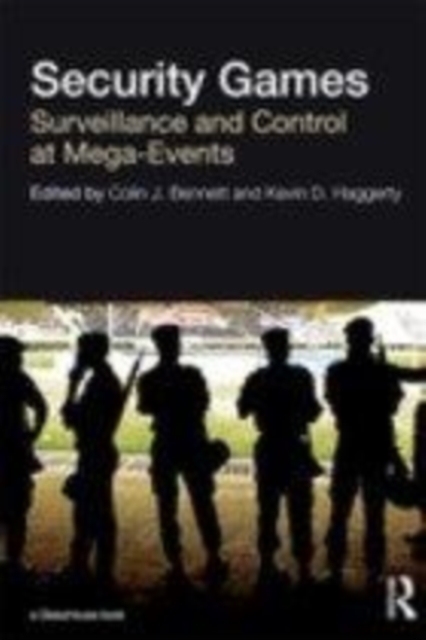
Security Games
Security Games: Surveillance and Control at Mega-Events addresses the impact of mega-events - such as the Olympic Games and the World Cup - on wider practices of security and surveillance. \"Mega-Events\" pose peculiar and extensive security challenges. The overwhelming imperative is that \"nothing should go wrong.\" There are, however, an almost infinite number of things that can \"go wrong\"; producing the perceived need for pre-emptive risk assessments, and an expanding range of security measures, including extensive forms and levels of surveillance. These measures are delivered by a \"security/industrial complex\" consisting of powerful transnational corporate, governmental and military actors, eager to showcase the latest technologies and prove that they can deliver \"spectacular levels of security\".
Mega-events have thus become occasions for experiments in monitoring people and places. And, as such, they have become important moments in the development and dispersal of surveillance, as the infrastructure established for mega-events are often marketed as security solutions for the more routine monitoring of people and place. Mega-events, then, now serve as focal points for the proliferation of security and surveillance. They are microcosms of larger trends and processes, through which - as the contributors to this volume demonstrate - we can observe the complex ways that security and surveillance are now implicated in unique confluences of technology, institutional motivations, and public-private security arrangements. As the exceptional conditions of the mega-event become the norm, Security Games: Surveillance and Control at Mega-Events therefore provides the glimpse of a possible future that is more intensively and extensively monitored.
eBook
Guiding crowds when facing limited compliance: Simulating strategies
At traffic hubs, it is important to avoid congestion of pedestrian streams to ensure safety and a good level of service. This presents a challenge, since distributing crowds on different routes is much more difficult than opening valves to, for example, regulate fluid flow. Humans may or may not comply with re-directions suggested to them typically with the help of signage, loudspeakers, apps, or by staff. This remains true, even if they perceive and understand the suggestions. Yet, simulation studies so far have neglected the influence of compliance. In view of this, we complement a state-of-the-art model of crowd motion and crowd behavior, so that we can vary the compliance rate. We consider an abstracted scenario that is inspired by a metro station in the city of Munich, where traffic regulators wish to make some passengers abandon the obviously shortest route so that the flow evens out. We investigate the effect of compliance for two very simple guiding strategies. In the first strategy, we alternate routes. In the second strategy, we recommend the path with the lowest crowd density. We observe that, in both cases, it suffices to reroute a small fraction of the crowd to reduce travel times. But we also find that taking densities into account is much more efficient when facing low compliance rates.
Journal Article
Early warning on safety risk of highly aggregated tourist crowds based on VGGT-Count network model
In the era of mass tourism, more and more people are attracted by internet-famous site. With people’s demand for travel surged, tourists are getting together in one scenic spot with doubling numbers, which easily leads to high concentration of tourists with uncontrollable security risks. It needs to be highly valued by the tourism department. Monitoring and issuing warnings for crowd density in scenic areas with Highly Aggregated Tourist Crowds (HATCs) is an urgent challenge that needs to be addressed. In this paper, Highly Aggregated Tourist Crowds is taken as the research objective, and a VGGT-Count network model is proposed to forecast the density of HATCs. The experimental outcomes demonstrated a substantial improvement in counting accuracy for the ShanghaiTech B and UCF-QNRF datasets. Furthermore, the model allows for real-time monitoring of tourist attractions, enabling advanced prediction of high concentrations in scenic areas. This timely information can alert relevant authorities to implement preventive measures such as crowd control and flow regulation, thereby minimizing safety hazards.
Journal Article

Saudi Arabia’s Management of the Hajj Season through Artificial Intelligence and Sustainability
High-density gatherings have the potential to turn from a peaceful mass into a human disaster unless they are managed in an organized manner. Saudi Arabia’s Ministry of Hajj implemented an integrated system based on artificial intelligence. The Kingdom of Saudi Arabia (KSA) was eager to take advantage of the techniques of artificial intelligence to conduct its strategic plan, considering limited pilgrims who would be allowed to perform the Hajj rites during these exceptional circumstances. In this study, the experience of the KSA in crowd management using artificial intelligence during the Hajj was examined to create a model for similar circumstances. This study employed the descriptive analytical method. The program Arc Gis Pro 2.9.2 was used to produce maps related to the study. A strategic analysis was also conducted regarding the experience of the KSA in crowd management using SWOT analysis concerning the study area. This study found that the KSA has become a leader in crowd management and a reference and role model in managing crowds through an expanded use of artificial intelligence during the COVID-19 pandemic. It undertook all necessary precautionary measures to protect the pilgrims, and no injuries were reported.
Journal Article
A Framework for Crowd Management during COVID-19 with Artificial Intelligence
COVID-19 requires crowded events to enforce restrictions, aimed to contain the spread of the virus. However, we have seen numerous events not observing these restrictions, thus becoming super spreader events. In order to contain the spread of a human to human communicable disease, a number of restrictions, including wearing face masks, maintaining social distancing, and adhering to regular cleaning and sanitization, are critical. These restrictions are absolutely essential for crowded events. Some crowded events can take place spontaneously, such as a political rally or a protest march or a funeral procession. Controlling spontaneous crowded events, like a protest march, political rally, celebration after a sporting event, or concert, can be quite difficult, especially during a crisis like the COVID-19 pandemic. In this article, we review some well-known crowded events that have taken place during the ongoing pandemic. Guided by our review, we provide a framework using machine learning to effectively organize crowded events during the ongoing and for future crises. We also provide details of metrics for the validation of some components in the proposed framework, and an extensive algorithm. Finally, we offer explanations of its various functions of the algorithm. The proposed framework can also be adapted in other crises.
Journal Article

A Pilgrim Scheduling Approach to Increase Safety During the Hajj
By Islam’s principle, each adult Muslim who is physically and financially capable is obligated to perform Hajj—Pilgrimage to Mecca—once in his lifetime. With millions of faithful pilgrims, the Hajj is one the largest annual pedestrian events in the world. It is also a stress test to the authority’s ability to protect pilgrims' safety throughout the multiday rituals. In “A Pilgrim Scheduling Approach to Increase Safety during the Hajj,” K. Haase, M. Kasper, M. Koch, and S. Müller describe the combined optimization and simulation approach used in the years 2007–2014 and 2016–2017 to plan safe pilgrim flows between the ritual sites and pilgrim camps.
The Hajj—the great pilgrimage to Mecca, Saudi Arabia—is one of the five pillars of Islam. Up to four million pilgrims perform the Hajj rituals every year. This makes it one of the largest pedestrian problems in the world.
Ramy al-Jamarat
—the symbolic stoning of the devil—is known to be a particularly crowded ritual. Up until 2006, it was repeatedly overshadowed by severe crowd disasters. To avoid such disasters, Saudi authorities initiated a comprehensive crowd management program. A novel contribution to these efforts was the development of an optimized schedule for the pilgrims performing the stoning ritual. A pilgrim schedule prescribes specific routes and time slots for all registered pilgrim groups. Together, the assigned routes strictly enforce one-way flows toward and from the ritual site. In this paper, we introduce a model and a solution approach to the Pilgrim Scheduling Problem. Our multistage procedure first spatially smooths the utilization of infrastructure capacity to avoid dangerous pedestrian densities in the network. In the next optimization step, it minimizes overall dissatisfaction with the scheduled time slots. We solve the Pilgrim Scheduling Problem by a fix-and-optimize heuristic, and subsequently simulate the results to identify necessary modifications of the scheduling constraints. Our numerical study shows that the approach solves instances with more than 2.3 million variables in less than 10 minutes on average. At the same time, the gap between optimal solution and upper bound never exceeds 0.28%. The scheduling approach was an integral part of the Hajj planning process in 2007–2014 and 2016–2017. No crowd disaster occurred in these years. Our approach was not applied in 2015, when a severe crowd crush happened close to the ritual site. We briefly discuss possible causes and consequences of this accident.
Journal Article

2023 ELI Writing Competition Runner-Up Essay: Keep Calm and Rock On: A Federal Crowd Management Law for the Live Music Industry
[...]states are inescapably concerned with the cost of adopting such stringent crowd management directive, especially since live performance is a huge revenue stream - the biggest one for artists.18 Cincinnati, which adopted a 'festival seating' law that banned first-come, first-served seating after The Who crowd crush, abandoned it 25 years later after allegations of performers skipping the city because of this law.19 In defiance of its urgency, states are bound to be unenthusiastic about a federal legislation when it evidently presages reduced pront. There is, however, a regulation currently used in every U.S. state and adopted in 43 states; the National Fire Protection Association (NFPA)'s 101(r): Life Safety Code(r) (hereafter, \"NFPA 101\"). NFPA 101 incorporated Cincinnati's report on the crowd management at rock concerts specifically in regard to \"festival seating\" after the The Who crush.23 A 1990 report reflects Dr. John J. Fruin's \"crowd dynamics factors\" of time, space, information, and energy and incorporated them into NFPA 101.24 But to this day, it is without details as to how they should be regulated and managed. The California Concert and Festival Crowd Safety Act, passed recently in September 2022, sets out to establish minimum crowd safety standards for large outdoor events.31 The City of Houston-Harris County Special Events Task Force published updated safety protocols for NRG Park, the Astroworld 2021 venue, after the tragedy.32 The Texas Task Force on Concert Safety (\"TFCS\") recommends a Concert Attendee Code of Conduct as part of ticketing process to clarify what behaviors will lead to ejection, encourages communication among venues that have hosted the same artist and recommends crowd management training albeit leaving details to be determined by associated parties.33 The House Oversight and Reform Committee launched a probe into the festival, but so far it amounts to a letter to the CEO of Live Nation, requesting information on the promoter's role in the incident.34 While the U.S. Department of Homeland Security recognizes \"Soft Targets and Crowded Places (ST-CPs)\", crowd management is omitted in related publication; the focus is on possible bomb threats and mass shootings.35 The Event Safety Alliance's The Event Safety Guide makes useful suggestions to consider categorization of shows by size, timing of door opening to prevent bottleneck effect, safe stage design and subdivisions for large shows, maximum rate of flow for turnstiles and artist movement around the pit, but again is without methodology.36 The Entertainment Services and Technology Association (\"ESTA\") Technical Standards Program, arguably the most detailed guideline available as it incorporated much of the NFPA 101 and has taken into consideration and extended works of crowd management experts, also supplies relevant information such as types of barricade required-T shape barricade for forward-facing general admissions events and round corners for bigger events.
Journal Article

Enhanced UAV-Dot for UAV Crowd Localization: Adaptive Gaussian Heat Map and Attention Mechanism to Address Scale/Low-Light Challenges
What are the main findings? * The proposed scale-adaptive Gaussian kernel dynamically adjusts heatmap supervision, effectively resolving target merging and fragmentation caused by UAV altitude variations, contributing to a 1.62% gain in L-mAP. * The integrated CBAM attention module enhances feature extraction under low-light conditions via a “channel–spatial” focusing mechanism, improving feature discriminability and yielding a 0.92% L-mAP increase. The proposed scale-adaptive Gaussian kernel dynamically adjusts heatmap supervision, effectively resolving target merging and fragmentation caused by UAV altitude variations, contributing to a 1.62% gain in L-mAP. The integrated CBAM attention module enhances feature extraction under low-light conditions via a “channel–spatial” focusing mechanism, improving feature discriminability and yielding a 0.92% L-mAP increase. What is the implication of the main finding? * The enhanced UAV-Dot achieves a state-of-the-art 53.38% L-mAP on DroneCrowd with minimal overhead—parameters increase by only 0.36% (training) and 0.29% (testing), reconciling high accuracy with model efficiency for UAV deployment. * The synergistic combination of adaptive heatmaps and attention mechanisms establishes a new architectural paradigm for addressing the coupled challenges of scale variation and low-light degradation in aerial crowd localization. The enhanced UAV-Dot achieves a state-of-the-art 53.38% L-mAP on DroneCrowd with minimal overhead—parameters increase by only 0.36% (training) and 0.29% (testing), reconciling high accuracy with model efficiency for UAV deployment. The synergistic combination of adaptive heatmaps and attention mechanisms establishes a new architectural paradigm for addressing the coupled challenges of scale variation and low-light degradation in aerial crowd localization. In public safety scenarios, such as large-scale event security and urban crowd management, unmanned aerial vehicles (UAVs) serve as a vital tool for crowd localization, offering high mobility and broad coverage. However, UAV-based overhead localization faces challenges, including significant target scale variations due to altitude changes and poor feature visibility in low-light conditions. To overcome these issues, this study enhances the UAV-Dot framework by introducing a scale prediction branch for adaptive Gaussian heatmap adjustment, embedding a CBAM attention module in the U-Net encoder to strengthen feature extraction in dim environments and optimizing post-processing via dynamic thresholding and DBSCAN clustering. Experiments on the DroneCrowd dataset show that the improved model increases parameters by only 0.36% during training and 0.29% during testing yet achieves 53.38% L-mAP—outperforming the original UAV-Dot by 2.38% and STNNet by 12.93%. The model also delivers consistent gains of approximately 2% in L-AP@10, L-AP@15, and L-AP@20.
Journal Article