
Catalogue Search | MBRL


Are you sure you want to remove the book from the shelf?

{{itemTitle}}
370
result(s) for
"Speculation Mathematical models."
Sort by:

Forecasting in financial and sports gambling markets : adaptive drift modeling
\"This book discusses cointegrated time series associated with financial and sports gambling markets are analyzed in terms of time-varying parameter models. Modeling premises are that present and past disequilibria--shocks both within and between time series--may affect subsequent changes and rates of these changes within individual series and sufficiently large shocks may disrupt/alter model structure such that resulting forecasts may be temporarily unreliable. Reduced forecasting equations are in terms of higher order ARMA models that are not limited to bilinear processes. Sports forecasting models based on public information are usually more effective--in terms of profitable trading/wagering strategies--than those for the financial sector for two reasons: insider information is less prevalent, and modeling is simplified since lagged shocks associated with the gambling lines/spreads are known--in contrast with financial modeling where there are no comparable gambling shocks, only unknown, lagged statistical shocks in terms of MA variables. Forecasting is illustrated for NFL and NBA playoff games. In financial markets, cointegration is discussed in terms of candlestick chart variants with modeling illustrations given in terms of recent Google price changes. Chapter coverage includes candlestick charts, higher order ARMA processes in financial markets, the effects of gambling shocks in sports gambling markets, cointegrated time series with model drift, modeling volatility, and the promotion of financial and mathematical literacy\"--Provided by publisher.
Book

Quantitative Trading
The first part of this book discusses institutions and mechanisms of algorithmic trading, market microstructure, high-frequency data and stylized facts, time and event aggregation, order book dynamics, trading strategies and algorithms, transaction costs, market impact and execution strategies, risk analysis, and management. The second part covers market impact models, network models, multi-asset trading, machine learning techniques, and nonlinear filtering. The third part discusses electronic market making, liquidity, systemic risk, recent developments and debates on the subject.
eBook

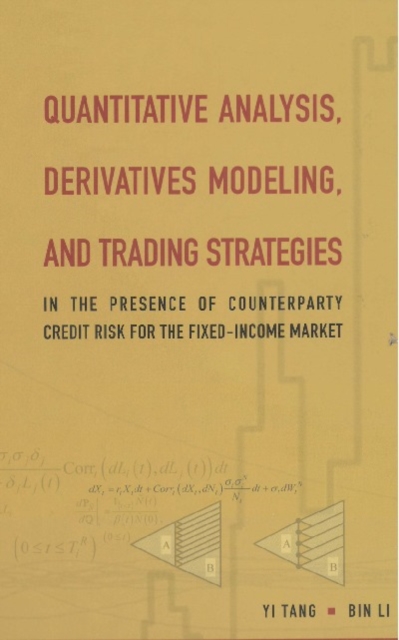
Quantitative analysis, derivatives modeling, and trading strategies
This book addresses selected practical applications and recent developments in the areas of quantitative financial modeling in derivatives instruments, some of which are from the authors' own research and practice. It is written from the viewpoint of financial engineers or practitioners, and, as such, it puts more emphasis on the practical applications of financial mathematics in the real market than the mathematics itself with precise (and tedious) technical conditions. It attempts to combine economic insights with mathematics and modeling so as to help the reader to develop intuitions.
eBook

Forecasting in financial and sports gambling markets
A guide to modeling analyses for financial and sports gambling markets, with a focus on major current events
Addressing the highly competitive and risky environments of current-day financial and sports gambling markets, Forecasting in Financial and Sports Gambling Markets details the dynamic process of constructing effective forecasting rules based on both graphical patterns and adaptive drift modeling (ADM) of cointegrated time series. The book uniquely identifies periods of inefficiency that these markets oscillate through and develops profitable forecasting models that capitalize on irrational behavior exhibited during these periods. Providing valuable insights based on the author's firsthand experience, this book utilizes simple, yet unique, candlestick charts to identify optimal time periods in financial markets and optimal games in sports gambling markets for which forecasting models are likely to provide profitable trading and wagering outcomes. Featuring detailed examples that utilize actual data, the book addresses various topics that promote financial and mathematical literacy, including: Higher order ARMA processes in financial markets The effects of gambling shocks in sports gambling markets Cointegrated time series with model drift Modeling volatility Throughout the book, interesting real-world applications are presented, and numerous graphical procedures illustrate favorable trading and betting opportunities, which are accompanied by mathematical developments in adaptive model forecasting and risk assessment. A related web site features updated reviews in sports and financial forecasting and various links on the topic. Forecasting in Financial and Sports Gambling Markets is an excellent book for courses on financial economics and time series analysis at the upper-undergraduate and graduate levels. The book is also a valuable reference for researchers and practitioners working in the areas of retail markets, quant funds, hedge funds, and time series. Also, anyone with a general interest in learning about how to profit from the financial and sports gambling markets will find this book to be a valuable resource.
eBook
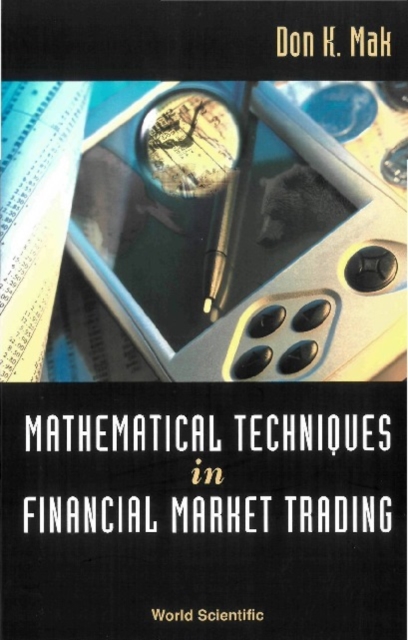
Mathematical techniques in financial market trading
The present book contains much more materials than the author's previous book The Science of Financial Market Trading. Spectrum analysis is again emphasized for the characterization of technical indicators employed by traders and investors. New indicators are created. Mathematical analysis is applied to evaluate the trading methodologies practiced by traders to execute a trade transaction. In addition, probability theory is employed to appraise the utility of money management techniques.
eBook

Quantitative Analysis, Derivatives Modeling, and Trading Strategies
This book addresses selected practical applications and recent developments in the areas of quantitative financial modeling in derivatives instruments, some of which are from the authors' own research and practice. While the primary scope of this book is the fixed-income market (with further focus on the interest rate market), many of the methodologies presented also apply to other financial markets, such as the credit, equity, and foreign exchange markets. This book, which assumes that the reader is familiar with the basics of stochastic calculus and derivatives modeling, is written from the point of view of financial engineers or practitioners, and, as such, it puts more emphasis on the practical applications of financial mathematics in the real market than the mathematics itself with precise (and tedious) technical conditions. It attempts to combine economic insights with mathematics and modeling so as to help the reader develop intuitions. In addition, the book addresses the counterparty credit risk modeling, pricing, and arbitraging strategies, which are relatively recent developments and are of increasing importance. It also discusses various trading structuring strategies and touches upon some popular credit/IR/FX hybrid products, such as PRDC, TARN, Snowballs, Snowbears, CCDS, credit extinguishers.
Book

THE ROLE OF INVENTORIES AND SPECULATIVE TRADING IN THE GLOBAL MARKET FOR CRUDE OIL
We develop a structural model of the global market for crude oil that for the first time explicitly allows for shocks to the speculative demand for oil as well as shocks to flow demand and flow supply. The speculative component of the real price of oil is identified with the help of data on oil inventories. Our estimates rule out explanations of the 2003–2008 oil price surge based on unexpectedly diminishing oil supplies and based on speculative trading. Instead, this surge was caused by unexpected increases in world oil consumption driven by the global business cycle. There is evidence, however, that speculative demand shifts played an important role during earlier oil price shock episodes including 1979, 1986 and 1990. Our analysis implies that additional regulation of oil markets would not have prevented the 2003–2008 oil price surge. We also show that, even after accounting for the role of inventories in smoothing oil consumption, our estimate of the short-run price elasticity of oil demand is much higher than traditional estimates from dynamic models that do not account for for the endogeneity of the price of oil.
Journal Article

SENTIMENTS
This paper develops a new theory of fluctuations—one that helps accommodate the notions of \"animal spirits\" and \"market sentiment\" in unique-equilibrium, rational-expectations, macroeconomic models. To this goal, we limit the communication that is embedded in a neoclassical economy by allowing trading to be random and decentralized. We then show that the business cycle may be driven by a certain type of extrinsic shocks which we call sentiments. These shocks formalize shifts in expectations of economic activity without shifts in the underlying preferences and technologies; they are akin to sunspots, but operate in unique-equilibrium models. We further show how communication may help propagate these shocks in a way that resembles the spread of fads and rumors and that gives rise to boom-and-bust phenomena. We finally illustrate the quantitative potential of our insights within a variant of the RBC model.
Journal Article
Speculation in the Oil Market
The run-up in oil prices since 2004 coincided with growing investment in commodity markets and increased price co-movement among different commodities. We assess whether speculation in the oil market played a role in driving this salient empirical pattern. We identify oil shocks from a large dataset using a dynamic factor model. This method is motivated by the fact that a small-scale vector autoregression is not informationally sufficient to identify the shocks. The main results are as follows. (i) While global demand shocks account for the largest share of oil price fluctuations, speculative shocks are the second most important driver. (ii) The increase in oil prices over the last decade is mainly driven by the strength of global demand. However, speculation played a significant role in the oil price increase between 2004 and 2008 and its subsequent collapse. (iii) The co-movement between oil prices and the prices of other commodities is mainly explained by global demand shocks. Our results support the view that the recent oil price increase is mainly driven by the strength of global demand but that the financialization process of commodity markets also played a role.
Journal Article