
Catalogue Search | MBRL


Are you sure you want to remove the book from the shelf?

{{itemTitle}}
18
result(s) for
"Spinoza, Benedictus de, 1632-1677. Ethica"
Sort by:

Spinoza on Ethics and Understanding
Peter Guy Winch (1926–1997) was one of the most important philosophers of the second half of the twentieth century. He is best known for his early work on the philosophy of the social sciences, in particular his monograph The Idea of a Social Science and its Relation to Philosophy (1958), which generated controversy within both philosophical and social scientific circles.
This volume unites Peter Winch’s previously unpublished work on Baruch de Spinoza. The primary source for the text is a series of seminars on Spinoza that Winch gave, first at the University of Swansea in 1982 and then at King’s College London in 1989. Audio recordings of the majority of the Swansea seminars have survived. The editors have transcribed these, edited them for coherence, style and clarity, and supplemented them with material drawn from Winch’s typescripts and preparatory notebooks. What emerges is an original interpretation of Spinoza’s work that demonstrates his continued relevance to contemporary issues in metaphysics, epistemology and ethics, and establishes connections to other philosophers - not only Spinoza’s predecessors such as Descartes, but also to the philosophical views of Ludwig Wittgenstein and Simone Weil.
There is currently a resurgence of interest in Spinoza’s philosophy, and this volume will contribute to burgeoning debates within that field. Winch’s account of Spinoza is uncommon insofar as it takes as central to Spinoza’s project his conceptions of meaning, understanding and language, and directly connecting these to his ethical concerns. At the same time, Winch makes useful links to modern debates in ways that throw helpful light on Spinoza. As well as issues which are central to the philosophy of language, these include debates on the nature of the mind, naturalism and the place of the human being within the natural world.
eBook
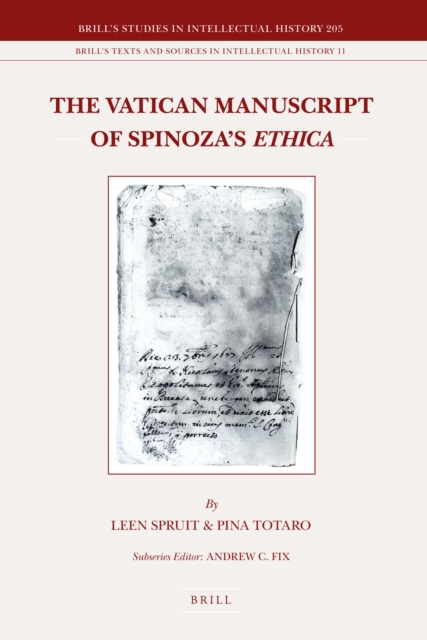
The Vatican manuscript of Spinoza's Ethica
Brill authors Leen Spruit and Pina Totaro discovered the original manuscript of Spinoza's \"Ethica\" in the Vatican library. This spectacular discovery attracted a lot of media attention. This edition will be published in Brill's Texts and Sources on Intellectual History (BSIH) in August. The Vatican codex, which contains the complete text of Spinoza's Ethics, is the only surviving manuscript of this work and constitutes a document of great importance, as it predates the publication of the Opera Posthuma, which appeared in the first months of 1678.
eBook

The Influence of Abraham Cohen de Herrera's Kabbalah on Spinoza's Metaphysics
In this book, Miquel Beltrán undertakes the task of comparing Puerta del Cielo with Spinoza's Ethica, in order to find the doctrines asserted both by Herrera and Spinoza concerning God's essence and attributes.
eBook
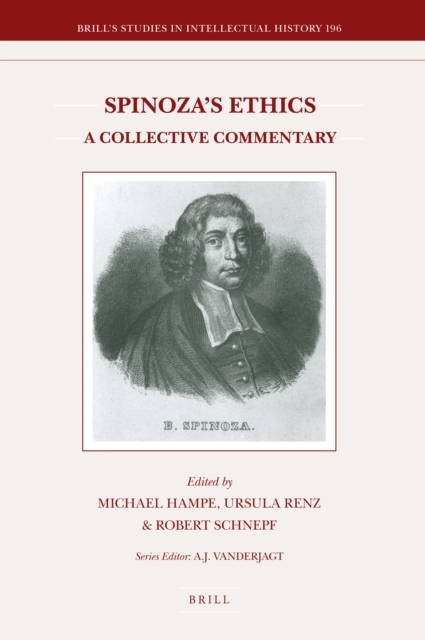
Spinoza's Ethics
Till today Spinoza's Ethics is a standard for enlightened theoretical and practical reasoning. His five parts are elucidated by this collective commentary. An introduction sketches the historical consequences and the still relevant philosophical ambitions of the Ethics.
eBook
Éthique de Spinoza - L'origine et la nature des sentiments (Commentaire)
Plongez-vous dans l'analyse de l'origine et la nature des sentiments dans Éthique de Spinoza pour approfondir votre compréhension de l'œuvre! Que retenir de l'origine et la nature des sentiments dans Éthique, l'oeuvre fondamentale de Spinoza? Retrouvez toutes les subtilités de ce concept dans un commentaire original et complet pour approfondir votre réflexion sur l'œuvre. Vous trouverez dans cette fiche: • Une introduction sur l'œuvre et son auteur • Une mise en contexte • L'extrait étudié: L'origine et la nature des sentiments • L'explication et l'analyse du texte • ConclusionL'outil indispensable pour percevoir rapidement ce qui fait de ce texte de l' Éthique une clé qui mène à la connaissance de soi! À propos de la collection LePetitPhilosophe.fr: Destinée avant tout à un public de néophytes et aux lycéens qui préparent le bac de philo, LePetitPhilosophe.fr propose des analyses d'œuvres philosophiques classiques et contemporaines. Nos analyses, disponibles aux formats papier et numérique, ont été conçues pour guider les lecteurs à travers toute la philosophie. Nos auteurs combinent théories, citations, anecdotes et commentaires pour vous faire découvrir les plus grands penseurs d'hier et d'aujourd'hui.
eBook

Peeling Potatoes or Grinding Lenses
\"I can work best now while peeling potatoes. . . . It is for me what lens-grinding was for Spinoza.\"-L. WittgensteinMore than 250 years separate the publication of Baruch Spinoza'sEthicsand Ludwig Wittgenstein'sTractatus Logico-Philosophicus.Both are considered monumental philosophical treatises, produced during markedly different times in human history, and notoriously challenging to interpret. InPeeling Potatoes or Grinding Lenses,Aristides Baltas contends that these works bear a striking similarity based on the idea of \"radical immanence.\" Each purports to understand the world, thought, and language from the inside and in a way leading to the dissolution of all philosophy. In that guise, both offer a powerful argument against fundamentalism of all sorts and kinds.
To Spinoza, God is just Nature. God is not above or separate from the world, humanity, or mere objects for, as Nature, He inheres in everything. To Wittgenstein, logic is not above or separate from language, thought, and the world. The hardness of the logical \"must\" inheres in states of affairs, facts, thoughts, and linguistic acts. Outside there are no truths or sense-only nonsense.
Through close readings of the texts based on lessons drawn from radical paradigm change in science, Baltas finds in both works a single-minded purpose, implacable reasoning, and an austerity of style that are rare in the history of philosophy. He analyzes the structure and content of each treatise, the authors' intentions, the limitations and possibilities afforded by scientific discovery in their respective eras, their radical opposition to prevailing philosophical views, and draws out the particulars, as well as the implications, of the arresting match between the two.
eBook
Spinoza's Ethics
Everything you need to know about Spinoza's Ethics in one volume.The Ethics presents a complete metaphysical, epistemological and ethical world-view that is immensely inspiring. However, it is also an extremely difficult text to read. This book takes readers through the text, stopping at the most perplexing passages to explain key terms, unfold arguments, offer concrete examples and raise questions for further thought. It is designed to be read alongside the Ethics, enabling students to think critically about Spinoza's views and build an understanding of his complex system.
eBook
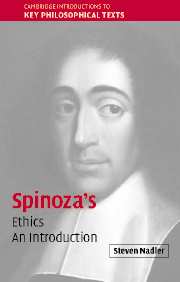
Spinoza's 'Ethics'
Spinoza's Ethics is one of the most remarkable, important, and difficult books in the history of philosophy: a treatise simultaneously on metaphysics, knowledge, philosophical psychology, moral philosophy, and political philosophy. It presents, in Spinoza's famous 'geometric method', his radical views on God, Nature, the human being, and happiness. In this wide-ranging 2006 introduction to the work, Steven Nadler explains the doctrines and arguments of the Ethics, and shows why Spinoza's endlessly fascinating ideas may have been so troubling to his contemporaries, as well as why they are still highly relevant today. He also examines the philosophical background to Spinoza's thought and the dialogues in which Spinoza was engaged - with his contemporaries (including Descartes and Hobbes), with ancient thinkers (especially the Stoics), and with his Jewish rationalist forebears. His book is written for the student reader but will also be of interest to specialists in early modern philosophy.
eBook
Spinoza's ethics : a reader's guide
The Ethics is one of the undisputed masterworks of early modern philosophy.In this single volume Spinoza offers the reader an unorthodox account of God, a novel version of the mind-body relation, a systematic theory of the emotions and a detailed prescription for human virtue and blessedness.
eBook