
Catalogue Search | MBRL


Are you sure you want to remove the book from the shelf?

{{itemTitle}}
25,297
result(s) for
"Spirit"
Sort by:

The Transformations of Magic
In this original, provocative, well-reasoned, and thoroughly documented book, Frank Klaassen proposes that two principal genres of illicit learned magic occur in late medieval manuscripts: image magic, which could be interpreted and justified in scholastic terms, and ritual magic (in its extreme form, overt necromancy), which could not. Image magic tended to be recopied faithfully; ritual magic tended to be adapted and reworked. These two forms of magic did not usually become intermingled in the manuscripts, but were presented separately. While image magic was often copied in the fourteenth and fifteenth centuries, The Transformations of Magic demonstrates that interest in it as an independent genre declined precipitously around 1500. Instead, what persisted was the other, more problematic form of magic: ritual magic. Klaassen shows that texts of medieval ritual magic were cherished in the sixteenth century, and writers of new magical treatises, such as Agrippa von Nettesheim and John Dee, were far more deeply indebted to medieval tradition—and specifically to the medieval tradition of ritual magic—than previous scholars have thought them to be.
eBook

Windows of the soul : my journeys in the Muslim world = نوافذ الروح
Presents anecdotes and photographs depicting the author's travels through Somalia, the Gaza strip, Sudan, Iran, the U.S., Palestine, and other places where Muslims suffer from povery, repression, and conflict, and chronicles her encounters with families, farmers, artisans, and radicals, including Hezbollah.

x0398;#x03B5;#x03CC;#x03C2;, Father and the 'Holy Trinity' in the New Testament
The term 'Holy Trinity', not known to the writers of the Bible, is still an elusive term to use nowadays, especially when one first reads the New Testament in light of the Old Testament and not immediately in light of the Creeds and Statements of Faith. This article discusses the roles of Θεός (God) and 'Father' in the New Testament with reference to the Holy Trinity. The conclusion is that the New Testament does not depict a Holy Trinity, but rather portrays Θεός as a coordinator, bringing a harmony between his anthropomorphic assignments 'Father', 'Son' and 'Holy Spirit', as well as all the followers of Θεός on Earth. Intradisciplinary and/or interdisciplinary implications On the first level, this article covers the disciplines of Old Testament, New Testament (NT) and Practical Theology. On the second level, it makes use of philosophy and logics to help determine the 'truths' in the Bible. Who is Θεός? We propose that the NT depicts him as coordinator of his three revelations, 'Father', 'Son' and 'Holy Spirit'. Using anthropomorphic terms, Θεός reveals himself to his followers on Earth. The Bible is used as the main source, with references to the three Creeds and four Statements of Faith.
Journal Article


On Freud's \On Beginning the Treatment\
Like his other papers on technique, Freud's 1913 essay \"On beginning the treatment\" had an enduring influence on psychoanalysts for generations to come, providing them with a solid and worldwide-accepted conceptual basis on how to initiate psychoanalytic treatments. After a century of clinical experience and theoretical research, are all of Freud's rules and advice still valid today?
eBook

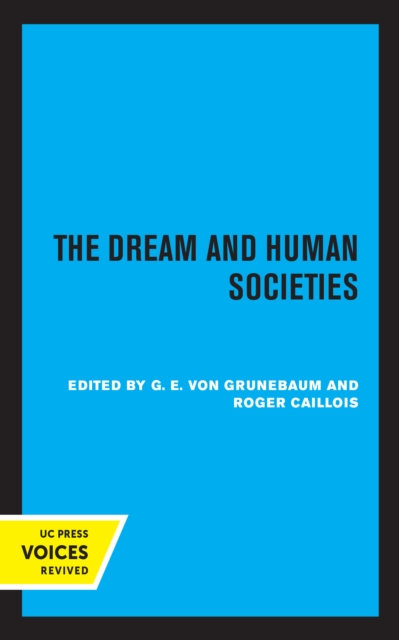
The Dream and Human Societies
This title is part of UC Press's Voices Revived program, which commemorates University of California Press's mission to seek out and cultivate the brightest minds and give them voice, reach, and impact. Drawing on a backlist dating to 1893, Voices Revived makes high-quality, peer-reviewed scholarship accessible once again using print-on-demand technology. This title was originally published in 1966.
eBook


Conversions
Under the combined effects of the Protestant and Catholic Reformations within and pressure from the Ottoman Empire without, early modern Europe became a site in which an unprecedented number of people were confronted by new beliefs, and collective and individual religious identities were broken down and reconfigured. Conversions: gender and religious change in early modern Europe is the first collection to explicitly address the intersections between sexed identity and religious change in the two centuries following the Reformation. The varied and wide-ranging chapters in this collection bring the Renaissance 'turn of the soul' into productive conversation with the three most influential ‘turns’ of recent literary, historical, and art historical study: the ‘turn to religion’, the ‘material turn’, and the ‘gender turn’. Contributors consider masculine as well as feminine identity, and consider the impact of travel, printing, and the built environment alongside questions of genre, race and economics. Of interest to scholars of early modern history, literature, and architectural history, this collection will appeal to anyone interested in the vexed history of religious change, and the transformations of gendered selfhood. Bringing together leading scholars from across the disciplines of literary study, history and art history, Conversions: gender and religious change offers novel insights into the varied experiences of, and responses to, conversion across and beyond Europe. A lively Afterword by Professor Matthew Dimmock (University of Sussex) drives home the contemporary urgency of these themes, and the lasting legacies of the Reformations.
eBook