
Catalogue Search | MBRL


Are you sure you want to remove the book from the shelf?

{{itemTitle}}
190
result(s) for
"Spiritual direction"
Sort by:


Spiritual Taxonomies and Ritual Authority
The people of the late ancient Mediterranean world thought about and encountered gods, angels, demons, heroes, and other spirits on a regular basis. These figures were diverse, ambiguous, and unclassified and were not ascribed any clear or stable moral valence. Whether or not they were helpful or harmful under specific circumstances determined if and what virtues were attributed to them. That all changed in the third century C.E., when a handful of Platonist philosophers-Plotinus, Origen, Porphyry, and Iamblichus-began to produce competing systematic discourses that ordered the realm of spirits in moral and ontological terms.
InSpiritual Taxonomies and Ritual Authority, Heidi Marx-Wolf recounts how these Platonist philosophers organized the spirit world into hierarchies, or \"spiritual taxonomies,\" positioning themselves as the high priests of the highest gods in the process. By establishing themselves as experts on sacred, ritual, and doctrinal matters, they were able to fortify their authority, prestige, and reputation. The Platonists were not alone in this enterprise, and it brought them into competition with rivals to their new authority: priests of traditional polytheistic religions and gnostics. Members of these rival groups were also involved in identifying and ordering the realm of spirits and in providing the ritual means for dealing with that realm. Using her lens of spiritual taxonomy to look at these various groups in tandem, Marx-Wolf demonstrates that Platonist philosophers, Christian and non-Christian priests, and gnostics were more interconnected socially, educationally, and intellectually than previously recognized.
eBook

Changing Your Mind
This book takes you on a journey that unpacks and demystifies what spiritual growth is and how it unfolds.The aim is to set you on your own path toward genuine, personal spiritual transformation.The book provides all the tools you need--biblical, scientific, and practical--so that you can develop your own pathway for spiritual growth.
eBook

THE CATHOLIC INFLUENCER AS A CHALLENGE FOR SPIRITUAL LEADERSHIP IN THE AGE OF SOCIAL MEDIA
Currently, the Internet is a space where many people and institutions carry out various activities. This situation was exacerbated by the COVID-19 pandemic. Due to the pandemic, a large proportion of educational, cultural and religious activities took place through the Internet. This network is also a space for people to meet and exchange views and experiences. The Internet, with its huge media possibilities, is a natural environment for influencers, including Catholic influencers, who appear to be leaders and spiritual advisers in the contemporary mediatized world. The characteristics of Catholic influencing and answering the question of whether this is a challenge for traditional spiritual counselling direction and are important goals in this text. The article refers to broadly understood counseling, but focuses on religious counseling and spiritual guidance realized through social media.
Journal Article
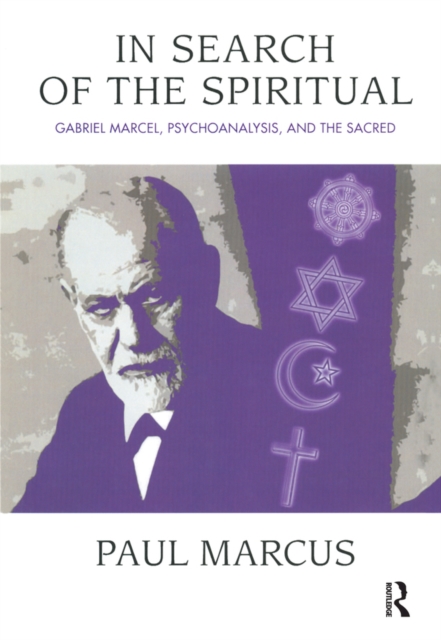
In Search of the Spiritual
Gabriel Marcel (1889-1973), the first French existentialist and phenomenologist, was a world-class Catholic philosopher, an accomplished playwright, drama critic and musician. He wrote brilliantly about many of the classic existential themes associated with Sartre, Heidegger, Jaspers and Buber, prior to the publication of their main works. As a self-described \"philosopher of the threshold\" and \"an awakener,\" his stated goal was to shed some light on the nature of spiritual reality, those moments when one experiences an upsurge of the love of life. In this book, Paul Marcus joins the best of Marcellian and psychoanalytic insights to help the reader develop an inner sensibility that is more receptive, responsive and responsible to the transforming sacred presences that grace everyday life, such as are experienced in selfless love, hoping beyond hope, and maintaining faith in the goodness of the world despite its harsh challenges.
eBook
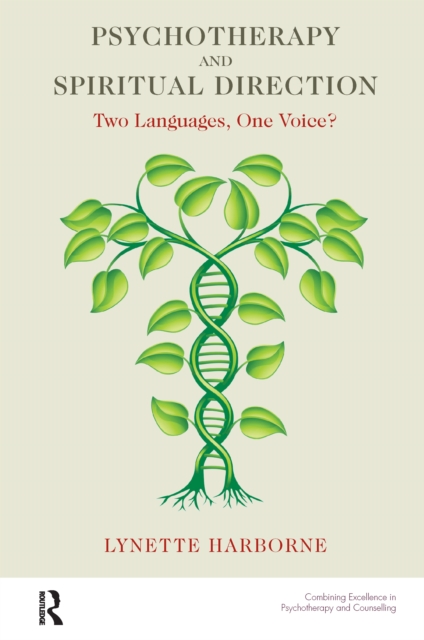
Psychotherapy and Spiritual Direction
This book explores the similarities and differences between the practice of psychotherapy and spiritual direction and suggests that, whilst there may be distinctions between the two activities, the process is essentially the same. The purpose of the book is to improve the understanding between therapists and spiritual directors, to encourage dialogue and discussion between them, as well as to offer challenges and learning to both. In the process of exploring the interface between the practice of therapy and the practice of spiritual direction, questions arise about how to address issues of spirituality in a psychological context and psychological issues in a spiritual context. A brief overview of the historical background to spiritual direction is given, and attention drawn to the links between this tradition and the development of psychotherapy. Spiritual issues that may arise in therapy together with psychological issues that occur during spiritual direction are discussed, leading on to a comparison between 'dark night of the soul' experiences and clinical depression.
eBook
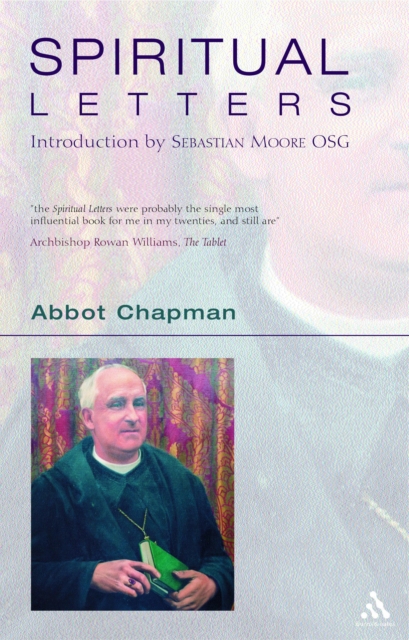
Spiritual Letters
Abbott Chapman's Spiritual Letters, collected and edited posthumously by Dom Roger Hudleston, have been read and found of profound help by countless thousands since they were first published almost half a century ago.
eBook

What Is That in Your Hand? A Diary
The author of this autobiographical narrative entered seminary assuming a call to a preaching ministry. However, her ongoing diary-writing practice gradually clarified her unique preparation for a complementary ministry of spiritual direction and soul companionship, a fairly new concept and practice within the African American community. This essay describes how her longstanding interest in personal writing, especially once it morphed into spiritual journaling, uniquely equipped her with an effective means for facilitating spiritual direction of others. Her personal journey of vocational discovery validates writing as a form of prayer and a pathway to discernment.
Journal Article

A Spiritual Theology of Pastoral Supervision and Spiritual Direction: Incarnational and Redemptive Ministries of Love in Truth
Pastoral supervision and spiritual direction are inherently personal in nature. They reveal a transformative life of spiritual and soul care demanding the formation of theological reflection, healing, guidance, and discernment. Whilst pastoral supervision serves to guide theological reflection on service and mission, spiritual direction facilitates the moments of awakening to the presence and narrative of God’s grace and work in the depths of the soul. Under the light of Catholic Social Teaching, the notions of solidarity and subsidiarity will be pressed into service to unveil a common spiritual–theological foundation animating the roots of both these ministries. To understand the common dynamics of pastoral supervision and spiritual direction, the article develops a spiritual theology to reveal that both ministries, however distinct in practice, share the same incarnational (creative) and redemptive (re-creative) qualities. In other words, they both share the same source, root, origin, or existence in God’s word and grace. This comes to light by learning to pronounce love in truth, a prophetical work of solidarity and subsidiarity, of friendship and sharing orienting integral human development to listen and respond to God’s movement. The actions of solidarity and subsidiarity are rooted in the beatitude of righteousness revealing the little goodness, a work of possibility and responsibility. Such actions serve to transform the time of ministry into spaces of blessing and mystery, of appreciating the sacredness and unknowability of the other with boldness, curiosity and gentleness. The article concludes by showing how both ministries of pastoral supervision and spiritual direction share the spiritual-pastoral appeal to form communities witnessing the little goodness of love in truth.
Journal Article

Apontamentos para a direcção espiritual na Época Moderna em Portugal : (séculos XVI-XVIII)
This article aims to present a provisional bibliography of the works of spiritual direction, published in Portugal between 1600 and 1750. Pointing out some research tracks, it aims to question this practice as a specific phenomenon of Modern Age, accepting that it extends, in different dimensions, up to the contemporaneity.
Journal Article