
Catalogue Search | MBRL


Are you sure you want to remove the book from the shelf?

{{itemTitle}}
1,923
result(s) for
"Spiritual healing"
Sort by:

Foundations of Reiki Ryهohهo : a manual of shoden and okuden
\"A comprehensive guide to the first and second degrees of Usui Reiki Ryoho as well as Reiki's history and Western evolution\"-- Provided by publisher.
Book

Healing Secular Life
In contemporary Turkey-a democratic, secular, and predominantly Muslim nation-the religious healer is a controversial figure. Attracting widespread condemnation, religious healers are derided as exploiters of the sick and vulnerable, discredited forms of Islamic and medical authority, and superstitious relics of a pre-modern era. Yet all sorts of people, and not just the desperately ill, continue to seek them out. After years of research with healers and their patients in working-class neighborhoods of urban Turkey, anthropologist Christopher Dole concludes that the religious healer should be regarded not as an exception to Turkey's secular modern development but as one of its defining figures.Healing Secular Lifedemonstrates that religious healing and secularism in fact have a set of common stakes in the ordering of lives and the remaking of worlds.
Linking the history of medical reforms and scientific literacy campaigns to contemporary efforts of Qur'anic healers to treat people afflicted by spirits and living saints through whom deceased political leaders speak,Healing Secular Lifeapproaches stories of healing and being healed as settings for examining the everyday social intimacies of secular political rule. This ethnography of loss, care, and politics reveals not only that the authority of the religious healer is deeply embedded within the history of secular modern reform in Turkey but also that personal narratives of suffering and affliction are inseparable from the story of a nation seeking to recover from the violence of its own secular past.
eBook

First, we make the beast beautiful : a new journey through anxiety
Challenges cultural beliefs about anxiety from the perspectives of medical and spiritual leaders to explore how the condition needs to be viewed less as a burdensome affliction and more as a source of divine growth.
Book
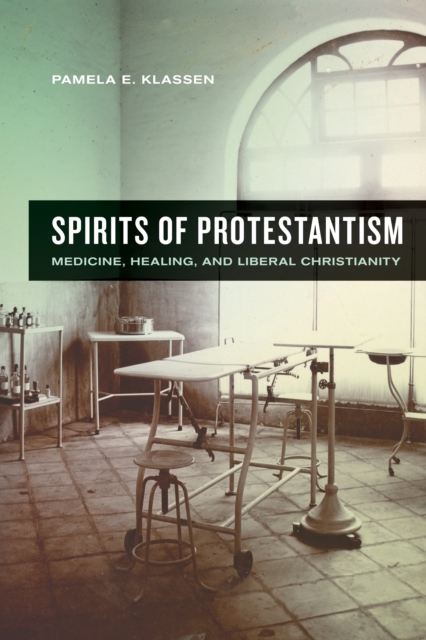
Spirits of protestantism
Spirits of Protestantism reveals how liberal Protestants went from being early-twentieth-century medical missionaries seeking to convert others through science and scripture, to becoming vocal critics of missionary arrogance who experimented with non-western healing modes such as Yoga and Reiki. Drawing on archival and ethnographic sources, Pamela E. Klassen shows how and why the very notion of healing within North America has been infused with a Protestant \"supernatural liberalism.\" In the course of coming to their changing vision of healing, liberal Protestants became pioneers three times over: in the struggle against the cultural and medical pathologizing of homosexuality; in the critique of Christian missionary triumphalism; and in the diffusion of an ever-more ubiquitous anthropology of \"body, mind, and spirit.\" At a time when the political and anthropological significance of Christianity is being hotly debated, Spirits of Protestantism forcefully argues for a reconsideration of the historical legacies and cultural effects of liberal Protestantism, even for the anthropology of religion itself.
eBook

Mysterious healing
Describes reported instances of psychic healing and offers some possible explanations of these phenomena.
Book

God of justice : ritual healing and social justice in the central Himalayas
This book deals with ritual healing in the Central Himalayas of north India. It focuses on the cult of Bhairav, a local deity who is associated with the lowest castes, the so-called Dalits, who are frequently victims of social injustice. When powerless people are exploited or abused and have nowhere else to go, they often turn to Bhairav for justice, and he afflicts their oppressors with disease and misfortune. In order to end their suffering, they must make amends with their former victims and worship Bhairav with bloody sacrifices. Many acts of perceived injustice occur within the family, so that much of the book focuses on the tension between the high moral value placed on family unity on the one hand, and the inevitable conflicts within it on the other. Such conflicts can lead to ghost possession, cursing, and other forms of black magic, all of which are vividly described. The book includes a personal account of the author's own experiences in the field as well as descriptions of blood sacrifice, possession, exorcism, and cursing. The book begins with a straightforward description of the author' s fieldwork and goes on to describe the god Bhairav and his relationship to the weak and powerless. Subsequent chapters deal with the lives of local oracles and healers; the main rituals of the cult and the dramatic Himalayan landscape in which they are embedded; the moral, ritual, and therapeutic centrality of the family; the importance of ghosts and exorcism; and practices of cursing and counter-cursing. The final chapter examines the problematic relationship between ritual healing and modernity.
eBook


The powerful ephemeral
The violent partitioning of British India along religious lines and ongoing communalist aggression have compelled Indian citizens to contend with the notion that an exclusive, fixed religious identity is fundamental to selfhood. Even so, Muslim saint shrines known as dargahs attract a religiously diverse range of pilgrims. In this accessible and groundbreaking ethnography, Carla Bellamy traces the long-term healing processes of Muslim and Hindu devotees of a complex of dargahs in northwestern India. Drawing on pilgrims' narratives, ritual and everyday practices, archival documents, and popular publications in Hindi and Urdu, Bellamy considers questions about the nature of religion in general and Indian religion in particular. Grounded in stories from individual lives and experiences, The Powerful Ephemeral offers not only a humane, highly readable portrait of dargah culture, but also new insight into notions of selfhood and religious difference in contemporary India.
eBook
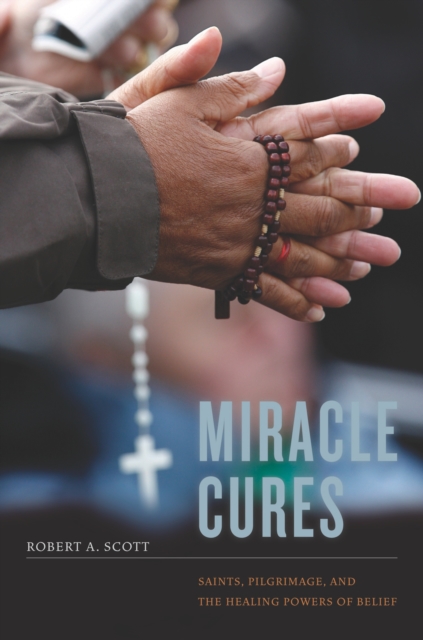
Miracle Cures
Iconic images of medieval pilgrims, such as Chaucer's making their laborious way to Canterbury, conjure a distant time when faith was the only refuge of the ill and infirm, and thousands traveled great distances to pray for healing. Why, then, in an age of advanced biotechnology and medicine, do millions still go on pilgrimages? Why do journeys to important religious shrines-such as Lourdes, Compostela, Fátima, and Medjugorje-constitute a major industry? InMiracle Cures, Robert A. Scott explores these provocative questions and finds that pilgrimage continues to offer answers for many. Its benefits can range from a demonstrable improvement in health to complete recovery. Using research in biomedical and behavioral science, Scott examines accounts of miracle cures at medieval, early modern, and contemporary shrines. He inquires into the power of relics, apparitions, and the transformative nature of sacred journeying and shines new light on the roles belief, hope, and emotion can play in healing.
eBook