
Catalogue Search | MBRL


Are you sure you want to remove the book from the shelf?

{{itemTitle}}
8,530
result(s) for
"Sports Language."
Sort by:

Sport, Rhetoric, and Gender
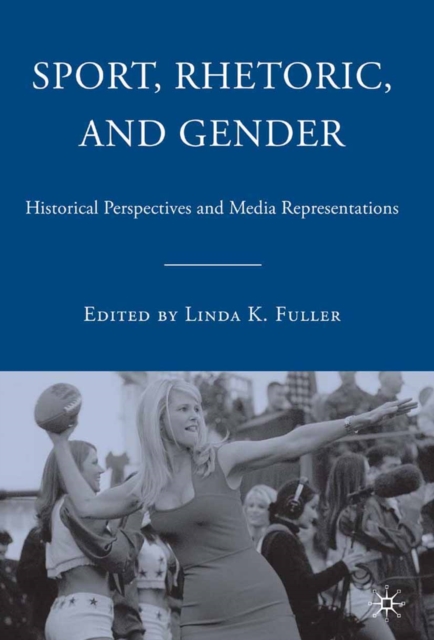
Interested in the nexus between sport, gender, and language, Sport, Rhetoric, and Gender: Historical Perspectives and Media Representations contains 21 wide-ranging chapters examining sport vis-à-vis the language surrounding and incorporated by it in the world arena.
eBook


Appropriating Live Televised Football through Talk
Appropriating live televised football through talk illustrates linguistic and embodied resources, e.g. cohesive devices, sequentiality and gestures, used by empirical audiences in the reception situation for a variety of functions such as the construction of an identity as football fan.
eBook

Sports discourse
\"This book both defines sports discourse, and provides an account of the different discourses that are utilized and come into play when the field of sport speaks. It shows how the sports communities have been addressed over time by various speakers, across various multimodal genres. Tony Schirato looks first at how discourse can be viewed as a form of work, something that produces and naturalizes meanings, and habituates the way we see the world. Grounding this exploration is an account of the development of the field of sport as a specific discursive regime, one that is both reflected and refracted by the dominant discourses and values of the time. These discourses have become naturalized and shape activities and materialities at local and global levels. The book ends with an examination of how new technologies and the Web are changing sports discourse, in some cases radically via online commentary, Twitter and user-generated content\"-- Provided by publisher.
Book

Enhancing communicative competence of future athletes through the integration of international languages in team sports among multicultural students
Introduction: The integration of English as an international language in team sports provides a unique opportunity to enhance communicative competence and teamwork in multicultural environments. Team sports serve as an effective platform for fostering linguistic and intercultural skills. Objective: This study aimed to evaluate the effects of using English as the primary language of communication in team sports on the communicative competence, collaboration, and performance outcomes of culturally diverse Physical Education students. Methodology: A mixed-methods approach was employed, including pre- and post-assessments, surveys, focus group discussions, and observations. The study involved 240 undergraduate students from three universities, divided into Experimental and Control Groups, focusing on football, basketball, and volleyball during one semester. Results: The Experimental Group showed significant improvements in communicative competence, collaboration, and teamwork compared to the Control Group. Performance outcomes varied by sport, with significant improvements in basketball and volleyball but no statistically significant differences in football. Discussion: These findings align with existing research on experiential learning, supporting the idea that team sports enhance linguistic and interpersonal skills. The differing results across sports highlight the varying communication demands inherent to each game. Conclusions: Integrating English into team sports enhances linguistic, teamwork, and intercultural skills among Physical Education students, preparing them for globalized sports environments and fostering intercultural collaboration effectively.
Journal Article


Ontology reasoning scheme for constructing meaningful sports video summarisation
As digital sports video becomes increasingly pervasive, semantic video summary becomes one of the important components for the next generation of multimedia applications. Ontology is a feasible way to mine the semantic information from the video stream. However, current ontology-based methods did not concentrate on the effectiveness and soundness of semantic reasoning. Here, the authors propose a content-directed ontology reasoning approach to produce meaningful sports video summarisation. The proposed ontology can facilitate the metadata acquisition of video and the improvement of query performance. It also provides a flexible way to query the sports video database, which cannot be achieved by simple keyword search. For annotating, describing and managing the sports video content, we propose a sports video descriptive language (SVDL) based on the proposed ontology. Moreover, the semantically meaningful sports video abstraction is produced by reasoning engine which is based on the extension of the Tableau algorithm. Meanwhile, the soundness and completeness of the reasoning algorithm can be solidly proved. Subjective assessment experimental results reveal the reliability and efficiency of the propose scheme.
Journal Article