
Catalogue Search | MBRL


Are you sure you want to remove the book from the shelf?

{{itemTitle}}
31
result(s) for
"Sports franchises -- Social aspects -- United States"
Sort by:

The Sports Franchise Game
Power, prestige, and millions of dollars-these are the stakes in the sports franchise game. In this book, sports attorney Kenneth Shropshire describes the franchise warfare that pits city against city in the fierce bidding competition to capture major league teams. Rigorous research, fascinating interviews with major players, stories behind the headlines, and an insider's perspective converge in this rare view of the business side of professional sports. Shropshire portrays a complex web of motivations, negotiations, and public relations, and discusses examples from Philadelphia, the Bay Area, and Washington D.C.
eBook
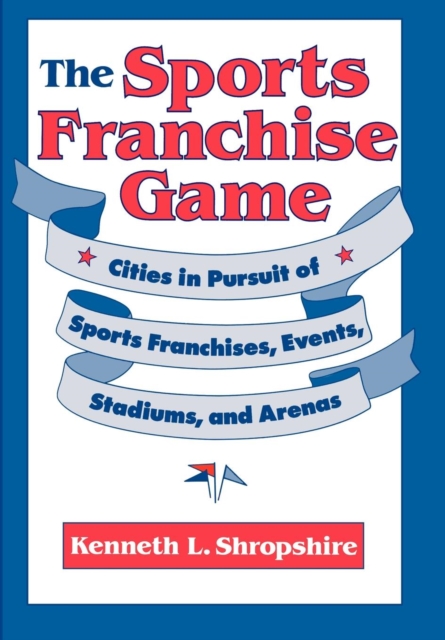
The sports franchise game : cities in pursuit of sports franchises, events, stadiums, and arenas
Kenneth Shropshire describes the franchise warfare that pits city against city in the bidding competition to capture a major league team, using interviews with major players to present an insider's perspective on the business side of professional sports.
eBook

The Influence of Social Alliances with Sports Teams on Intentions to Purchase Corporate Sponsors' Products
Sponsorship has become an increasingly popular form of marketing communications, yet little is known about what might influence consumers' intentions to purchase a sponsor's products. The focus here is on how the social alliances existing between fans and a preferred sports team influence purchase intentions. Data from a convenience sample of 678 adults attending a college football game suggest that favorable purchase intentions are more likely to occur (1) as identification with the team increases and (2) when such intentions are perceived as a group norm. Moreover, an ordinal interaction indicates that team identification has a greater effect on intentions at lower levels of group norms than at higher levels. Implications for practice are discussed.
Journal Article

STADIUMS AND ARENAS: ECONOMIC DEVELOPMENT OR ECONOMIC REDISTRIBUTION?
This article explores the literature on the impact of professional sports teams and stadiums on their host communities. A large body of research has addressed these issues, some of it academic and much of it for hire by team and sport boosters. The broad conclusion of this literature is that stadiums and franchises are ineffective means to creating local economic development, whether that is measured as income or job growth. There may be substantial public benefits from stadiums and franchises, but those too are insufficient to warrant large‐scale subsidies by themselves. In combination with consumer surpluses from attendance, however, subsidies may be efficient. (JEL R58, J30, H71, L83)
Journal Article

The growth effects of sport franchises, stadia, and arenas
This paper investigates the relationship between professional sports franchises and venues and real per capita personal income in 37 standard metropolitan statistical areas in the United States over the period 1969 to 1994. Our empirical framework accounts for the entry and departure of professional football, basketball, and baseball franchises; the construction of arenas and stadia; and other sports related factors over this time period. In contrast to other existing studies, we find evidence that some professional sports franchises reduce the level of per capita personal income in metropolitan areas and have no effect on the growth in per capita income, casting doubt on the ability of a new sports franchise or facility to spur economic growth. We also find evidence that results obtained from estimating reduced-form relationships, a common practice in the literature, are not robust to alternative reduced-form specifications. © 1999 by the Association for Public Policy Analysis and Management.
Journal Article

Racial Discrimination in Professional Basketball: Evidence from Nielsen Ratings
Using data on Nielsen ratings for locally televised NBA basketball games, we find strong evidence that viewership increases when there is greater participation by white players. This finding controls for a wide variety of other factors that could systematically affect Nielsen ratings, and signifies the presence of customer discrimination in the market for NBA players. We also find that higher Nielsen ratings allow NBA teams to realize greater advertising revenues, meaning that the marginal revenue product of white players exceeds that of comparable black players. This factor explains much of the race‐based salary gap that exists in professional basketball.
Journal Article
PROFESSIONAL SPORTS, HURRICANE KATRINA, AND THE ECONOMIC REDEVELOPMENT OF NEW ORLEANS
Hurricane Katrina devastated the city of New Orleans in late August 2005, resulting in damage to much of the city’s sports infrastructure and the departure of both of New Orleans’ major‐league professional sports teams, the National Football League Saints and the National Basketball Association Hornets. What should the city provide in the way of financial accommodation to encourage them to return? This paper suggests that post‐Katrina New Orleans will have a difficult time retaining their franchises over the long run and in attempting to do so may hinder the redevelopment of the city. Furthermore, the very incentives designed to attract teams in the first place leave cities vulnerable to their departure in times of crisis. Finally, playing host to professional sports and mega‐events does have symbolic significance, but it is arguable that this is an amenity the city cannot currently afford. (JEL H25, H71, H40, L83, Q54)
Journal Article
THE PECULIAR EXTERNALITIES OF PROFESSIONAL TEAM SPORTS
The economics literature has long been divided regarding whether competing sports teams can achieve the same, efficient allocation of playing skills that a revenue‐maximizing league monopolist would choose despite the external effects the teams impose on each other in their pursuit of athletic talent. In this article an explicit consideration of the arbitrage incentives that underlie the marketing and pricing of playing skills indicates that decentralized franchises generally fail to allocate talent efficiently. For fans concerned about the championship prospects of their preferred team, the popular complaint has merit: “Big‐city teams win too much.”(JEL L83)
Journal Article


A Public Accommodations Challenge to the Use of Indian Team Names and Mascots in Professional Sports
Five professional sports teams currently have American Indian names and mascots: the Atlanta Braves, Chicago Blackhawks, Cleveland Indians, Kansas City Chiefs, and Washington Redskins. The accompanying mascots, such as the Cleveland Indians' Chief Wahoo, represent stereotypical and racist depictions of American Indians. In addition, team mascots, players, and cheerleaders engage in sham rituals - war songs, dances, and actions like the tomahawk chop - that not only manifest blatant racism, but also constitute direct attacks on American Indian religious practices. It is clear that the analogous use of any other racial or ethnic group as a sports team mascot would be considered socially repugnant and reprehensible. A mounting chorus of protests denounce the use of Indian mascots and team names as a virulently racist practice, and the public acknowledgment of impropriety is growing. The fundamental purpose of remedial civil rights legislation is to alter the majority group's actions. With sufficient factual findings of a deterrent effect, Title II of the Civil Rights Act of 1964 should succeed in prohibiting discriminatory Indian team names and mascots.
Journal Article