
Catalogue Search | MBRL


Are you sure you want to remove the book from the shelf?

{{itemTitle}}
12,065
result(s) for
"Sri Lanka."
Sort by:


In My Mother's House
In May 2009, the Sri Lankan army overwhelmed the last stronghold of the Liberation Tigers of Tamil Eelam-better known as the Tamil Tigers-officially bringing an end to nearly three decades of civil war. Although the war has ended, the place of minorities in Sri Lanka remains uncertain, not least because the lengthy conflict drove entire populations from their homes. The figures are jarring: for example, all of the roughly 80,000 Muslims in northern Sri Lanka were expelled from the Tamil Tiger-controlled north, and nearly half of all Sri Lankan Tamils were displaced during the course of the civil war. Sharika Thiranagama'sIn My Mother's Houseprovides ethnographic insight into two important groups of internally displaced people: northern Sri Lankan Tamils and Sri Lankan Muslims. Through detailed engagement with ordinary people struggling to find a home in the world, Thiranagama explores the dynamics within and between these two minority communities, describing how these relations were reshaped by violence, displacement, and authoritarianism. In doing so, she illuminates an often overlooked intraminority relationship and new social forms created through protracted war.In My Mother's Houserevolves around three major themes: ideas of home in the midst of profound displacement; transformations of familial experience; and the impact of the political violence-carried out by both the Tamil Tigers and the Sri Lankan state-on ordinary lives and public speech. Her rare focus on the effects and responses to LTTE political regulation and violence demonstrates that envisioning a peaceful future for post-conflict Sri Lanka requires taking stock of the new Tamil and Muslim identities forged by the civil war. These identities cannot simply be cast away with the end of the war but must be negotiated anew.
eBook

The rough guide to Sri Lanka
The Rough Guide to Sri Lanka is the most comprehensive and user-friendly guide to exploring this fascinating island country. Each chapter includes thoroughly researched travel information, hotel and restaurant listings, and thoughtful background on the environment, politics, culture, music and history, and a practical language guide ensures you can interact with locals. The full-color design combines glorious images to whet your appetite with a practical layout and dozens of accessible and accurate maps to guide you from the urban centers to the jungle, beaches and mountains.
Book

When Counterinsurgency Wins
For twenty-six years, civil war tore Sri Lanka apart. Despite numerous peace talks, cease-fires, and external military and diplomatic pressure, war raged on between the separatist Liberation Tigers of Tamil Eelam and the Sinhala-dominated Sri Lankan government. Then, in 2009, the Sri Lankan military defeated the insurgents. The win was unequivocal, but the terms of victory were not. The first successful counterinsurgency campaign of the twenty-first century left the world with many questions. How did Sri Lanka ultimately win this seemingly intractable war? Will other nations facing insurgencies be able to adopt Sri Lanka's methods without encountering accusations of human rights violations? Ahmed S. Hashim-who teaches national security strategy and helped craft the U.S. counterinsurgency campaign in Iraq-investigates those questions in the first book to analyze the final stage of the Sri Lankan civil war.When Counterinsurgency Winstraces the development of the counterinsurgency campaign in Sri Lanka from the early stages of the war to the later adaptations of the Sri Lankan government, leading up to the final campaign. The campaign itself is analyzed in terms of military strategy but is also given political and historical context-critical to comprehending the conditions that give rise to insurgent violence. The tactics of the Tamil Tigers have been emulated by militant groups in Palestine, Iraq, Afghanistan, and Somalia. Whether or not the Sri Lankan counterinsurgency campaign can or should be emulated in kind, the comprehensive, insightful coverage ofWhen Counterinsurgency Winsholds vital lessons for strategists and students of security and defense.
eBook

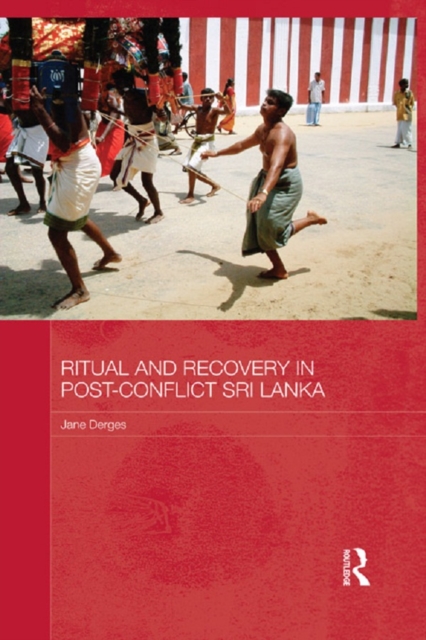
Ritual and Recovery in Post-Conflict Sri Lanka
Following over twenty years of war, Sri Lanka's longest cease-fire (2002-2006) provided a final opportunity for an inclusive peace settlement between the Sri Lankan government and the Liberation Tigers of Tamil Eelam (LTTE). However, hostilities resumed with ever increasing desperation and ferocity on both sides, until the LTTE were overcome and largely eradicated in 2009.
This book provides a contextualised analysis of the effects of war on a small Tamil community living in northern Sri Lanka during the cease-fire period. It examines how the society changed and adapted in order to accommodate the upheaval and destruction of war, and its inevitable resumption. In particular, it focuses on the nature of suffering through an exploration of a well-known ritual: Thuukkukkaavadi that transformed the experience of pain and suffering and contributed to a process whereby many village communities could come together in a demonstration of strength and resilience.
It contributes to studies on violence, reparation processes of so-called 'post-conflict' societies and the medical anthropology of healing. It questions assumptions concerning the nature of suffering and critiques the application of western categories in settings like northern Sri Lanka, where entire communities have been silenced by political violence. The book therefore presents a claim for more culturally specific understandings of what constitutes suffering and is of interest to students and scholars of South Asian Studies, Conflict Resolution, and Social and Cultural Anthropology.
eBook


Les minorités tamoules à Colombo, Kuala Lumpur et Singapour
Cet ouvrage propose, à travers une analyse tant spatiale que politique et culturelle, dans une perspective comparative à l'aide de trois terrains asiatiques (Colombo, Kuala Lumpur et Singapour), d'étudier les différents modes et degrés d'intégration des minorités tamoules, tant localement (évaluer leur citadinité), nationalement (évaluer leur citoyenneté) que mondialement (situer leurs transnationalités diasporiques). L'analyse des politiques menées par la puissance coloniale, puis par les trois États indépendants à l'égard des minorités, permet de mieux comprendre leurs impacts sur le sentiment d'identification et d'intégration des Tamouls à la nation, ainsi que sur leur répartition dans ces villes. À l'échelle locale, les politiques urbaines développées par les États, qui selon les cas préservent ou détruisent les ethnoterritoires, transforment l'empreinte urbaine et la pratique de la ville des Tamouls et influent sur la façon dont ils perçoivent leur appartenance à la nation. Enfin, les liens transnationaux et les dynamiques migratoires internationales contemporaines des Tamouls dans ces trois pays ont aussi des conséquences sur leur identification et leur intégration.
eBook

The Sarvodaya movement : holistic development and risk governance in Sri Lanka
\"This book provides an important case study of how local cultures, religions and spiritualties can enhance development activities, and provide helpful frameworks for contemporary societies facing the pressures of neoliberalism. It specifically traces how the influential Sri Lankan Sarvodaya Movement has deployed concepts of spirituality-based holistic development to help local communities with post-tsunami reconstruction and redevelopment. Throughout, the author provides a Three Sphere conceptualisation of holistic sustainable development, focused on Culture, Economics and Power, slightly revising the Sarvodaya's Three Sphere model comprising Spirituality, Economics and Power. The author contends that the success of holistic development, including risk governance, is largely contingent on an awareness of the interdependency of these three spheres, and establishing equitable partnerships between communities, NGOs, INGOs, States, and the private sector. Overall, this book argues that religion, spirituality, and non-religious worldviews play an important role amongst other resources concerned with how to survive the pressures of neoliberalism and environmental risks and crises. The Sarvodaya Movement, which draws on Buddhist concepts of spirituality, is widely acknowledged as an important example of spirituality and community-driven development, and as such, this book will be of interest to scholars of Development and Humanitarian Studies, Religious Studies, and South Asian Studies\"-- Provided by publisher.
Book

Childhood in a Sri Lankan Village
Like toddlers all over the world, Sri Lankan children go through a period that in the U.S. is referred to as the \"terrible twos.\" Yet once they reach elementary school age, they appear uncannily passive, compliant, and undemanding compared to their Western counterparts. Clearly, these children have undergone some process of socialization, but what?Over ten years ago, anthropologist Bambi Chapin traveled to a rural Sri Lankan village to begin answering this question, getting to know the toddlers in the village, then returning to track their development over the course of the following decade.Childhood in a Sri Lankan Villageoffers an intimate look at how these children, raised on the tenets of Buddhism, are trained to set aside selfish desires for the good of their families and the community. Chapin reveals how this cultural conditioning is carried out through small everyday practices, including eating and sleeping arrangements, yet she also explores how the village's attitudes and customs continue to evolve with each new generation.Combining penetrating psychological insights with a rigorous observation of larger social structures, Chapin enables us to see the world through the eyes of Sri Lankan children searching for a place within their families and communities.Childhood in a Sri Lankan Villageoffers a fresh, global perspective on child development and the transmission of culture.
eBook