
Catalogue Search | MBRL


Are you sure you want to remove the book from the shelf?

{{itemTitle}}
11
result(s) for
"Stables Fiction."
Sort by:

Sammy the shy kitten
Emma wants to adopt Sammy, one of the kittens that live in her riding school's stable, but must first convince her parents that this is a good idea.
Book

Tales of the far north; Dr William Gordon Stables and the Arctic adventure story in the late Victorian era
Dr William Gordon Stables (1837–1910) was perhaps the most prolific author of juvenile works during the second half of the 19th century, publishing more than 130 full-length novels, in addition to offering regular contributions to juvenile magazines. His writings covered a diverse range of subject areas, spanning all regions of the globe, and offered lively tales of adventure often coupled with moral guidance and imperialistic overtones. However, it was juvenile tales of adventure set in the far north that were his favourites and among his most frequent selections. Drawing upon his own first-hand Arctic experiences, Stables provided a knowledgeable view of the northern regions, offering vivid and realistic depictions of life and work in the Arctic, as well as its peoples, natural history and natural wonders. The challenges of survival in the harsh environment of the Arctic fostered a physical approach to manliness and maturity in Stables’ young heroes, who served as powerful role models for his youthful audience. Stables’ works enjoyed widespread popularity among impressionable juvenile readers and helped to shape their perceptions of the Arctic regions and impart character values on their path to adulthood. This article examines Stables’ contribution to Arctic storytelling in the late Victorian era.
Journal Article
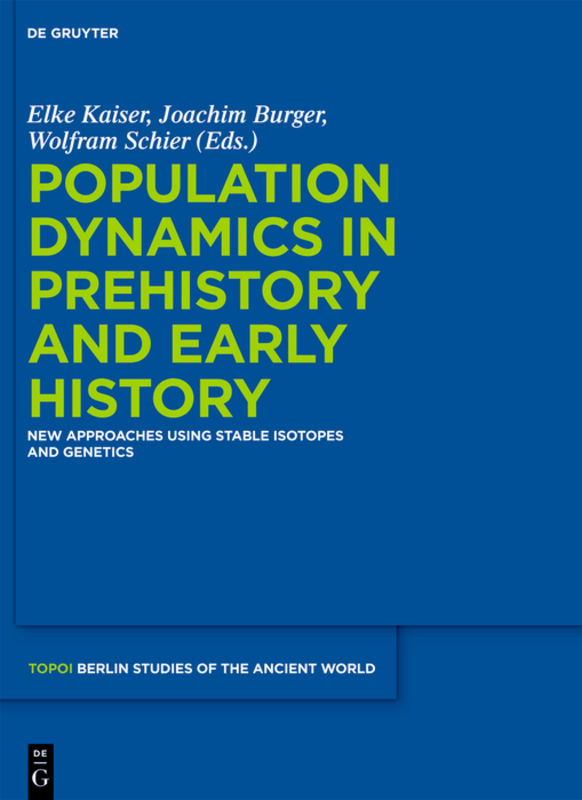
Population Dynamics in Prehistory and Early History
Migrations and population dynamics are considered very problematic topics in the fields of ancient studies. Recent scholarship in (pre)historical population has generated new impulses by using scientific approaches using radiogenic and stable isotopes, and palaeogenetics, as well as computer simulation. As a result, the state of migration research has undergone rapid change. Several research groups presented papers at aconference held in Berlin in 2010, addressing specific historical aspects of population dynamics and migration, with no chronological or geographical restrictions, in the light of cutting-edge bio-archaeological research. This volume, divided into three larger thematic sections (isotope analysis, population genetics, and modelling and computer simulation), presents experiences and insights about methodological approaches, research results and prospects for future research in this area in a varied collection of papers. Scholars from widely diverse scientific disciplines present their approaches, findings and interpretations to an audience far broader than the circles of the individual disciplines.
eBook


Anglo‐Irish Conflict in Jennifer Johnston's Fiction
This chapter contains sections titled:
References and Further Reading
Book Chapter

Transformation in the Verbal Art of Clementina Todesco
The volume upon which the present discussion is focused comes to us as part of the Wayne State University Folklore Archive Study Series. Elizabeth Mathias and Richard Raspa, authors ofItalian Folktales in America: The Verbal Art of an Immigrant Woman,¹ have centered their study on folk artist Clementina Todesco and have effectively redeemed from oblivion the tales and talent of this heretofore unknown emigrant from the village of Faller in the Veneto.
Who was Clementina Todesco, and how did this unusual book come to be written about her? The volume had an interesting genesis. In 1941, a young coed
Book Chapter
