
Catalogue Search | MBRL


Are you sure you want to remove the book from the shelf?

{{itemTitle}}
10
result(s) for
"Stalinist state"
Sort by:

Through Soviet Jewish Eyes
Most view the relationship of Jews to the Soviet Union through the lens of repression and silence. Focusing on an elite group of two dozen Soviet-Jewish photographers, including Arkady Shaykhet, Alexander Grinberg, Mark Markov-Grinberg, Evgenii Khaldei, Dmitrii Baltermants, and Max Alpert,Through Soviet Jewish Eyespresents a different picture. These artists participated in a social project they believed in and with which they were emotionally and intellectually invested-they were charged by the Stalinist state to tell the visual story of the unprecedented horror we now call the Holocaust.These wartime photographers were the first liberators to bear witness with cameras to Nazi atrocities, three years before Americans arrived at Buchenwald and Dachau. In this passionate work, David Shneer tells their stories and highlights their work through their very own images-he has amassed never-before-published photographs from families, collectors, and private archives.Through Soviet Jewish Eyeshelps us understand why so many Jews flocked to Soviet photography; what their lives and work looked like during the rise of Stalinism, during and then after the war; and why Jews were the ones charged with documenting the Soviet experiment and then its near destruction at the hands of the Nazis.
eBook

Cultivating the Masses
Under Stalin's leadership, the Soviet government carried out a massive number of deportations, incarcerations, and executions. Paradoxically, at the very moment that Soviet authorities were killing thousands of individuals, they were also engaged in an enormous pronatalist campaign to boost the population. Even as the number of repressions grew exponentially, Communist Party leaders enacted sweeping social welfare and public health measures to safeguard people's well-being. Extensive state surveillance of the population went hand in hand with literacy campaigns, political education, and efforts to instill in people an appreciation of high culture.
InCultivating the Masses, David L. Hoffmann examines the Party leadership's pursuit of these seemingly contradictory policies in order to grasp fully the character of the Stalinist regime, a regime intent on transforming the socioeconomic order and the very nature of its citizens. To analyze Soviet social policies, Hoffmann places them in an international comparative context. He explains Soviet technologies of social intervention as one particular constellation of modern state practices. These practices developed in conjunction with the ambitions of nineteenth-century European reformers to refashion society, and they subsequently prompted welfare programs, public health initiatives, and reproductive regulations in countries around the world.
The mobilizational demands of World War I impelled political leaders to expand even further their efforts at population management, via economic controls, surveillance, propaganda, and state violence. Born at this moment of total war, the Soviet system institutionalized these wartime methods as permanent features of governance. Party leaders, whose dictatorship included no checks on state power, in turn attached interventionist practices to their ideological goal of building socialism.
eBook

Becoming a Cold Warrior: The Peregrinations of a Soviet Jewish Defector
Until September 1938, when the Soviet authorities began disassembling the system of Yiddish-medium education, most young entrants to literary careers were graduates of teachers’ training institutions. The life story of Hershl (Grigory) Vinokur, aka Herschel Weinrauch/Vaynroykh, stands out among the writers of that cohort. After graduating in Odesa as a Yiddish teacher in 1932, he worked as a journalist on Yiddish newspapers in Birobidzhan, the Jewish territorial unit in Russian Far East, and in Bialystok, annexed to Soviet Belorussia in 1939. His collections of Yiddish stories came out in Moscow and Minsk. A war veteran, he settled in Chernivtsi in 1944, worked as a teacher at one of the last remaining Yiddish schools, but in 1946 used counterfeit documents to emigrate to Poland, then Germany, and arrived in Israel together with Jewish displaced persons. Vinokur’s articles began appearing in
Forverts
(The Forward), the New York Yiddish daily, which helped him move to the United States. There he acted as an authoritative expert on Jewish life in the Soviet Union. His 1950 heavily autobiographical book
Blut oyf der zun: Yidn in Sovet Rusland
(Blood on the Sun: Jews in the Soviet Union) is referred to in scholarly and other publications. This article represents the first attempt to trace Vinokur’s tempestuous life and his input to the McCarthyist discourse of the 1950s. Although Vinokur had never become a major figure in the world of literature, culture, or politics, his life linked uniquely together important developments and moments in Jewish history of the twentieth century.
Journal Article

Stalinism, the Terror, and Social History
Historians, like writers and artists, often choose their subjects for deep political, emotional, or familial reasons. For many in my generation, the attraction to certain topics was political. As a teenager in New York City in the early 1970s, I frequently skipped school to participate in left-wing political meetings. The city at that time was pulsing with revolutionary energy: hippies, anarchists, Maoists, Black Panthers, Young Lords, radical feminists, and other groups—all convinced that “the System,” as we then called it, was on the verge of collapse. My memories of those smoke-filled meetings have long faded, but the electric excitement
Book Chapter
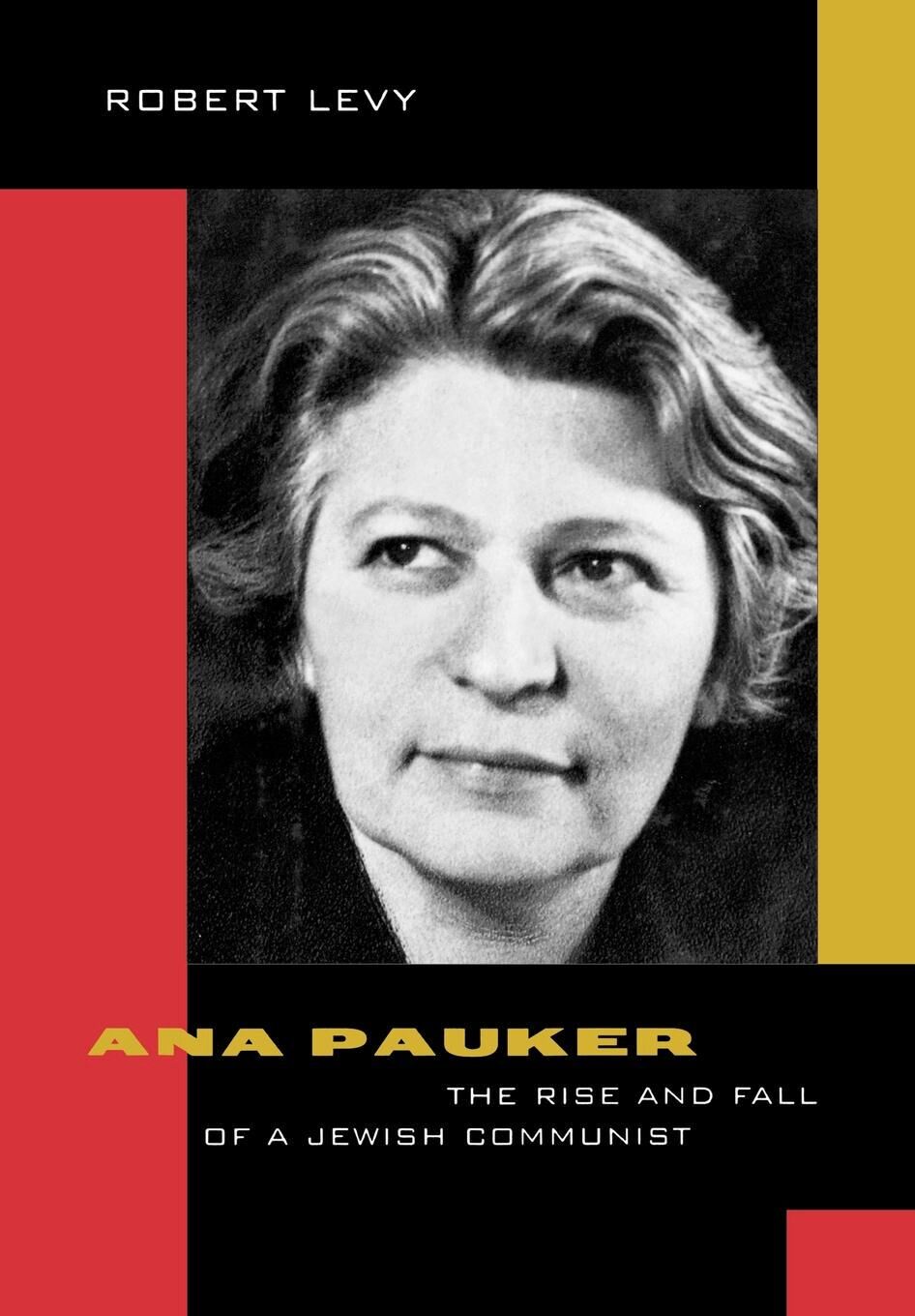
Ana Pauker : the rise and fall of a Jewish Communist
In her own day, Ana Pauker was named \"The Most Powerful Woman in the World\" by Time magazine. Today, when she is remembered at all, she is thought of as the puppet of Soviet communism in Romania, blindly enforcing the most brutal and repressive Stalinist regime. Robert Levy's new biography changes the picture dramatically, revealing a woman of remarkable strength, dominated by conflict and contradiction far more than by dogmatism. Telling the story of Pauker's youth in an increasingly anti-Semitic environment, her commitment to a revolutionary career, and her rise in the Romanian Communist movement, Levy makes no attempt to whitewash Pauker's life and actions, but rather explores every contour of the complicated persona he found expressed in masses of newly accessible archival documents. Many titles in the Voices Revived program are also newly available as ebooks, offered at a discounted price to support wider access to scholarly work.
eBook

Terror and Conciliation 1935–1936
WHETHER OR NOT Stalin was involved in Kirov’s murder, he took full advantage of the opportunities it presented to further his own objectives. Principally, he used it as an excuse to eliminate his former political opponents, the leaders and members of the opposition movements active in the 1920s and early 1930s. Between 1935 and 1938 a large number of oppositionists were destroyed. In almost every case, the accusations of terror leveled against them included allegations of involvement in plans to kill Kirov. Besides serving as a vehicle for settling old accounts, his murder became the starting point for a large-scale
Book Chapter
A Facade of Liberalization 1934
THE BRIEF PERIOD between the surge in state terror in 1932–1933 and the new hardening of the general line that followed the murder of Sergei Kirov on 1 December 1934 had many of the features of a thaw, however limited it might have been by the systems that had taken shape over the previous few years. In the opinion of Mikhail Gefter, this brief period offered an opportunity—an opportunity that was missed—to choose, on the one hand, between further bloodletting and a continuation of the same course and, on the other, normalization of the “anti-Fascist democratization of
Book Chapter
SHOTS FROM UNDERGROUND
The first successful Soviet experiment in cinema sound-recording was a chronicle of the Promparty trial.³ Stalinisation of Soviet cinematography coincided with the appearance of talking pictures. As Oksana Bulgakowa notes,
The model of the ‘Soviet film’ achieves its total expression at the very moment when cinema becomes the medium not of another art (a traditional and therefore an impaired solution), but of another reality, and above all of ‘another’ history. The uniqueness of Soviet monumental films is defined not just by their rejection of tried and tested narrative structures. Cinema inherits the mantle of the chronicler, which is merely a
Book Chapter

The Party-State in the Factory
It is impossible to dispute Seymour Martin Lipset’s contention that “the nature of working class politics has been profoundly influenced by the variations in the historic conditions under which the proletariat entered the political arena” (1983: 1). Arguably the single most important historic condition is the state: not simply an arena in which politics takes place, it is an organization that directly structures political activity and political relationships, defining and enforcing the legitimate. This is true no less for a liberal-democratic regime than for an authoritarian one, and it is true whether one views the state as a relatively autonomous
Book Chapter