
Catalogue Search | MBRL


Are you sure you want to remove the book from the shelf?

{{itemTitle}}
733
result(s) for
"Stanford University"
Sort by:


Human Life in Motion
Human Life in Motion presents for the first time the
previously unpublished transcripts of the seminars on Aristotle
Martin Heidegger gave in the 1920s. These transcripts reveal much
about the evolution of his thought during that time.
Detailed student transcripts for these seminars appear among the
papers of one of Heidegger's students, Helene Weiss, held today in
the Special Collections Department of Stanford University.
Analyzing and organizing hundreds of pages of these transcripts
written by different students, Francisco Gonzalez brilliantly
reconstructs the original seminars. He summarizes what Heidegger
presented and claimed in each class. Gonzalez also throws into
relief the overarching philosophical significance of the seminars,
showing how the different interpretative moves or claims are
connected and where they lead, something which in turn requires
explicating them in the context of both the Aristotelian texts
discussed and Heidegger's own thought during this period.
Essential reading for students and scholars of Heidegger or
Aristotle, Human Life in Motion is a publishing event that
forces a reconsideration of the thought and legacy of both
philosophers.
eBook

Who killed Jane Stanford? : a gilded age tale of murder, deceit, spirits and the birth of a university
\"A premier historian penetrates the fog of corruption and cover-up still surrounding the murder of a Stanford University founder to establish who did it, how, and why. In 1885 Jane and Leland Stanford cofounded a university to honor their recently deceased young son. After her husband's death in 1893, Jane Stanford, a devoted spiritualist who expected the university to inculcate her values, steered Stanford into eccentricity and public controversy for more than a decade. In 1905 she was murdered in Hawaii, a victim, according to the Honolulu coroner's jury, of strychnine poisoning. With her vast fortune the university's lifeline, the Stanford president and his allies quickly sought to foreclose challenges to her bequests by constructing a story of death by natural causes. The cover-up gained traction in the murky labyrinths of power, wealth, and corruption of Gilded Age San Francisco. The murderer walked. Deftly sifting the scattered evidence and conflicting stories of suspects and witnesses, Richard White gives us the first full account of Jane Stanford's murder and its cover-up. Against a backdrop of the city's machine politics, rogue policing, tong wars, and heated newspaper rivalries, White's search for the murderer draws us into Jane Stanford's imperious household and the academic enmities of the university. Although Stanford officials claimed that no one could have wanted to murder Jane, we meet several people who had the motives and the opportunity to do so. One of these, we discover, also had the means\"-- Provided by publisher.
Book
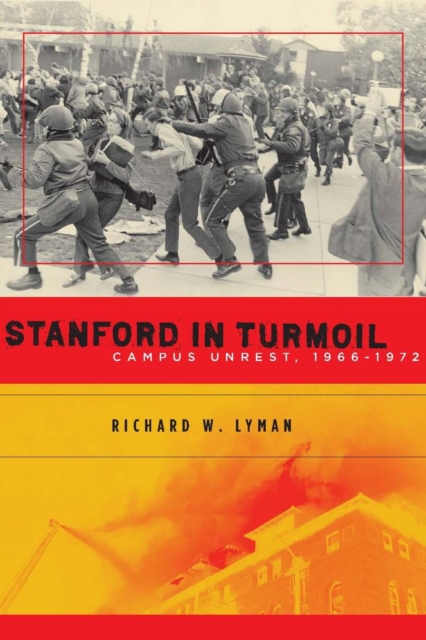
Stanford in turmoil
Stanford in Turmoil is a rare insider's look at one school's experience of dramatic political unrest during the late 1960s and early 1970s. It provides a unique perspective on the events that roiled the campus during this period-a period in which the author, Richard Lyman, served as the university's vice president, provost, and then president. In a cross between memoir and history, the book guides us through major cases of arson, including the destruction of the president's office, the notorious \"Cambodia Spring\" of 1970-when dozens of students and police were injured-and the forced resignation of another Stanford president after just nineteen months in office. Remarkably, Stanford's prestige and academic strength grew unabated throughout this time of crisis. How this came to pass is the central theme ofStanford in Turmoil.
eBook


Transforming comparative education : fifty years of theory building at Stanford
Over the past fifty years, new theoretical approaches to comparative and international education have transformed it as an academic field. We know that fields of research are often shaped by \"collectives\" of researchers and students converging at auspicious times throughout history. Part institutional memoir and part intellectual history, Transforming Comparative Education takes the Stanford \"collective\" as a framework for discussing major trends and contributions to the field from the early 1960s to the present day, and beyond. Carnoy draws on interviews with researchers at Stanford to present the genesis of their key theoretical findings in their own words. Moving through them chronologically, Carnoy situates each work within its historical context, and argues that comparative education is strongly influenced by its economic and political environment. Ultimately, he discusses the potential influence of feminist theory, organizational theory, impact evaluation, world society theory, and state theory on comparative work in the future, and the political and economic changes that might inspire new directions in the field.
eBook


Propagation Modelling of Path Loss Models for Wireless Communication in Urban and Rural Environments at 1800 GSM Frequency Band
In this research various channel propagation models of wireless communication systems were analysed. There are many types of propagation models that can minutely calculate the path loss in all types of terrain. Performance estimation of different propagation models was analysed using simulations. In the simulations the selected propagation models have been proposed at the operating frequency of 1800 MHz for different receiver antenna heights in urban and rural environments. Simulations were performed using MATLAB R2013b. The propagation models depend on location, frequency range and clutter type such as urban, suburban and countryside. It was noticed from the results of the path loss calculation for 2 m, 7 m and 14 m receiver antenna heights in urban environment that COST 231 (W-I) model showed the lowest path loss results (138 dB) as compared with the other models in urban environment. On the contrary, SUI model showed the highest path loss result (166 dB in 2 m receiver antenna height) as compared with the other models in the same environment.
Journal Article


Starving for Justice
In the 1990s three college campuses in California exploded as Chicano/a and Latino/a students went on hunger strikes. Through courageous self-sacrifice, these students risked their lives to challenge racial neoliberalism, budget cuts, and fee increases. The strikers acted and spoke spectacularly and, despite great odds, produced substantive change.Social movement scholars have raised the question of why some people risk their lives to create a better world. InStarving for Justice, Ralph Armbruster-Sandoval uses interviews and archival material to examine people's willingness to make the extreme sacrifice and give their lives in order to create a more just society.Popular memory and scholarly discourse around social movements have long acknowledged the actions of student groups during the 1960s. Now Armbruster-Sandoval extends our understanding of social justice and activism, providing one of the first examinations of Chicana/o and Latina/o student activism in the 1990s.Students at University of California, Los Angeles; University of California, Santa Barbara; and Stanford University went on hunger strikes to demand the establishment and expansion of Chicana/o studies departments. They also had even broader aspirations-to obtain dignity and justice for all people. These students spoke eloquently, making their bodies and concerns visible. They challenged anti-immigrant politics. They scrutinized the rapid growth of the prison-industrial complex, racial and class polarization, and the university's neoliberalization. Though they did not fully succeed in having all their demands met, they helped generate long-lasting social change on their respective campuses, making those learning institutions more just.
eBook