
Catalogue Search | MBRL


Are you sure you want to remove the book from the shelf?

{{itemTitle}}
1,402
result(s) for
"State, The Origin."
Sort by:

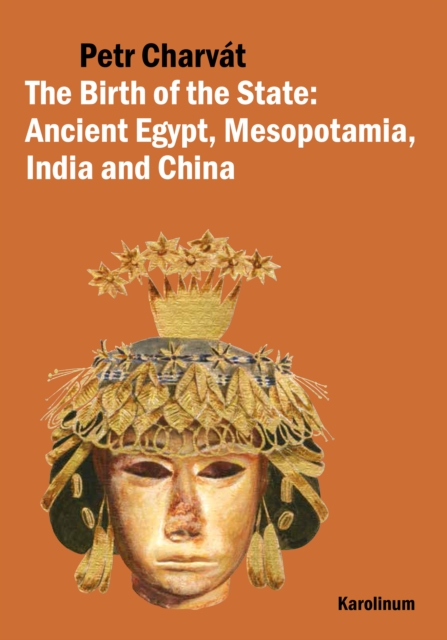
The Birth of the State
In the book titled Birth of the State, readers learn what researchers nowadays think about the rise and stabilization of the oldest statehood in the original civilization centres of the Old World - Egypt, Mesopotamia, India and China. The scholar takes them through essential economic, political and spiritual changes caused in those societies by the rise and stabilization of the first states. The overviews are completed with a comprehensive view of the entire theme, attempting to provide a balanced view of the rise of the oldest states not only as a question of economy, politics or power, but also as exceeding the basic threshold in the spiritual sphere. The book allows the very founders and cultivators of the oldest state units to speak: in the moments when their work seemed to be on the verge of total collapse, they spoke to their contemporaries urging them to defend the ideals that formed the basis of their civilizations. The book is intended for university students as well as others interested in the rise and development of the oldest states of the humankind.
eBook


Against the Grain
An Economist Best History Book 2017
\"History as it should be written.\"-Barry Cunliffe,
Guardian \"Scott hits the nail squarely on
the head by exposing the staggering price our ancestors paid for
civilization and political order.\"-Walter Scheidel, Financial
Times Why did humans abandon hunting and gathering
for sedentary communities dependent on livestock and cereal grains,
and governed by precursors of today's states? Most people believe
that plant and animal domestication allowed humans, finally, to
settle down and form agricultural villages, towns, and states,
which made possible civilization, law, public order, and a
presumably secure way of living. But archaeological and historical
evidence challenges this narrative. The first agrarian states, says
James C. Scott, were born of accumulations of domestications: first
fire, then plants, livestock, subjects of the state, captives, and
finally women in the patriarchal family-all of which can be viewed
as a way of gaining control over reproduction. Scott explores why
we avoided sedentism and plow agriculture, the advantages of mobile
subsistence, the unforeseeable disease epidemics arising from
crowding plants, animals, and grain, and why all early states are
based on millets and cereal grains and unfree labor. He also
discusses the \"barbarians\" who long evaded state control, as a way
of understanding continuing tension between states and nonsubject
peoples.
eBook


Origin Stories in Political Thought
Origin stories are a recurring motif in the history of political thought. Presented as narratives that describe the beginnings of politics and power, these stories are among the most provocative and politically contentious means by which Western society organizes and represents its experience. Indeed, as scripts of citizenship, origin stories seek to manufacture consent to a preconceived - and hierarchical - political vision.
Joanne H. Wright'sOrigin Stories in Political Thoughtexamines Plato'sTimaeus, Hobbes's story of the state of nature and the social contract, and early Second Wave feminist stories about the beginnings of patriarchal social relations. Using a historically sensitive, feminist methodology, Wright documents and deconstructs the tradition of telling origin stories in the larger history of political thought.
Although individual tales have been assessed in current scholarship, the motif of the origin story itself has, until now, escaped systematic analysis. With meticulous research and convincing conclusions,Origin Stories in Political Thoughtmakes a groundbreaking and valuable contribution to both feminist and political studies.
eBook

The birth of the state : ancient Egypt, Mesopotamia, India and China
'The Birth of the State' provides an overview of four of the most significant cultural centres in the ancient world, now in Egypt, the Persian Gulf region, India, and China.
BOOK

From Colonization to Domestication
Winner of the Don D. and Catherine S. Fowler Prize. Eastern North America is one of only a handful of places in the world where people first discovered how to domesticate plants. In this book, anthropologist Shane Miller uses two common, although unconventional, sources of archaeological data—stone tools and the distribution of archaeological sites—to trace subsistence decisions from the initial colonization of the American Southeast at the end of the last Ice Age to the appearance of indigenous domesticated plants roughly 5,000 years ago. Miller argues that the origins of plant domestication lie within the context of a boom/bust cycle that culminated in the mid-Holocene, when hunter-gatherers were able to intensively exploit shellfish, deer, oak, and hickory. After this resource “boom” ended, some groups shifted to other plants in place of oak and hickory, which included the suite of plants that were later domesticated. Accompanying these subsistence trends is evidence for increasing population pressure and declining returns from hunting. Miller contends, however, that the appearance of domesticated plants in eastern North America, rather than simply being an example of necessity as the mother of invention, is the result of individuals adjusting to periods of both abundance and shortfall driven by climate change.
eBook
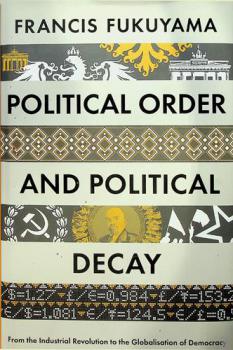
Political order and political decay : from the French Revolution to the present
In The Origins of Political Order, Francis Fukuyama took us from the dawn of mankind to the French and American Revolutions. Here, he picks up the thread again in the second instalment of his definitive account of mankind's emergence as a political animal. This is the story of how state, law and democracy developed after these cataclysmic events, how the modern landscape - with its uneasy tension between dictatorships and liberal democracies - evolved and how in the United States and in other developed democracies, unmistakable signs of decay have emerged. If we want to understand the political systems that dominate and order our lives, we must first address their origins - in our own recent past as well as in the earliest systems of human government. Fukuyama argues that the key to successful government can be reduced to three key elements: a strong state, the rule of law, and institutions of democratic accountability. This magisterial account is required reading for anyone wishing to know more about mankind's greatest achievements.
Book

Origin of the emergent fragile-to-strong transition in supercooled water
Liquids can be broadly classified into two categories, fragile and strong ones, depending on how their dynamical properties change with temperature. The dynamics of a strong liquid obey the Arrhenius law, whereas the fragile one displays a super-Arrhenius law, with a much steeper slowing down upon cooling. Recently, however, it was discovered that many materials such as water, oxides, and metals do not obey this simple classification, apparently exhibiting a fragile-to-strong transition far above T
g. Such a transition is particularly well known for water, and it is now regarded as one of water’s most important anomalies. This phenomenon has been attributed to either an unusual glass transition behavior or the crossing of a Widom line emanating from a liquid–liquid critical point. Here by computer simulations of two popular water models and through analyses of experimental data, we show that the emergent fragile-to-strong transition is actually a crossover between two Arrhenius regimes with different activation energies, which can be naturally explained by a two-state description of the dynamics. Our finding provides insight into the fragile-to-strong transition observed in a wide class of materials.
Journal Article