
Catalogue Search | MBRL


Are you sure you want to remove the book from the shelf?

{{itemTitle}}
234
result(s) for
"Stateless persons."
Sort by:


Stateless
A captivating auto-ethnography and study of
statelessness. \"In the springtime of the year that I
was twenty-one, I found myself stuck at the border between two
familiar countries, unable to enter either. I had never felt my
statelessness so keenly.\" Japan's 1971 termination of
diplomatic ties with the Republic of China left 9,200 Chinese
residents stateless. Tienshi \"Lara\" Chen was one of them, born to
Chinese parents in Yokohama's Chinatown. What does it mean to be
stateless? What does it feel like? To answer, Stateless
presents Chen's engaging autobiographical account of her
bi-cultural upbringing and Japanese education. She reflects on her
experience of statelessness eventually led her into a career
spanning academia and activism, and she analyzes the contradictions
inherent in the concepts of nationality, nation-state, and
citizenship, in a world where individual nationality, identity, and
experience are increasingly complex. She concludes that the current
system of regulating individuals with citizenship is unworkable in
the long run. Blending life writing, auto-ethnography, and a study
of stateless communities around Asia, this book unpacks the idea of
citizenship by showing the hidden everyday narratives and lived
experiences of stateless persons who have no legal ties to any
nation-state. Originally published in Japanese, this adapted and
updated English edition critically engages with questions of
borders, mobility, belonging, and identity.
eBook

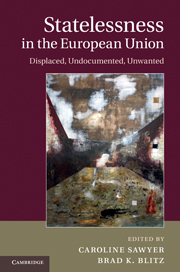
Statelessness in the European Union
Statelessness in the European Union draws together original research from over one hundred interviews in Estonia, France, Slovenia and the United Kingdom to provide one of the first comparative accounts of the de facto or de jure stateless populations in the European Union. It blends legal, political and empirical research to examine how non-citizens without secure status, in some cases established undocumented migrants and their descendants, manage their lives in four European Union member states. Normative and legal analyses of the practical meaning of basic human rights are combined with a groundbreaking investigation of the obstacles that prevent people from accessing essential services. Contrasting the situation of Europe's stateless now with that examined by Arendt over fifty years ago, it considers proposals for the future security of Europe's stateless people.
eBook

Nationality and statelessness under international law
\"Written by leading experts, Nationality and Statelessness under International Law introduces the study and practice of 'international statelessness law' and explains the complex relationship between the international law on nationality and the phenomenon of statelessness. It also identifies the rights of stateless people, outlines the major legal obstacles preventing the eradication of statelessness and charts a course for this new and rapidly changing field of study\"-- Provided by publisher.
Book
Protecting stateless persons : the implementation of the Convention Relating to the Status of the Stateless Persons across EU states
In Protecting Stateless Persons: The Implementation of the Convention Relating to the Status of Stateless Persons across EU States, Katia Bianchini offers a study of legislation, case-law and decision-making concerning the protection of stateless persons in ten EU Member States.
eBook

Statelessness and Citizenship
What does it mean to be a citizen? In depth research with a stateless population in Bangladesh has revealed that, despite liberal theory's reductive vision, the limits of political community are not set in stone. The Urdu-speaking population in Bangladesh exemplify some of the key problems facing uprooted populations and their experience provides insights into the long term unintended consequences of major historical events. Set in a site of camp and non-camp based displacement, it illustrates the nuances of political identity and lived spaces of statelessness that Western political theory has too long hidden from view. Using Bangladesh as a case study, Statelessness and Citizenship: Camps and the creation of political space argues that the crude binary oppositions of statelessness and citizenship are no longer relevant. Access to and understandings of citizenship are not just jurally but socially, spatially and temporally produced.
Unpicking Agamben's distinction between 'political beings' and 'bare life', the book considers experiences of citizenship through the camp as a social form. The camps of Bangladesh do not function as bounded physical or conceptual spaces in which denationalized groups are altogether divorced from the polity. Instead, citizenship is claimed at the level of everyday life, as the moments in which formal status is transgressed. Moreover, once in possession of 'formal status' internal borders within the nation-state render 'rights-bearing citizens' effectively 'stateless', and the experience of 'citizens' is very often equally uneven. While 'statelessness' may function as a cold instrument of exclusion, certainly, it is neither fixed nor static; just as citizenship is neither as stable nor benign as the dichotomy would suggest. Using these insights, the book develops the concept of 'political space' - an analysis of the way history and space inform the identities and political subjectivity available to people. In doing so,
eBook

The 'Poe cases': Preventing statelessness for foundlings in the Philippines
Philippine Senator, Grace Poe, is a foundling. Due to her status as a foundling, the question of whether Senator Poe was a natural-born citizen was raised in the Supreme Court of the Philippines ('the Supreme Court'), as the Philippine Constitution provides that only natural-born citizens may run for national government offices. Natural-born citizens are those who are citizens of the Republic of the Philippines ('the Philippines') from birth without having to perform any act to acquire or perfect their Philippine citizenship. Hence, the status of Senator Poe's citizenship was crucial in determining whether she could run for national office.
Journal Article
Statelessness and the recognition of the right to have rights in Germany
'This means I will die as undetermined,' a Statefree community member said during a recent discussion about the structural barriers stateless people face trying to access the right to nationality in Germany. Statefree, a non-profit organisation dedicated to the empowerment of stateless people, had organised a 'Community Lab' in which participants discussed the recently announced proposal to reform German citizenship law. Community members affected by statelessness came together to discuss the implications of these reforms, highlighting the lack of consideration of stateless people in the reform. Echoing the opening quote in this piece, participants discussed the many barriers to meeting the requirements for naturalisation, especially due to the difficulty of being recognised as stateless in the first place. This struggle for recognition is the result of intersecting structural issues, such as the absence of a dedicated statelessness determination procedure and the extensive use of the administrative classification 'undetermined nationality' in Germany. The lack of information and awareness about statelessness on the part of administrative officials adds to the widespread misidentification of stateless people. As a result, more and more stateless people find themselves stuck in a legal limbo produced by being recorded as having an undetermined nationality. This commentary provides an overview of statelessness in Germany and discusses Statefree’s community-informed advocacy work. It argues that it is crucial to look at what statelessness means in practice and to attend to the intersectional effects of statelessness. This leads to an understanding that, following Hannah Arendt’s argument that citizenship concerns ‘the right to have rights’, being stateless in Germany also concerns the struggle over the recognition of the right to have rights. Since many other rights depend on the state’s formal recognition of a person’s statelessness, it is crucial to drive advocacy work on the rights of all stateless people and those at risk of it, independent of whether they are formally recognised as stateless or not.
Journal Article