
Catalogue Search | MBRL


Are you sure you want to remove the book from the shelf?

{{itemTitle}}
81,284
result(s) for
"States, Small"
Sort by:


Small states in world politics
Small states are survival artists. Understanding the story of small state survival requires a clear focus on the international states system. This book finds that different variations of the Westphalian states system had very different effects on small state survival. The most hostile environment for the small state was the late nineteenth-century concert system; the most supportive environment was the bipolar world of the later twentieth century. The book investigates the era of the classic balance of power which began after the end of the Thirty Years' War in 1648 and ended during the French Revolutionary Wars and the reign of Napoleon Bonaparte. Surprisingly, the crude balance-of-power system of the eighteenth century proved fairly accommodating of small state survival. Looking to the future, a modest rise in the number of small states can be predicted. The book views international relations since at least the mid seventeenth century to be driven by concerns over state power. Consequently, it deals with power, weakness, and power politics. To do so properly, a theoretical framework was needed that puts power and power balancing front and center. Power and power politics are important concepts in the academic discipline of International Relations theory, and particularly in Realist thinking.
eBook

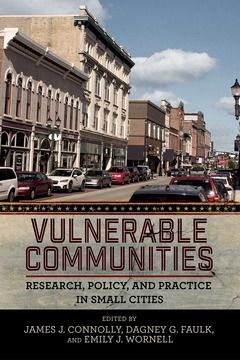
Vulnerable Communities
Vulnerable Communities
examines the struggles of smaller cities in the United
States, those with populations between 20,000 and 200,000.
Like many larger metropolitan centers, these places are confronting
change within a globalized economic and cultural order. Many of
them have lost their identities as industrial or commercial centers
and face a complex and distinctive mix of economic, social, and
civic challenges. Small cities have not only fewer resources but
different strengths and weaknesses, all of which differentiate
their experiences from those of larger communities.
Vulnerable Communities draws together scholars from a
broad range of disciplines to consider the present condition and
future prospects of smaller American cities. Contributors offer a
mix of ground-level analyses and examinations of broader
developments that have impacted economically weakened communities
and provide concrete ideas for local leaders engaged in
redevelopment work. The essays remind policy makers and academics
alike that it is necessary to consider cultural tensions and
place-specific conflicts that can derail even the most well-crafted
redevelopment strategies prescribed for these communities.
eBook

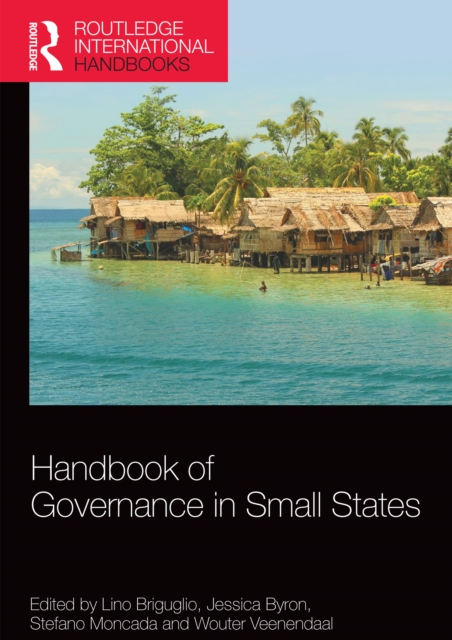
Handbook of Governance in Small States
This volume covers a wide spectrum of governance issues relating to small states in a global context. While different definitions of governance are given in the chapters, most authors associate governance with the setting and implementation of policies aimed at managing a country or territory, and with the related institutional structures and interventions by political actors. Generally, good governance is associated with concepts such as policy effectiveness, accountability, transparency, control of corruption, encouragement of citizens' voice and gender equality-factors which are, in turn, linked with democracy. What emerges from the book is that the societies of small states are being re-shaped by various forces outside their control, including the globalization process and climate change, rendering their governance ever more complex. These problems are not solely faced by small states, but small country size tends to lead to a higher degree of exposure to external factors.
The chapters are grouped into four sections broadly covering political, environmental, social and economic governance. Governance is influenced by many, often intertwined, factors; the division of the book into four parts therefore does not detract from the fact that governance is multifaceted, and such division was based on the primary focus of each particular study and its main disciplinary background. The expert authors have, moreover, used a variety of approaches in the studies, the subject of small states being well suited to scholarly work from different disciplines using qualitative, quantitative and mixed approaches to arrive at useful conclusions.
eBook

A paradise of small houses : the evolution, devolution, and potential rebirth of urban housing
\"From the Haitian-style \"shotgun\" houses of the 19th century to the lavish high-rises of the 21st century, a walk through the streets of America's neighborhoods that reveals the rich history-and future-of urban housing\"-- Provided by publisher.
Book

Small States in the International System
Small States in the International System addresses the little understood foreign policy choices of small states. It outlines a theoretical perspective of small states that starts from the assumption that small states are not just large states writ small. In essence, small states behave differently from larger and more powerful states. As such, this book compares three theories of foreign policy choice: realism (and its emphasis on structural factors), domestic factors, and social constructivism (emphasizing norms and identity) across seven focused case studies from around the world in the 20th Century. Through an examination of the foreign policy choices of Switzerland, Ireland, Finland, Norway, the Netherlands, Belgium, Ethiopia, Somalia, Vietnam, Bolivia and Paraguay, this book concludes that realist theories built on great power politics cannot adequately explain small state behavior in most instances. When small states are threatened by larger, belligerent states, the small state behaves along the predictions of social constructivist theory; when small states threaten each other, they behave along realist predictions.
eBook


The Foreign Policy of Small Caribbean States Towards China in the Cold War Era: Looking Past the Veiling
Conventional wisdom suggests that small states’ foreign policies are constrained in several ways. These may be confined to size, material resources, geopolitical positioning and limited participation in inter-state affairs. Yet, despite their diminutiveness, small Caribbean states appeared to have acted with surprising dynamism in seeking to promote and uphold relations with China in an unlikely period, the bipolar era. Drawing from official records of their interactions and other documentary sources, these states showed themselves to be quite willing to transcend their various limitations and become rather active participants on issues aligning with their interests in the international sphere. This paper examines how policy-making between the Caribbean region and China unfolded and why it evolved the way it did. It argues that acting through the more ideational context of the Cold War era, policymakers within the Caribbean region implemented strategies and policies premised on shared ideals of Third World solidarity to further relations with China. In embarking on this analysis, two main contributions are envisaged. First, the paper addresses the knowledge gap on small Caribbean states’ foreign policy decision-making vis-_a-vis China in the Cold War era. Second, interrogating the dynamic provides a unique opportunity to challenge the received wisdom on small states’ foreign policy behavior in line with an emphasis on small states agency amidst internal and international constraints.
Journal Article