
Catalogue Search | MBRL


Are you sure you want to remove the book from the shelf?

{{itemTitle}}
113
result(s) for
"Storytelling Data processing."
Sort by:

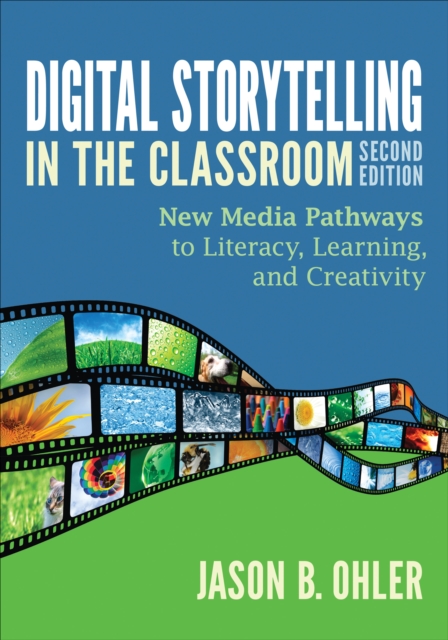
Digital storytelling in the classroom : new media pathways to literacy, learning, and creativity
This text shows how to integrate storytelling into curriculum design and use the principles of storytelling as a measurement of learning and literacies. It also covers important copyright and fair use information, and offers numerous implementation tips, concrete examples, and illustrative video clips. Aimed at primary and secondary teachers, the book is designed to help them: Teach their students to create digital stories that employ effective principles of storytelling, technology application, and media technique.; Use digital storytelling as a tool to promote the development of emerging literacies, such as digital and media literacy, as well as traditional literacies, such as reading, writing, speaking, and art.; Help students use digital storytelling as an academic tool to explore content and to communicate what they understand.; Understand the importance of combining the power of story and critical thinking as an approach to teaching and learning.
eBook


Moviemaking in the Classroom
Written by an award-winning classroom teacher with years of experience integrating moviemaking into curriculum, this book offers quick-start lesson plans for any content area and grade level, helping students amplify their voices and effect change through moviemaking.
eBook

Storytelling with Image Data: A Systematic Review and Comparative Analysis of Methods and Tools
In our digital age, data are generated constantly from public and private sources, social media platforms, and the Internet of Things. A significant portion of this information comes in the form of unstructured images and videos, such as the 95 million daily photos and videos shared on Instagram and the 136 billion images available on Google Images. Despite advances in image processing and analytics, the current state of the art lacks effective methods for discovering, linking, and comprehending image data. Consider, for instance, the images from a crime scene that hold critical information for a police investigation. Currently, no system can interactively generate a comprehensive narrative of events from the incident to the conclusion of the investigation. To address this gap in research, we have conducted a thorough systematic literature review of existing methods, from labeling and captioning to extraction, enrichment, and transforming image data into contextualized information and knowledge. Our review has led us to propose the vision of storytelling with image data, an innovative framework designed to address fundamental challenges in image data comprehension. In particular, we focus on the research problem of understanding image data in general and, specifically, curating, summarizing, linking, and presenting large amounts of image data in a digestible manner to users. In this context, storytelling serves as an appropriate metaphor, as it can capture and depict the narratives and insights locked within the relationships among data stored across different islands. Additionally, a story can be subjective and told from various perspectives, ranging from a highly abstract narrative to a highly detailed one.
Journal Article

Storytelling with data
Don't simply show your data--tell a story with it!Storytelling with Data teaches you the fundamentals of data visualization and how to communicate effectively with data.You'll discover the power of storytelling and the way to make data a pivotal point in your story.
eBook

A Visual Data Storytelling Framework
While the consumption of visual information becomes a daily commodity integrated into our lives, data visualisation is dominated by dashboards and charts. The main contribution of this article is an advanced way to visualise data as a data story. We converged paradigms from digital storytelling, serious games, and data visualisation to turn data into useful insights. The creation, management, and analysis of data have been increasingly given more attention in industry and professional practices. However, the potential of packaging data and analytic results into easily digestible and visually explorable content intended for non-professional audiences has not yet been investigated to its full extent. We contributed towards overcoming the gap between data analytics and data presentation. By integrating a story-like environment and entertainment into data visualisation, we explore the possibilities of efficiently communicating data and insights to general audiences in a casual context. We present this modular approach to customising messages for visual data storytelling from an information and communication perspective, including a test prototype developed to illustrate our data storytelling framework.
Journal Article

What People “Like”: Analysis of Social Media Strategies Used by Food Industry Brands, Lifestyle Brands, and Health Promotion Organizations on Facebook and Instagram
Health campaigns have struggled to gain traction with young adults using social media, even though more than 80% of young adults are using social media at least once per day. Many food industry and lifestyle brands have been successful in achieving high levels of user engagement and promoting their messages; therefore, there may be lessons to be learned by examining the successful strategies commercial brands employ.
This study aims to identify and quantify social media strategies used by the food industry and lifestyle brands, and health promotion organizations across the social networking sites Facebook and Instagram.
The six most engaging posts from the 10 most popular food industry and lifestyle brands and six health promotion organizations were included in this study. A coding framework was developed to categorize social media strategies, and engagement metrics were collected. Exploratory linear regression models were used to examine associations between strategies used and interactions on Facebook and Instagram.
Posts from Facebook (143/227, 63.0%) and Instagram (84/227, 37.0%) were included. Photos (64%) and videos (34%) were used to enhance most posts. Different strategies were most effective for Facebook and Instagram. Strategies associated with higher Facebook interactions included links to purchasable items (beta=0.81, 95% CI 0.50 to 1.13, P<.001) featuring body image messages compared with food content (beta=1.96, 95% CI 1.29 to 2.64, P<.001), and where the content induced positive emotions (beta=0.31, 95% CI 0.04 to 0.57, P=.02). Facebook interactions were negatively associated with using pop culture (beta=-0.67, 95% CI -0.99 to -0.34, P<.001), storytelling (beta=-0.86, 95% CI -1.29 to -0.43, P<.001) or visually appealing graphics (beta=-0.53, 95% CI -0.78 to -0.28, P<.001) in their posts compared with other strategies. Posting relatable content was negatively associated with interactions on Facebook (beta=-0.29, 95% CI -0.53 to -0.06, P=.01), but positively associated on Instagram (beta=0.50, 95% CI 0.05 to 0.95, P=.03). Instagram interactions were negatively associated with weight loss (beta=-1.45, 95% CI -2.69 to -0.21, P=.02) and other content (beta=-0.81, 95% CI -1.57 to -.06, P=.04) compared with food content.
Health promotion professionals and organizations can improve engagement using positive messaging and tailoring posts appropriate for different social media channels.
Journal Article

Storytelling in online shops: the impacts on explicit and implicit user experience, brand perceptions and behavioral intention
PurposeThis paper examines in detail how the use of storytelling with parallax technology can influence the user experience (UX) in online shops as well as brand- and behavior-relevant variables. Furthermore, this study analyzes the causal relationships between UX, brand attitudes and brand-related behavioral intentions in terms of purchase intention and price premiums. Explicit and implicit paths of human information processing are considered.Design/methodology/approachA sample of 266 respondents completed a web-based experiment under two conditions (text-based vs parallax storytelling online shop). An existing and operational online shop was used. The causal relationships were assessed by using partial least squares structural equation modeling (PLS-SEM). To measure implicit information processing, a single category implicit association test was applied.FindingsBy applying the storytelling technique with parallax scrolling, the online shop increased visitors' UX on explicit and implicit information processing levels and increased the online shop's overall perceived attractiveness. Storytelling with parallax motion enables an efficient transmission of brand-related associations to consumers' minds, enhances their explicit and implicit brand attitudes and increases their willingness to pay a higher price. Moreover, this study provides empirical evidence on the effects of UX on brand-related measures by applying PLS-SEM and thus reveals a causal chain of effects from UX on online shop attractiveness, brand attitude and behavioral intentions. Again, explicit and implicit perceptions were considered.Originality/valueScience and practice are increasingly emphasizing that storytelling emotionalizes content, which facilitates effective communication and builds strong relationships with customers. Little evidence exists about its efficient implementation in an online shopping context and in fulfilling hedonic and pragmatic needs throughout the online journey. This study provides novel insights into managing online shoppers' UX, brand-related perceptions and behavioral intentions with the optimal use of techniques to implement storytelling. Furthermore, this is one of the first studies to holistically consider the human perception of online shops by drawing on theories and methods of psychology, marketing, consumer behavior, brand research and consumer neuroscience and considering explicit and implicit information processing in terms of hedonic and pragmatic UX and brand-related measures.
Journal Article

The human is the loop: new directions for visual analytics
Visual analytics is the science of marrying interactive visualizations and analytic algorithms to support exploratory knowledge discovery in large datasets. We argue for a shift from a ‘human in the loop’ philosophy for visual analytics to a ‘human is the loop’ viewpoint, where the focus is on recognizing analysts’ work processes, and seamlessly fitting analytics into that existing interactive process. We survey a range of projects that provide visual analytic support contextually in the sensemaking loop, and outline a research agenda along with future challenges.
Journal Article