
Catalogue Search | MBRL


Are you sure you want to remove the book from the shelf?

{{itemTitle}}
64
result(s) for
"Stowe, Harriet Beecher, 1811-1896 Criticism and interpretation."
Sort by:

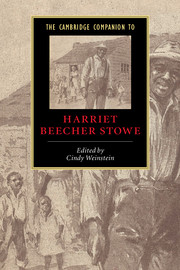
The Cambridge Companion to Harriet Beecher Stowe
The Cambridge Companion to Harriet Beecher Stowe establishes new parameters for both scholarly and classroom discussion of Beecher Stowe's writing and life. This collection of specially commissioned essays provides new perspectives on the frequently read classic Uncle Tom's Cabin, as well as on topics of perennial interest, such as Stowe's representation of race, her attitude to reform, and her relationship to the American novel. The volume investigates Stowe's impact on the American literary tradition and the novel of social change. Contributions also offer lucid and provocative readings that analyze Stowe's writings through a variety of contexts, including antebellum reform, regionalism, law and the protest novel. Fresh, accessible, and engaged, this is the most up to date introduction available to Stowe's work. The volume, which offers a comprehensive chronology of Stowe's life and a helpful guide to further reading, will be of interest to students and teachers alike.
eBook


Transatlantic Stowe
Uncle Tom’s Cabin broke publishing records and made Harriet Beecher Stowe in her time one of the world’s most famous authors. The book was a bestseller in Britain and was translated into some forty languages. Yet today Stowe tends to be seen wholly in the context of American literary history. Transatlantic Stowe: Harriet Beecher Stowe and European Culture is the first book to consider multiple aspects of Stowe’s career in an international context. The groundbreaking essays of Transatlantic Stowe examine the author’s literary and literal forays in Europe and the ways in which intellectual and cultural exchanges between the Old and New Worlds shaped her work. It was a crucial moment in the transatlantic discourse, a turning of the tide, and Stowe was among the first American novelists to be lionized in Europe---and pirated by publishers---in the same way that European writers had been treated in America.Blending historical and cultural criticism and drawing on fresh primary material from London and Paris, Transatlantic Stowe includes essays exploring Stowe’s relationship with European writers and the influence of her European travels on her work, especially the controversial travel narrative Sunny Memories of Foreign Lands and her “Italian novel\" Agnes of Sorrento.Interdisciplinary and itself transatlantic, the collection discusses visual art and material culture as well as literature and politics and includes contributions from Britain, Ireland, and the United States. Together these essays offer new interpretations of Stowe’s most popular novel as well as new readings of her many other works, illuminate the myriad connections between Stowe and European writers, and thus rewrite literary history by returning Stowe to the larger political, historical, and literary contexts of nineteenth-century Europe.
eBook

Formalism, experience, and the making of American literature in the nineteenth century
Theo Davis offers an account of the emergence of a national literature in the United States. She contends that Emerson, Hawthorne and Stowe's noted investigations of experience are actually based in a belief that experience is an abstract category governed by typicality, not the property of the individual subject.
BOOK

The Cambridge Introduction to Harriet Beecher Stowe
Through the publication of her bestseller Uncle Tom's Cabin, Harriet Beecher Stowe became one of the most internationally famous and important authors in nineteenth-century America. Today, her reputation is more complex, and Uncle Tom's Cabin has been debated and analysed in many different ways. This book provides a summary of Stowe's life and her long career as a professional author, as well as an overview of her writings in several different genres. Synthesizing scholarship from a range of perspectives, the book positions Stowe's work within the larger framework of nineteenth-century culture and attitudes about race, slavery and the role of women in society. Sarah Robbins also offers reading suggestions for further study. This introduction provides students of Stowe with a richly informed and accessible introduction to this fascinating author.
eBook

Beyond Uncle Tom's cabin
Ever since feminist scholarship began to reintroduce Harriet Beecher Stowe's writings to the American Literary canon in the 1970s, critical interest in her work has steadily increased. Rediscovery and ultimate canonization, however, have concentrated to a large extent on her major novelistic achievement, Uncle Tom's Cabin (1852). Only in recent years have critics begun to focus more seriously on the wide variety of her work and started to create knowledge that broadens our understanding. Beyond Uncle Tom's Cabin: The Writings of Harriet Beecher Stowe, edited by Sylvia Mayer and Monika Mueller, shows that during her long writing and publishing career, Stowe was a highly prolific writer who targeted diverse audiences, dealt with drastically changing economic, commercial, and cultural contexts, and wrote in a diversity of genres. Reflecting a recent trend to move Stowe's other texts to the fore, the essays collected in this volume thus go beyond the critical focus on Uncle Tom's Cabin. They focus on several of Stowe's other texts that have also significantly contributed to American literary and cultural history, among them her New England novels, her New York City novels, and her fictional writings on religious differences between Europe and the United States. The essays in the first part of Beyond Uncle Tom's Cabin concentrate on Stowe's language use, her rhetoric and choices of narrative technique and style, while the essays in the second part concentrate on thematic issues such as the representation of race, ethnicity, and religion, her participation in the emerging environmentalist movement, and Stowe's response to major economic shifts after the Civil War.
eBook


Women's Lives
Heilbrun looks at the biographies and memoirs of great women and reveals the ways in which feminism has changed our perceptions of their lives. Electronic Format Disclaimer: Excerpt from the poem \"Where Did I Leave Off\" by Virginia Hamilton Adair on pages 65-66 removed at the request of the rights holder.
eBook

Abolitionist Geographies
Traditional narratives of the period leading up to the Civil War are invariably framed in geographical terms. The sectional descriptors of the North, South, and West, like the wartime categories of Union, Confederacy, and border states, mean little without reference to a map of the United States. InAbolitionist Geographies, Martha Schoolman contends that antislavery writers consistently refused those standard terms.
Through the idiom Schoolman names \"abolitionist geography,\" these writers instead expressed their dissenting views about the westward extension of slavery, the intensification of the internal slave trade, and the passage of the Fugitive Slave Law by appealing to other anachronistic, partial, or entirely fictional north-south and east-west axes. Abolitionism's West, for instance, rarely reached beyond the Mississippi River, but its East looked to Britain for ideological inspiration, its North habitually traversed the Canadian border, and its South often spanned the geopolitical divide between the United States and the British Caribbean.
Schoolman traces this geography of dissent through the work of Martin Delany, Ralph Waldo Emerson, William Wells Brown, and Harriet Beecher Stowe, among others. Her book explores new relationships between New England transcendentalism and the British West Indies; African-American cosmopolitanism, Britain, and Haiti; sentimental fiction, Ohio, and Liberia; John Brown's Appalachia and circum-Caribbeanmarronage. These connections allow us to see clearly for the first time abolitionist literature's explicit and intentional investment in geography as an idiom of political critique, by turns liberal and radical, practical and utopian.
eBook