
Catalogue Search | MBRL


Are you sure you want to remove the book from the shelf?

{{itemTitle}}
27
result(s) for
"Strafrechtspflege."
Sort by:


Justice in America
As reactions to the O. J. Simpson verdict, the Rodney King beating, and the Amadou Diallo killing make clear, whites and African Americans in the United States inhabit two different perceptual worlds, with the former seeing the justice system as largely fair and color blind and the latter believing it to be replete with bias and discrimination. The authors tackle two important questions in this book: what explains the widely differing perceptions, and why do such differences matter? They attribute much of the racial chasm to the relatively common personal confrontations that many blacks have with law enforcement – confrontations seldom experienced by whites. More importantly, the authors demonstrate that this racial chasm is consequential: it leads African Americans to react much more cynically to incidents of police brutality and racial profiling, and also to be far more skeptical of punitive anti-crime policies ranging from the death penalty to three-strikes laws.
eBook
Sovereign power and the law in China
In China the coexistence of arbitrary detention and a transition towards a rule of law is either seen as an oxymoron, or as an aberration. This book analyses under-researched institutions and practices in China's criminal justice system, arguing that derogations from the rule of law constitute an organic component of the legal order. Hidden behind the law, there lies sovereign power, a power premised on the choice to handle certain issues through procedures that derogate from rights. This theoretically sophisticated study overcomes the current impasses in analyses of China's criminal justice. The result is an highly innovative reading of law and legality in the PRC, useful to scholars of contemporary China, mainstream political theorists, philosophers of law and policy makers.\"This important book heralds a new chapter in the comparative study of Chinese law and society...it presents and analyses a tremendous wealth of information, above all from contemporary Chinese sources...[the book] provides a new basis for deeper comparisons of the emerging Chinese 'reforming Leninist' model with the 'rule of law' and its suspension in Western countries.\" - Magnus Fiskesjö, Cornell University
eBook
Social work practice in the criminal justice system
Social Work Practice in the Criminal Justice System presents an overview of the criminal justice system for social workers, exploring the networks and institutions which comprise it. Integrating social work ethics and a commitment to social justice, this textbook explores social work practice roles to address social problems within the criminal justice system and promotes the development of knowledge, skills, and critical reflection in this increasingly important area of practice. In addition to covering the four key areas for social work practice - law enforcement, courts, corrections, and legislation, it covers police social work and forensic social work. This second edition has been updated to include: The opioid crisis and opioid courts Separate chapters describing special populations and contemporary issues in the criminal justice system Expanded criminal justice perspectives and theoretical frameworks. Examining the challenges and opportunities of social work practice in the criminal justice system, this is the ideal text for social work instructors, students, and practitioners working with or within the criminal justice system. Each chapter includes a summary of social work practice implications, key terms, and suggestions for further reading.
eBook

Handbook of transnational crime and justice
In this handbook, editors Philip Reichel and Jay Albanese bring together renowned scholars from around the world to offer various perspectives providing global coverage of the increasingly transnational nature of crime and the attempts to provide co-operative cross-national responses.
eBook
Comparative criminal justice and globalization
In this exciting and topical collection, leading scholars discuss the implications of globalisation for the fields of comparative criminology and criminal justice. How far does it still make sense to distinguish nation states, for example in comparing prison rates? Is globalisation best treated as an inevitable trend or as an interactive process? How can globalisation's effects on space and borders be conceptualised? How does it help to create norms and exceptions? The editor, David Nelken, is a Distinguished Scholar of both Law and Sociology.
eBook
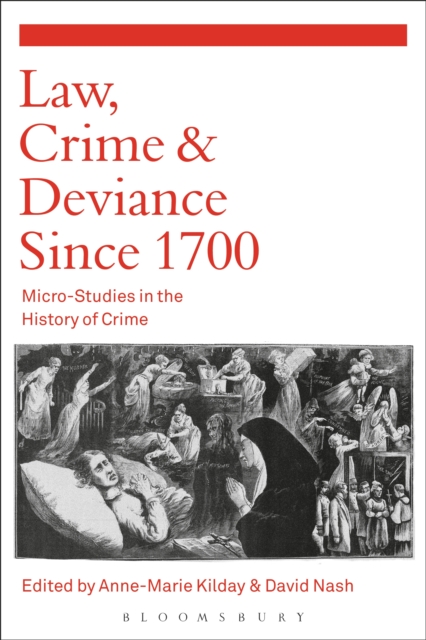
Law, Crime and Deviance since 1700
CHOICE Outstanding Academic Title 2017 Law, Crime and Deviance since 1700 explores the potential for the 'micro-study' approach to the history of crime and legal history. A selection of in-depth narrative micro-studies are featured to illustrate specific issues associated with the theme of crime and the law in historical context. The methodology used unpacks the wider historiographical and contextual issues related to each thematic area and facilitates discussion of the wider implications for the history of crime and social relations. The case studies in the volume cover a range of incidents relating to crime, law and deviant behaviour since 1700, from policing vice in Victorian London to chain gang narratives from the southern United States. The book concludes by demonstrating how these narratives can be brought together to produce a more nuanced history of the area and suggests avenues for future research and study.
eBook

Colonial Discourse and Gender in U.S. Criminal Courts
The occurrence in some criminal cases of \"cultural defenses\" on behalf of \"minority\" defendants has stirred much debate. This book is the first to illuminate how \"cultural evidence\" - i.e., \"evidence\" regarding ethnicity - is actually negotiated by attorneys, expert/lay witnesses, and defendants in criminal trials. Caroline Braunmühl demonstrates that this has occurred, overwhelmingly, in ways shaped by colonialist and patriarchal discourses common in the Western world. She argues that the controversy regarding the legitimacy of a \"cultural defense\" has tended to obscure this fact, and has been biased against minorities as well as all women from its inception, in the very terms in which the question for debate has been framed.
This study also breaks new ground by analyzing the strategies, and the failures, in which colonialist and patriarchal constructions of cultural evidence are resisted or - more commonly - colluded in by opposing attorneys, witnesses, and defendants themselves. The constructions at hand emerge as contradictory and unstable, belying the notion that cultural evidence is a matter of objective \"information\" about another culture, rather than - as Braunmühl argues - of discourses that are inevitably normatively charged.
Colonial Discourse and Gender in US Criminal Courts moves the debate about cultural defenses onto an entirely new plane, one based upon the understanding that only in-depth empirical analyses informed by critical, rigorous theoretical reflection can do justice to the irreducibly political character of any discussion of \"cultural evidence,\" and of its presentation in court.
eBook
Building Justice in Post-Transition Europe?
After the collapse of the Berlin wall in 1989 and disintegration of the Soviet Union, scholars focused on the problems of legal transitions within the newly emerging democracies. Two decades on, these states are in 'post-transition' conditions; having undergone and continuing to experience political, economic and constitutional upheavals to varying degrees. This book provides an interdisciplinary perspective on this largely unexamined topic.
Part I of the book sets the scene with a socio-historical overview and a theoretical chapter; both of which contextualise the book within current debates and provide the theoretical direction of the book as a whole. The later chapters set out contrasting perspectives and consist of themed essays on individual legal systems, investigating these through approaches ranging from socio-legal study to political economy. The book aims to refine important directions for the comparative conceptual study of criminal law policy and processes of criminalisation in emerging democratic states. The result is a significant contribution to the understanding of this subject in the fields of criminology, law, philosophy and political science.
The book will appeal to academics, policy-makers and practitioners who are attempting to grapple with the area of \"transitions\" in the fields of criminology, law, philosophy and political science. As a distinctively interdisciplinary text, it brings together analysis of both the social processes of creating (and abandoning) criminal law and a philosophical reflection. The book provides a comprehensive and critical analysis which points to future directions in criminalisation in the emerging democratic states of Eastern Europe.
eBook
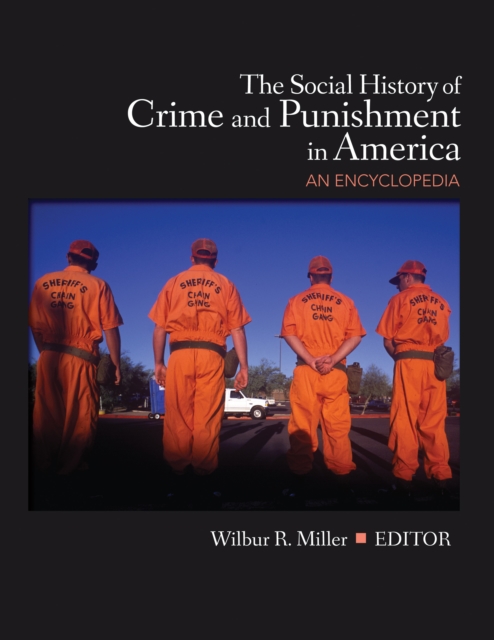
The social history of crime and punishment in America : an encyclopedia
Several encyclopedias overview the contemporary system of criminal justice in America, but full understanding of current social problems and contemporary strategies to deal with them can come only with clear appreciation of the historical underpinnings of those problems. Thus, this five-volume work surveys the history and philosophy of crime, punishment, and criminal justice institutions in America from colonial times to the present. It covers the whole of the criminal justice system, from crimes, law enforcement and policing, to courts, corrections and human services. Among other things, this encyclopedia will: explicate philosophical foundations underpinning our system of justice; chart changing patterns in criminal activity and subsequent effects on legal responses; identify major periods in the development of our system of criminal justice; and explore evolving debates and conflicts on how best to address issues of crime and punishment. Its signed entries provide the historical context for students to better understand contemporary criminological debates and the contemporary shape of the U.S. system of law and justice.
eBook