
Catalogue Search | MBRL


Are you sure you want to remove the book from the shelf?

{{itemTitle}}
3,262
result(s) for
"Structural analysis (Engineering) Mathematics."
Sort by:


Advanced modeling techniques in structural design
The successful design and construction of iconic new buildings relies on a range of advanced technologies, in particular on advanced modelling techniques. In response to the increasingly complex buildings demanded by clients and architects, structural engineers have developed a range of sophisticated modelling software to carry out the necessary structural analysis and design work.
Advanced Modelling Techniques in Structural Design introduces numerical analysis methods to both students and design practitioners. It illustrates the modelling techniques used to solve structural design problems, covering most of the issues that an engineer might face, including lateral stability design of tall buildings; earthquake; progressive collapse; fire, blast and vibration analysis; non-linear geometric analysis and buckling analysis . Resolution of these design problems are demonstrated using a range of prestigious projects around the world, including the Buji Khalifa; Willis Towers; Taipei 101; the Gherkin; Millennium Bridge; Millau viaduct and the Forth Bridge, illustrating the practical steps required to begin a modelling exercise and showing how to select appropriate software tools to address specific design problems.
eBook

Frameworks, tensegrities, and symmetry
\"This introduction to the theory of rigid structures explains how to analyze the performance of built and natural structures under loads, paying special attention to the role of geometry. The book unifies the engineering and mathematical literatures by exploring different notions of rigidity -- local, global, and universal -- and how they are interrelated. Important results are stated formally, but also clarified with a wide range of revealing examples. An important generalization is to tensegrities, where fixed distances are replaced with \"cables\" not allowed to increase in length and \"struts\" not allowed to decrease in length. A special feature is the analysis of symmetric tensegrities, where the symmetry of the structure is used to simplify matters and allows the theory of group representations to be applied. Written for researchers and graduate students in structural engineering and mathematics, this work is also of interest to computer scientists and physicists\"-- Provided by publisher.
Book

Static and Dynamic Analysis of Engineering Structures - Incorporating the Boundary Element Method
This book examines static and dynamic analysis of engineering structures for methodological and practical purposes. In one volume, the authors noted engineering experts provide an overview of the topic and review the applications of modern as well as classic methods of calculation of various structure mechanics problems. They clearly show the analytical and mechanical relationships between classical and modern methods of solving boundary value problems. The first chapter offers solutions to problems using traditional techniques followed by the introduction of the boundary element methods. The book discusses various discrete and continuous systems of analysis. In addition, it offers solutions for more complex systems, such as elastic waves in inhomogeneous media, frequency-dependent damping and membranes of arbitrary shape, among others. This book is filled with illustrative examples to aid in comprehension of the presented material.
eBook

Optimization and anti-optimization of structures under uncertainty
The volume presents a collaboration between internationally recognized experts on anti-optimization and structural optimization, and summarizes various novel ideas, methodologies and results studied over 20 years. The book vividly demonstrates how the concept of uncertainty should be incorporated in a rigorous manner during the process of designing real-world structures. The necessity of anti-optimization approach is first demonstrated, then the anti-optimization techniques are applied to static, dynamic and buckling problems, thus covering the broadest possible set of applications. Finally, anti-optimization is fully utilized by a combination of structural optimization to produce the optimal design considering the worst-case scenario. This is currently the only book that covers the combination of optimization and anti-optimization. It shows how various optimization techniques are used in the novel anti-optimization technique, and how the structural optimization can be exponentially enhanced by incorporating the concept of worst-case scenario, thereby increasing the safety of the structures designed in various fields of engineering.
eBook
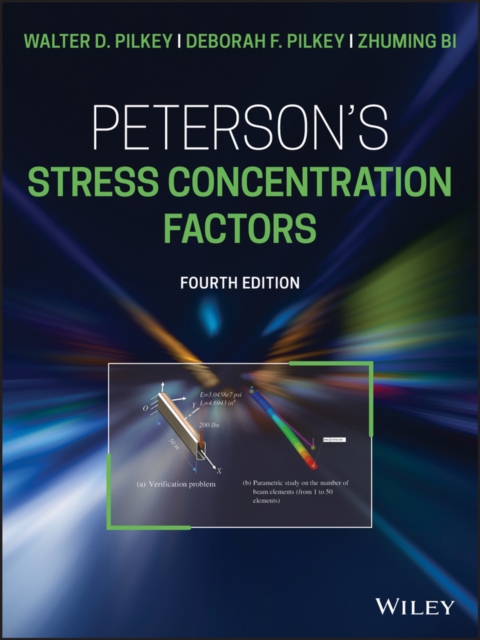
Peterson's Stress Concentration Factors (4th Edition)
This book establishes and maintains a system of data classification for all the applications of stress and strain analysis, and expedites their synthesis into CAD applications. Filled with all of the latest developments in stress and strain analysis, this Fourth Edition presents stress concentration factors both graphically and with formulas, and the illustrated index allows readers to identify structures and shapes of interest based on the geometry and loading of the location of a stress concentration factor. This book includes a thorough introduction of the theory and methods for static and fatigue design, quantification of stress and strain, research on stress concentration factors for weld joints and composite materials, and a new introduction to the systematic stress analysis approach using Finite Element Analysis (FEA). From notches and grooves to shoulder fillets and holes, readers will learn everything they need to know about stress concentration in one single volume.
eBook


Structural mechanics
Textbook covers the fundamental theory of structural mechanics and the modelling and analysis of frame and truss structures
* Deals with modelling and analysis of trusses and frames using a systematic matrix formulated displacement method with the language and flexibility of the finite element method
* Element matrices are established from analytical solutions to the differential equations
* Provides a strong toolbox with elements and algorithms for computational modelling and numerical exploration of truss and frame structures
* Discusses the concept of stiffness as a qualitative tool to explain structural behaviour
* Includes numerous exercises, for some of which the computer software CALFEM is used. In order to support the learning process CALFEM gives the user full overview of the matrices and algorithms used in a finite element analysis
eBook
The rayleigh-ritz method for structural analysis
A presentation of the theory behind the Rayleigh-Ritz (R-R) method, as well as a discussion of the choice of admissible functions and the use of penalty methods, including recent developments such as using negative inertia and bi-penalty terms. While presenting the mathematical basis of the R-R method, the authors also give simple explanations.
eBook
Analysis of structures : an introduction including numerical methods
Analysis of Structures offers an original way of introducing engineering students to the subject of stress and deformation analysis of solid objects, and helps them become more familiar with how numerical methods such as the finite element method are used in industry.
eBook