
Catalogue Search | MBRL


Are you sure you want to remove the book from the shelf?

{{itemTitle}}
33,174
result(s) for
"Student Responses"
Sort by:
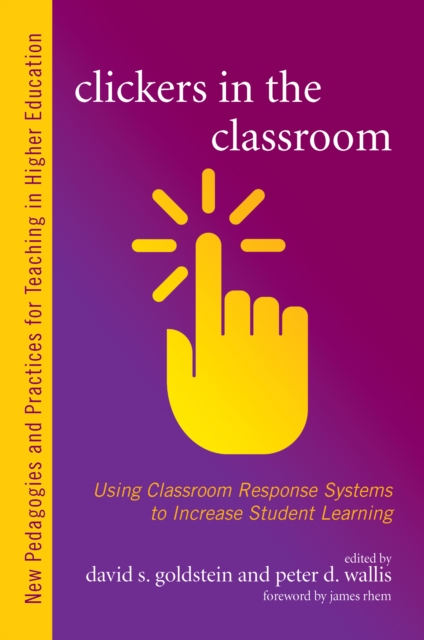
Clickers in the Classroom
With classroom response systems (or CRSs, also known as Student Response Systems, Individual Response Systems, or, informally, \"clickers\") in use in higher education for some 20 years, there is now both ample research and a wealth of examples and ideas to draw on for faculty who are contemplating their use, or exploring new ways to integrate them in their teaching.The research demonstrates that, integrated purposefully in courses, the use of clickers aligns with what neuroscience tells us about the formation of memory and the development of learning. In addition, they elicit contributions from otherwise reticent students and enhance collaboration, even in large lecture courses; foster more honest responses to discussion prompts; increase students' engagement and satisfaction with the classroom environment; and provide an instantaneous method of formative assessment.This book presents a brief history of the development of CRSs and a survey of empirical research to provide a context for current best practices, and then presents seven chapters providing authentic, effective examples of the use of clickers across a wide range of academic disciplines, demonstrating how they can be effective in helping students to recognize their misconceptions and grasp fundamental concepts.Like all pedagogical interventions, classroom response systems are no panacea, and the experienced contributors candidly describe avoidable pitfalls while demonstrating how clickers can deepen student learning and how, by providing instantaneous feedback, they enable teachers to make adjustments on the fly to better address student understandings or misunderstandings.The final chapter explores pros and cons of response systems that use mobile devices and smart phones, and the book concludes with an annotated list of further resources, such as books, articles, and videos.
eBook

Game-Based Versus to Non-Game-Based: The Impact of Student Response Systems on Students'Achievements, Engagements and Test Anxieties
The use of different tools in the field of education has become widespread with the developments in technology. Online student response systems are one of these tools. Online student response systems have been used for many years. In the last couple of years, game items have been added, and game-based online student response systems have started to be used. In this context, this study aims to find out the effects of online student response systems both with and without being based on games on the achievements, engagements, and test anxiety levels of students. The study group consists of 46 seventh grade students (Control, 23; Experimental, 23). This study was conducted by using a quasi-experimental design with pre-test and post-test groups. The topics in the \"living democracy\" chapter of social studies course were taught for four weeks by using the online student response system named Socrative for the control group and the online game-based student response system called Kahoot for the experimental group. The results of the study showed that game-based student response systems increase the achievement and engagement and decrease the test anxiety level when compared to non-game-based student response systems. In this direction, it may be suggested to use online game-based student response systems on different topics of social studies courses.
Journal Article

Effectiveness of student response systems in terms of learning environment, attitudes and achievement
In order to investigate the effectiveness of using Student Response Systems (SRS) among grade 7 and 8 science students in New York, the How Do You Feel About This Class? (HDYFATC) questionnaire was administered to 1097 students (532 students did use SRS and 565 students who did not use SRS). Data analyses attested to the sound factorial validity and internal consistency reliability of the HDYFATC, as well as its ability to differentiate between the perceptions of students in different classrooms. Very large differences between users and non-users of SRS, ranging from 1.17 to 2.45 standard deviations for various learning environment scales, attitudes and achievement, supported the efficacy of using SRS. [Author abstract]
Journal Article

Social media as a student response system : new evidence on learning impact
The ubiquitousness of social media renders it a potentially powerful tool in higher education. This study explores the use of Twitter as a tool to enhance active learning and improve feedback during large-sized lectures. Students in a final-year undergraduate accounting course at an Australian university engaged in Twitter-based synchronous activities, including answering in-lecture quizzes and posting questions. This study explores two key questions: (1) 'what encourages students to actively utilise social media in their learning process?' and (2) 'what pedagogical advantages are offered by social media in enhancing students' learning experiences?' Results of a student survey administered at the end of the course show that (1) students are more likely to participate in in-lecture Twitter activities if they are familiar with the technology, (2) Twitter activities encourage students to participate in active learning, (3) Twitter provides a platform enabling two-way student-instructor communication and (4) students find Twitter activities helpful regardless of whether they attend the lecture in real time or view online lecture recordings. These findings deepen our understanding of the pedagogical benefits of using Twitter as a student response system, which will assist educators to better harness the power of social media in the learning-teaching process. [Author abstract]
Journal Article

Using technology to make learning fun: technology use is best made fun and challenging to optimize intrinsic motivation and engagement
Educators have incorporated technologies designed to “gamify” or increase the fun and reward of classroom learning, but little is known about how these resources can be employed to create positive learning climates. Informed by self-determination theory (SDT), two experiments investigated a number of strategies teachers can use to frame one such technology, the student response system (SRS), when they use it as an educational tool to enhance its fun and contribution to positive learning environments. Participants (
n
= 30) in a pilot experiment were randomly assigned to a 2-month experiment that showed that using SRS versus non-technology-based learning increases academic well-being. A primary study (
n
= 120 students) experimentally manipulated the use of SRS with and without motivational framing strategies that were anticipated to enhance its effects, specifically by employing teamwork, friendly competition between students, and giving students a choice to participate. Results showed that motivational framing strategies enhanced students’ need satisfaction for autonomy (sense of choice), competence (sense of efficacy in relation to learning), relatedness (to others in the classroom), and academic well-being (interest and engagement). In short, the use of interactive technology and how it was implemented in class was vital for enhancing students’ learning outcomes.
Journal Article
Instructor strategies to aid implementation of active learning: a systematic literature review
BackgroundDespite the evidence supporting the effectiveness of active learning in undergraduate STEM courses, the adoption of active learning has been slow. One barrier to adoption is instructors’ concerns about students’ affective and behavioral responses to active learning, especially student resistance. Numerous education researchers have documented their use of active learning in STEM classrooms. However, there is no research yet that systematically analyzes these studies for strategies to aid implementation of active learning and address students’ affective and behavioral responses. In this paper, we conduct a systematic literature review and identify 29 journal articles and conference papers that researched active learning, affective and behavioral student responses, and recommended at least one strategy for implementing active learning. In this paper, we ask: (1) What are the characteristics of studies that examine affective and behavioral outcomes of active learning and provide instructor strategies? (2) What instructor strategies to aid implementation of active learning do the authors of these studies provide?ResultsIn our review, we noted that most active learning activities involved in-class problem solving within a traditional lecture-based course (N = 21). We found mostly positive affective and behavioral outcomes for students’ self-reports of learning, participation in the activities, and course satisfaction (N = 23). From our analysis of the 29 studies, we identified eight strategies to aid implementation of active learning based on three categories. Explanation strategies included providing students with clarifications and reasons for using active learning. Facilitation strategies entailed working with students and ensuring that the activity functions as intended. Planning strategies involved working outside of the class to improve the active learning experience.ConclusionTo increase the adoption of active learning and address students’ responses to active learning, this study provides strategies to support instructors. The eight strategies are listed with evidence from numerous studies within our review on affective and behavioral responses to active learning. Future work should examine instructor strategies and their connection with other affective outcomes, such as identity, interests, and emotions.
Journal Article

Student responses toward worksheets based on stem approach through project-based learning model
This study aims to determine student responses toward student worksheets based on the STEM approach through the PjBL model. The study was conducted on students of Class XI Science 4 at SMA Negeri 5 in Banda Aceh involving 27 students. The research method of the study used descriptive research which described student responses toward student worksheets based on the STEM approach through the PjBL model that has been previously developed. The data collection techniques utilized the student’s response questionnaire consisted of 10 statements and arranged using four alternative answers. The data processing of the research results used a Likert scale. Based on the result, the study obtained an average percentage of student responses of 85.09% with very good criteria. It showed that the students gave a positive response to student worksheets based on the STEM approach through the PjBL model.
Journal Article

Comparing science success of primary school students in the gamified learning environment via Kahoot and Quizizz
Gamification via Student Response Systems (SRSs) such as Kahoot and Quizizz has become an object of study for a large number of researchers around the world. This research aims to determine whether gamification via Kahoot and Quizizz contributes to developing a deeper conceptual understanding and retention of the contents of artificial terrestrial habitats taught to 3rd-grade primary school students. 72 students (9–10 years of age) are divided into the following groups: E1—learning with a Kahoot and E2—learning with a Quizizz. The results of the ANCOVA analysis showed that both Kahoot and Quizizz contribute to the development of both of these variables, with Kahoot doing so to a much greater extent compared to Quizizz, in terms of the development of a deeper conceptual understanding and the retention of the learned content at the level of reasoning. Kahoot proved significantly more efficient than Quizizz at this level, which is most likely related to the development and maintenance of student concentration during the implementation of the lesson. Gamification as a tool should be applied in science classes, where preference should be given to the Kahoot platform because it has a greater impact on the development of student concentration during the lesson.
Journal Article

Integrating Student Response Technology into a Large Undergraduate Course: Students’ Perceptions of their Motivations and Feedback
The purpose of this research was to explore how and in what ways students perceived the integration of student response technology, case studies, and discussions in a largely populated undergraduate course in management of human services at a large midwestern university affected their motivation, interest, and feedback. Qualitative data collection consisted of written artifacts (n = 56) and one-on-one interviews (n = 8). The qualitative findings showed that student response technology increased motivation and influenced learning with enjoyment, interest, and inclusion; and instructional feedback was perceived as immediate, constructive, and from various sources. In addition, a discussion, implications, and limitations are presented.
Journal Article

Enhancing student’s interactivity and responses in learning geometry by using augmented reality
This study investigates the impact of augmented reality (AR) applications on geometry learning among 56 eighth-grade students in Indonesia. Over four weeks, students were taught about basic three-dimensional figures such as cubes, rectangular cuboids, pyramids, and prisms using AR materials. We measured student interactivity and responses through observation and a questionnaire. The results showed a significant increase in student interactivity and overwhelmingly positive responses to the subject matter. A questionnaire revealed that students found AR materials satisfactory, easy to use, and helpful in concretizing abstract concepts. Most students expressed a desire to use AR applications in other subjects as well.
Journal Article