
Catalogue Search | MBRL


Are you sure you want to remove the book from the shelf?

{{itemTitle}}
13,713
result(s) for
"Students Economic conditions."
Sort by:


Choosing to labour?
Through a qualitative study of academic-track high school students and participants in youth apprenticeships in Germany and Canada, Lehmann shows how the range of available school-work transition options are defined by both gender and social class. Highlighting the importance of the institutional context in understanding school-work transitions, particularly in relation to Germany's celebrated apprenticeship system, which rests on highly streamed secondary schooling and a stratified labour market, Lehmann argues that social inequalities are maintained in part by the choices made by young people, rather than simply by structural forces.
eBook

Gauging the value of education for disenfranchised youth : flexible learning options
\"Disengagement of youth from schooling is an issue of significant national and international concern, and is a key driver of educational policy and reform that look to maximise school retention for the benefit of both students and the wider community. In Australia, Flexible Learning Options (FLOs) have arisen as a response to the premature disengagement from schooling of a sizeable number of Australian youth. FLOs attend to the educational, social and well-being needs of young people experiencing complex life circumstances, yet empirical evidence of their value to date has been largely anecdotal. The significance of this book lies in its innovative approach to gauging the value of FLOs--to young people themselves, as well as the wider Australian community. Drawing on past research and new findings from a national investigation, the authors provide novel insight into the pressures pushing young people out of schools and the mechanisms at work in FLOs to re-engage them in education. The varied contributions of this book elucidate many of the measurable impacts of FLOs on the life trajectories of disenfranchised youth, including improved economic integration, mental and emotional wellbeing, and myriad other outcomes. The significance of this project lies in its exploration of how young people and staff understand the transformative nature of the FLO experience, with an analysis that brings to light the wider value of this type of educational intervention in terms of long term community benefit\"-- Provided by publisher.
Book

Dangerous Writing
Building on recent work in rhetoric and composition that takes an historical materialist approach, Dangerous Writing outlines a political economic theory of composition. The book connects pedagogical practices in writing classes to their broader political economic contexts, and argues that the analytical power of students' writing is prevented from reaching its potential by pressures within the academy and without, that tend to wed higher education with the aims and logics of \"fast-capitalism.\" Since the 1980s and the \"social turn\" in composition studies and other disciplines, scholars in this field have conceived writing in college as explicitly embedded in socio-rhetorical situations beyond the classroom. From this conviction develops a commitment to teach writing with an emphasis on analyzing the social and political dimensions of rhetoric. Ironically, though a leftist himself, Tony Scott's analysis finds the academic left complicit with the forces in American culture that tend, in his view, to compromise education. By focusing on the structures of labor and of institutions that enforce those structures, Scott finds teachers and administrators are too easily swept along with the inertia of a hyper-commodified society in which students---especially working class students---are often positioned as commodities, themselves. Dangerous Writing, then, is a critique of the field as much as it is a critique of capitalism. Ultimately, Scott's eye is on the institution and its structures, and it is these that he finds most in need of transformation.
eBook


Storied Lives
During World War II over 5,500 young Japanese Americans left the concentration camps to which they had been confined with their families in order to attend college. Storied Lives describes often in their own words how nisei students found schools to attend outside the West Coast exclusion zone and the efforts of white Americans to help them. The book is concerned with the deeds of white and Japanese Americans in a mutual struggle against racism, and argues that Asian American studies indeed, race relations as a whole will benefit from an understanding not only of racism but also of its opposition, antiracism.
To uncover this little known story, Gary Okihiro surveyed the colleges and universities the nisei attended, collected oral histories from nisei students and student relocation staff members, and examined the records of the National Japanese American Student Relocation Council and other materials.
eBook

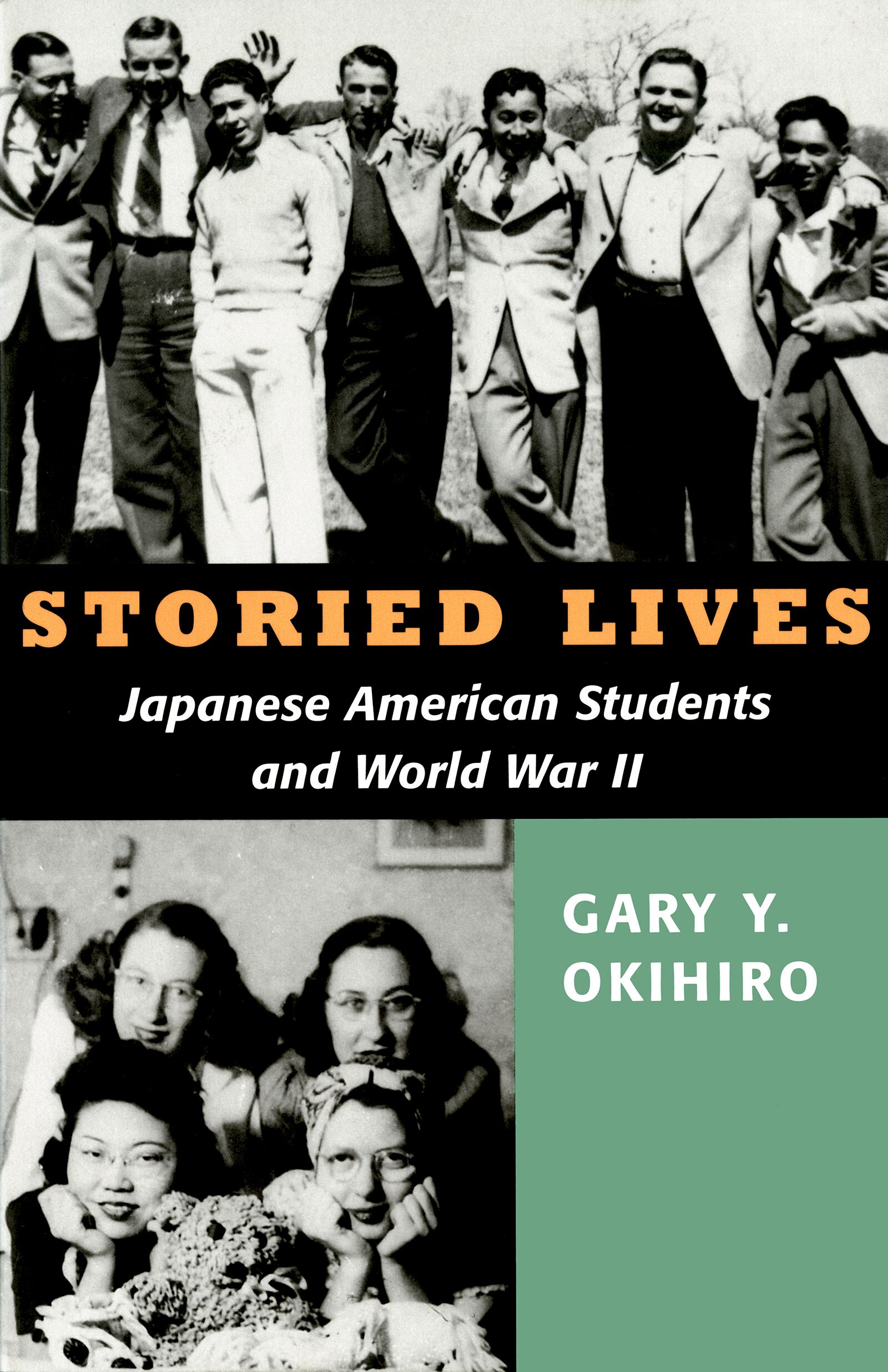
Storied Lives
During World War II over 5,500 young Japanese Americans left the concentration camps to which they had been confined with their families in order to attend college. Storied Lives describes—often in their own words—how nisei students found schools to attend outside the West Coast exclusion zone and the efforts of white Americans to help them. The book is concerned with the deeds of white and Japanese Americans in a mutual struggle against racism, and argues that Asian American studies—indeed, race relations as a whole—will benefit from an understanding not only of racism but also of its opposition, antiracism.To uncover this little known story, Gary Okihiro surveyed the colleges and universities the nisei attended, collected oral histories from nisei students and student relocation staff members, and examined the records of the National Japanese American Student Relocation Council and other materials.
eBook