Catalogue Search | MBRL


Are you sure you want to remove the book from the shelf?

{{itemTitle}}
12
result(s) for
"Subjectless constructions"
Sort by:

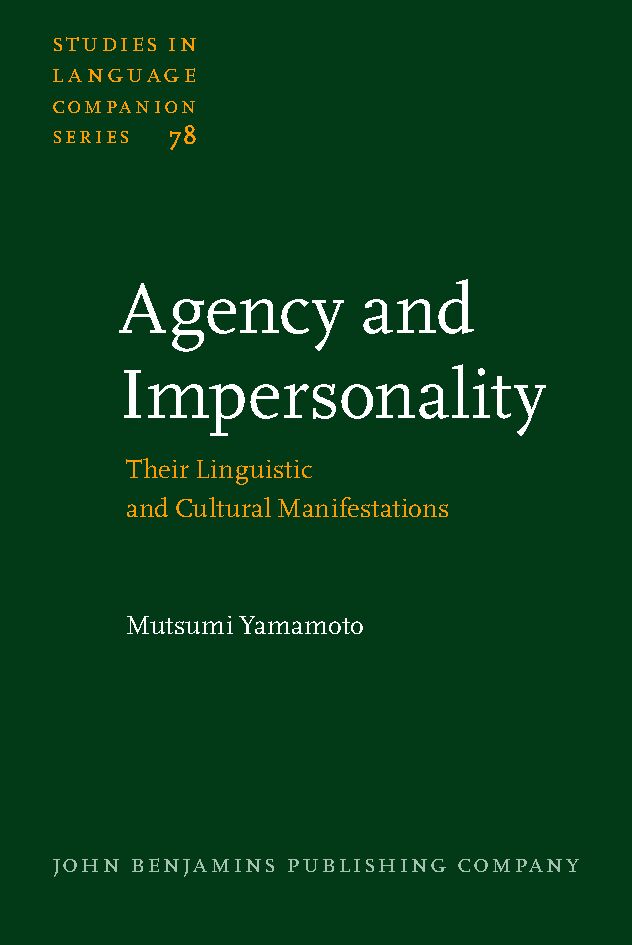
Agency and impersonality : their linguistic and cultural manifestations
In this monograph the author probes the fundamental nature of the concept of agency and its importance to human language and cognition. Whereas previous studies focused on grammatical manifestations this original work addresses such issues as the strong relationship between agency and responsibility, a philosophical interpretation of the concept of agency and a variety of epistemic attitudes towards agency that strongly influence our view of the world. Different cultures and languages process and express agency differently. To illustrate the co-relation between the linguistic expressions of agency and cultural stereotypes that lurk behind individual natural languages, the author analyses Japanese and English parallel corpora. It is shown that English tends to highlight agency in expressing actions and events, whereas Japanese largely obfuscates agency through impersonalising potential agents. Through the case studies on these languages this book sheds light on the close connection between language, thought and culture and contributes to the resurging interest in linguistic relativity.
eBook
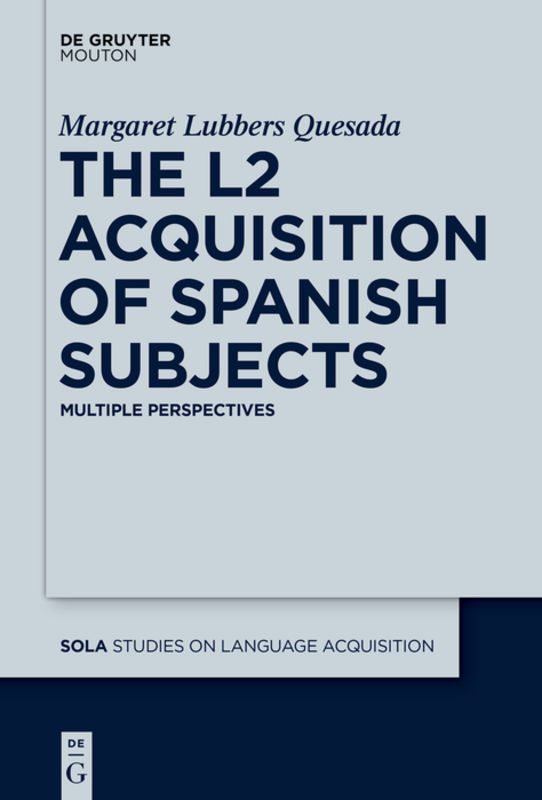
The L2 Acquisition of Spanish Subjects
There is a long overdue need to address the sharp philosophical and methodological divide between formal/generative and functional/discourse perspectives in contemporary theoretical linguistics and L2 acquisition. Language structure in general, and the use of subjects in particular, is dependent upon multiple syntactic, lexico-semantic, and discourse-pragmatic factors. Therefore, the study of L2 acquisition must be equally multi-faceted.
This volume examines data from over twenty years of research in the L2 acquisition of Spanish subjects from several theoretical perspectives, including generative approaches, processing theory, discourse-pragmatics and sociolinguistic-variationist models. By so doing, the author seeks to fulfill two principal objectives: the first is to determine the many linguistic and extra-linguistic properties of Spanish subjects that constrain their acquisition and use; and the second is to establish common ground among researchers from varied theoretical persuasions in acquisition studies. The author argues throughout the volume that central to native speaker use and L2 acquisition are universal properties ranging from highly specific syntactic principles to more general characteristics of human cognition and a range of these properties is responsible for language acquisition. An examination of the diverse body of research that considers a wider scope of universal properties of language can thus bring us closer to a unified account of the L2 acquisition of Spanish subject expression.
eBook

Impersonals and other Agent Defocusing Constructions in French
This book investigates French impersonals as a functional category. Any structure whose agent is defocused and whose predicate describes a situation stable enough to be generally available should be considered impersonal. In addition to il impersonals, the category also includes demonstrative (ce/ça), middle (se), and indefinite (on) structures. These different forms belong to the same functional category because they systematically code general and predictable events that cannot be imputed to a specific cause. Because generality and predictability are gradual notions, impersonals can only be identified within the context of specific constructional islands which therefore constitute the organizing principle of the French impersonal category.Conducted in Cognitive Grammar, the analysis follows the functional tradition in expanding the scope of French impersonals beyond il constructions, but also proposes a way of precisely delineating the category. This book will be of interest to anyone interested in impersonal constructions and French linguistics.
eBook

Impersonal \si\ constructions
This book is a research monograph on impersonal si constructions (ISC) in Italian within the Minimalist program framework. The book offers a new point of view on ISCs, providing a new set of crucial data that were previously unknown, and pointing out many characteristics of ISCs that were overlooked before. It results in the introduction of additional means of syntactic analysis at the edge between narrow syntax and pragmatics.
eBook

Impersonal constructions : a cross-linguistic perspective
In the four Pama-Nyungan languages Umpithamu, Morrobolam, Mbarrumbathama and Rimanggudinhma there is a core set of impersonals centred around experiencer object constructions. They describe involuntary physical processes, and are formally characterized by lack of nominative pronominal cross-reference, and optional absence of ergative agent nominals. In addition, systematic lack of nominative cross-reference is found in constructions with inanimate agents in all four languages, and in experienced action constructions in Umpithamu, in both cases with ergatively-marked nominals. It is argued that nominative cross-reference is the basic criterion for subject status, with ergative marking merely indicating agent status. Given the lack of any specific valency-changing morphology, impersonals with ergatively-marked nominals are functional equivalents of a voice mechanism, with agents demoted from subject status. This process has developed furthest in Umpithamu where the experienced action construction is systematically available as an alternative construal for a subset of transitive clauses. Keywords: impersonal; experiencer object; inanimate agent; passive; Umpithamu; Lamalamic.
eBook
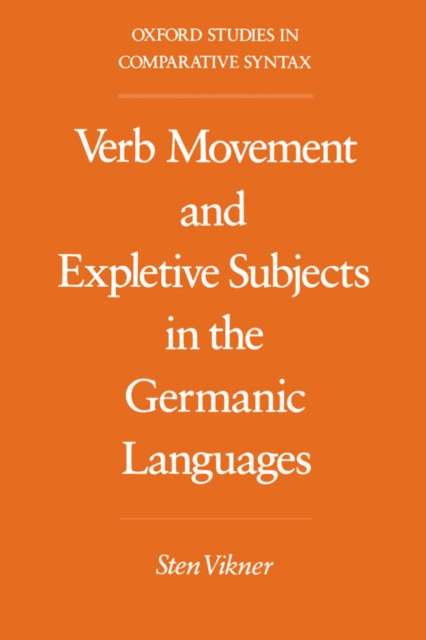
Verb Movement and Expletive Subjects in the Germanic Languages
This book is the study of two different kinds of variation across the Germanic languages. One involves the position of the finite verb, and the other the possible positions of the \"logical\" subject in constructions with expletive (or \"dummy\") subjects. The book applies the theory of principles and parameters (also known as the \"government-binding theory\") to the study of comparative syntax. Several languages are considered, including less frequently discussed ones like Danish, Faroese, Icelandic, and Yiddish.
eBook
Diachronic grammar : the history of Old and Middle English subjectless constructions
No detailed description available for \"Diachronic Grammar\".
eBook