
Catalogue Search | MBRL


Are you sure you want to remove the book from the shelf?

{{itemTitle}}
11,218
result(s) for
"Suburban Schools"
Sort by:


Political battles in suburbia
Media reports have shown suburban school officials being threatened and school board meetings erupting into chaos. Rachel S. White, Michael P. Evans, and Joel R. Malin examine whether these politically contentious experiences are occurring everywhere, or if there is something distinct about the contentiousness suburban superintendents face. Drawing on a national survey of superintendents, they asked: How do political experiences of rural, suburban, and urban superintendents differ? The results paint a bleak picture about the stresses of the superintendency, and the direct toll they have on some superintendents’ well-being. However, they also identify ways to support suburban superintendents as they face political challenges.
Journal Article

ATTENDANCE ZONES IN THE SUBURBS
While suburban schools across the country have become increasingly racially and economically diverse in recent decades, many remain highly segregated. School attendance zone boundaries (AZBs) play a critical role in shaping these patterns of within-district segregation. AZBs are especially important in suburban areas with growing and diversifying student populations. Using novel, longitudinal AZB data dating back to 1990, authors Sarah Asson, Erica Frankenberg, Christopher Fowler, and Ruth Krebs Buck studied the relationship between AZBs and segregation over time in three large suburban districts. They found AZB changes have not yet been realized as a force for desegregation. To do so will require more explicit action prioritizing racial and economic diversity.
Journal Article

The CRT culture war in the suburbs
The suburbs are on the frontlines of a politicized culture war with critical race theory (CRT) at its center. States are passing legislation censoring teachers and administrators from using CRT in schools. This war threatens the intellectual freedom of educators and school leaders. The voices of the teachers, especially teachers of color, are largely absent. Antony Farag shares his experiences on the front lines and provides strategies for teachers and school leaders to navigate this war. He suggests that educators need to be a unifying force and that they must not be limited by censorship laws taking away their intellectual freedoms.
Journal Article

Disillusioned : five families and the unraveling of America's suburbs
\"Through the stories of five American families, a masterful and timely exploration of how hope, history, and racial denial collide in the suburbs and their schools. Outside Atlanta, a middle-class Black family faces off with a school system seemingly bent on punishing their teenage son. North of Dallas, a conservative white family relocates to an affluent suburban enclave, but can't escape the changes sweeping the country. On Chicago's North Shore, a multiracial mom throws herself into an ultra-progressive challenge to the town's liberal status quo. In Compton, California, whose suburban roots are now barely recognizable, undocumented Hispanic parents place their gifted son's future in the hands of educators at a remarkable elementary school. And outside Pittsburgh, a Black mother buys a home on the same street where the author grew up, then confronts the destructive legacy left behind by white families like his. Education journalist Benjamin Herold's ability to braid these compelling human stories together with local and national history makes Disillusioned an astonishing reading experience, along with an urgent argument that America's suburbs and their schools are locked into a destructive cycle that has brought the country to a point of crisis. For generations, white families have reaped the benefits of massive federal investment in suburbia, then moved on as social and political infrastructure began to fail, leaving the mostly Black and brown families who follow to clean up the ensuing mess. Now, though, the suburbs are caught between rapidly shifting demographics and the reality that endless expansion is no longer feasible. Forced to confront truths that their communities were built to avoid, everyday suburban families find themselves at the center of the nation's most pressing debates: How do we repair America's divided communities? How do we build a future for all our children? In exploring these questions, Herold pulls back the curtain on suburban public schools and school boards, which he persuasively argues are the new ground zero in the fight for the country's future. Herold brings together research on the effects of racism on everyone with empathetic portrayals of families of wildly different backgrounds and perspectives. Nothing short of a journalistic masterpiece, Disillusioned brings readers face-to-face with the roots of America's discontent. Then, alongside the Black mother from his old neighborhood, who contributes a powerful epilogue to the book, Herold offers a hopeful path toward renewal\"-- Provided by publisher.
Book

Creating the Suburban School Advantage
Creating the Suburban School Advantage explains how American suburban school districts gained a competitive edge over their urban counterparts. John L. Rury provides a national overview of the process, focusing on the period between 1950 and 1980, and presents a detailed study of metropolitan Kansas City, a region representative of trends elsewhere.
While big-city districts once were widely seen as superior and attracted families seeking the best educational opportunities for their children, suburban school systems grew rapidly in the post-World War II era as middle-class and more affluent families moved to those communities. As Rury relates, at the same time, economically dislocated African Americans migrated from the South to center-city neighborhoods, testing the capacity of urban institutions. As demographic trends drove this urban-suburban divide, a suburban ethos of localism contributed to the socioeconomic exclusion that became a hallmark of outlying school systems. School districts located wholly or partly within the municipal boundaries of Kansas City, Missouri, make for revealing cases that illuminate our understanding of these national patterns.
As Rury demonstrates, struggles to achieve greater educational equity and desegregation in urban centers contributed to so-called white flight and what Senator Daniel Patrick Moynihan considered to be a crisis of urban education in 1965. Despite the often valiant efforts made to serve inner city children and bolster urban school districts, this exodus, Rury cogently argues, created a new metropolitan educational hierarchy-a mirror image of the urban-centric model that had prevailed before World War II. The stubborn perception that suburban schools are superior, based on test scores and budgets, has persisted into the twenty-first century and instantiates today's metropolitan landscape of social, economic, and educational inequality.
eBook
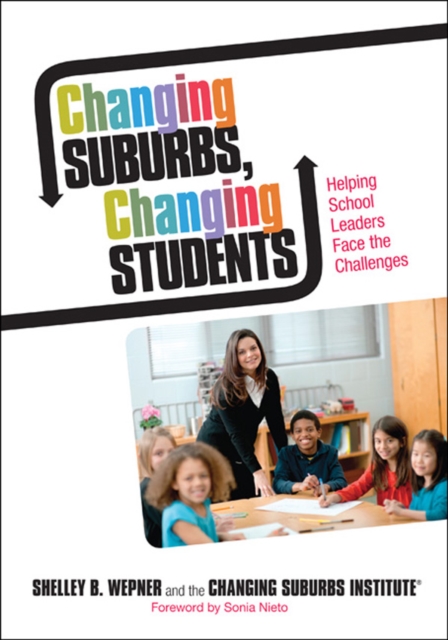
Changing suburbs, changing students
Embrace the changing suburbs by changing your school! As your students evolve, has your school evolved with them? Schools across the country face sweeping demographic changes and a reshaping of suburban scenery into a more urban landscape. This unique book offers not only an explanation of the increasing diversity in student makeup, but also ideas for acting as an agent of positive change for your school and tools to implement those ideas. Shelley Wepner and the experts at The Changing Suburbs Institute recommend ways you can improve student achievement by Developing a plan of action that addresses the need for more focused, culturally responsive student instruction Creating a culture that celebrates diversity and values cultural awareness Collaborating with universities and communities to promote professional development and student learning Providing programs for English learners such as tutoring, the arts, and summer support Involving parents to promote student achievement Effective teaching and engaged learning flourish in schools where diversity and awareness are embraced. Changing Suburbs, Changing Students puts education in suburban America into perspective and gives you the tools to maintain high achievement for all!
eBook

A Case Study on the Spatial Conceptualization Abilities for Sixth Grade Elementary Students from Urban, Suburban and Remote Schools
The main objective of this study was to investigate and compare the spatial conceptualization performance for sixth grade elementary school students from urban, suburban and remote schools in Taiwan. This study involved 27, 25, and 26 sixth grade students from one remote indigenous school in eastern Taiwan, one suburban indigenous school in northern Taiwan, and one urban Han Chinese school in northern Taiwan, respectively. Spatial ability assessments were carried out on the students to explore the spatial conceptualization abilities and the possible relationship between school children's spatial abilities and urban-rural, ethnic, and cultural diversities. The research tool utilized in this study was a scenario-based spatial ability assessment test, which had been carefully reviewed and pre-tested by experts. Test results revealed that: (1) Sixth grade students from the suburban and remote indigenous school shared no significant difference in their spatial abilities; (2) Sixth grade students from the urban Han Chinese school exhibited significantly better spatial performance than those from the suburban and remote indigenous schools. The spatial conceptualization performance for sixth grade elementary school students from urban, suburban and remote schools in Taiwan is different.
Journal Article