
Catalogue Search | MBRL


Are you sure you want to remove the book from the shelf?

{{itemTitle}}
8,135
result(s) for
"Subversive activities."
Sort by:

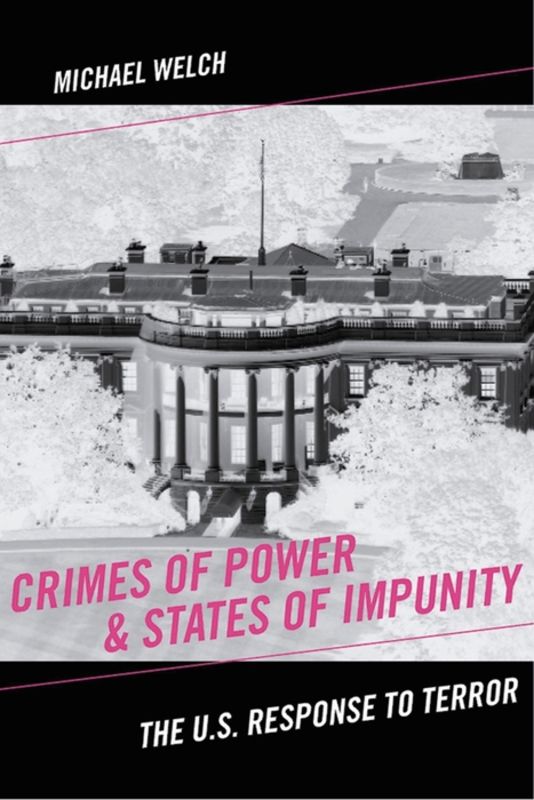
Crimes of Power & States of Impunity
Since 9/11, a new configuration of power situated at the core of the executive branch of the U.S. government has taken hold. In Crimes of Power & States of Impunity, Michael Welch takes a close look at the key historical, political, and economic forces shaping the country's response to terror.
Welch continues the work he began in Scapegoats of September 11th and argues that current U.S. policies, many enacted after the attacks, undermine basic human rights and violate domestic and international law. He recounts these offenses and analyzes the system that sanctions them, offering fresh insight into the complex relationship between power and state crime. Welch critically examines the unlawful enemy combatant designation, Guantanamo Bay, recent torture cases, and collateral damage relating to the war in Iraq. This book transcends important legal arguments as Welch strives for a broader sociological interpretation of what transpired early this century, analyzing the abuses of power that jeopardize our safety and security.
eBook

Illuminating the dark arts of war : terrorism, sabotage, and subversion in homeland security and the new conflict
Since 9/11, the dominant view is that we have entered an era of new conflict in which technology has empowered non-state actors who now pose unprecedented and unmanageable threats to U.S. national security. This unique work studies a range of threats, from homegrown and foreign terrorism to the possibility of cyber- or Chinese sabotage and fears of religious subversion to challenge every aspects of this new conflict argument and expose its underlying exaggerations and misunderstandings. Examining such issues as political violence, the role of religion in terrorism, the impact of technology, and the political aspects of homeland security, this unique survey demonstrates how such activities as terrorism are limited by their clandestine nature. It also addresses why we need to switch our strategic focus and increase the role citizens have in dealing with such threats.
Book

Karaoke Fascism
To come to Burma, one of the few places where despotism still dominates, is to take both a physical and an emotional journey and, like most Burmese, to become caught up in the daily management of fear. Based on Monique Skidmore's experiences living in the capital city of Rangoon, Karaoke Fascism is the first ethnography of fear in Burma and provides a sobering look at the psychological strategies employed by the Burmese people in order to survive under a military dictatorship that seeks to invade and dominate every aspect of life.Skidmore looks at the psychology and politics of fear under the SLORC and SPDC regimes. Encompassing the period of antijunta student street protests, her work describes a project of authoritarian modernity, where Burmese people are conscripted as army porters and must attend mass rallies, chant slogans, construct roads, and engage in other forms of forced labor. In a harrowing portrayal of life deep within an authoritarian state, recovering heroin addicts, psychiatric patients, girl prostitutes, and poor and vulnerable women in forcibly relocated townships speak about fear, hope, and their ongoing resistance to four decades of oppression.\"Karaoke fascism\" is a term the author uses to describe the layers of conformity that Burmese people present to each other and, more important, to the military regime. This complex veneer rests on resistance, collaboration, and complicity, and describes not only the Burmese form of oppression but also the Burmese response to a life of domination. Providing an inside look at the madness and the militarization of the city, Skidmore argues that the weight of fear, the anxiety of constant vulnerability, and the numbing demands of the State upon individuals force Burmese people to cast themselves as automata; they deliberately present lifeless hollow bodies for the State's use, while their minds reach out into the cosmos for an array of alternate realities. Skidmore raises ethical and methodological questions about conducting research on fear when doing so evokes the very emotion in question, in both researcher and informant.
eBook

The shadow war : inside Russia's and China's secret operations to defeat America
\"CNN's Chief National Security Correspondent reveals the invisible fronts of twenty-first century warfare and identifies the ongoing battles being waged -- often without the public's full knowledge -- from disinformation campaigns to advanced satellite weaponry. The United States is currently under attack from multiple adversaries -- yet most Americans have no idea of the dangers threatening us. In this eye-opening book, military and intelligence expert and seasoned reporter Jim Sciutto traces the expanding web of attacks that together amount to an undeclared but deeply dangerous war on America. With in-depth reporting from Ukraine to the South China Sea, Cuba to the earth's atmosphere, unprecedented access to America's Space Command, and new information from inside the intelligence agencies tracking election interference, Sciutto draws on his deep knowledge, high-level contacts, and personal experience as a journalist and diplomat to paint the most comprehensive and vivid picture of a nation targeted by a new and disturbing brand of warfare. America is engaged in a Shadow War on multiple fronts, with multiple enemies. The practitioners include America's most familiar adversaries: Russia, China, North Korea, and Iran. But unlike conventional warfare, these conflicts are conducted in the shadows, with no formal declaration and often use multiple sources, from influential businessmen and lawyers to hackers. And it is happening today. But America is adapting and fighting back. In The Shadow War, Sciutto introduces the dizzying array of soldiers, sailors, submariners and their commanders, space engineers, computer scientists, and civilians who are on the front lines of this new kind of forever war. Intensive and disturbing, this invaluable and important work opens our eyes and makes clear that future war is here.\" -- Provided by publisher.
Book
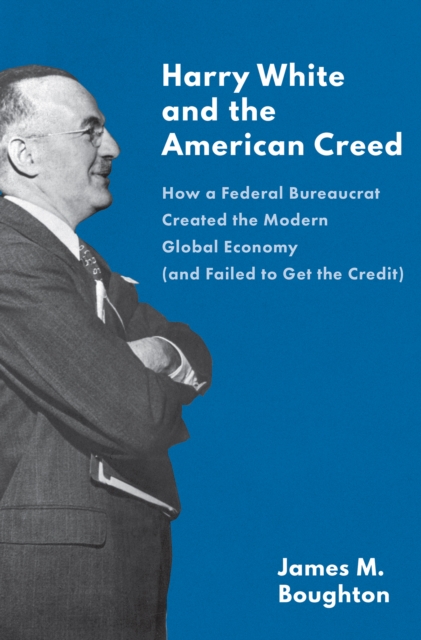
Harry White and the American Creed
The life of a major figure in twentieth‑century economic
history whose impact has long been clouded by dubious
allegations Although Harry Dexter White (1892-1948) was
arguably the most important U.S. government economist of the
twentieth century, he is remembered more for having been accused of
being a Soviet agent. During the Second World War, he became chief
advisor on international financial policy to Secretary of the
Treasury Henry Morgenthau, a role that would take him to Bretton
Woods, where he would make a lasting impact on the architecture of
postwar international finance. However, charges of espionage,
followed by his dramatic testimony before the House Un‑American
Activities Committee and death from a heart attack a few days
later, obscured his importance in setting the terms for the modern
global economy. In this book, James Boughton rehabilitates White,
delving into his life and work and returning him to a central role
as the architect of the world's financial system.
eBook

Whiskey tango foxtrot
\"The Committee, an international cabal of industrialists and media barons, is on the verge of privatizing all information. Dear Diary, an idealistic online Underground, stands in the way of that takeover, using radical politics, classic spycraft, and technology that makes Big Data look like dial-up. Into this secret battle stumbles an unlikely trio: Leila Majnoun, a disillusioned non-profit worker; Leo Crane, an unhinged trustafarian; and Mark Deveraux, a phony self-betterment guru who works for the Committee. Leo and Mark were best friends in college, but early adulthood has set them on diverging paths. Growing increasingly disdainful of Mark's platitudes, Leo publishes a withering takedown of his ideas online. But the Committee is reading -- and erasing -- Leo's words. On the other side of the world, Leila's discoveries about the Committee's far-reaching ambitions threaten to ruin those who are closest to her.\"--Publisher description.
BOOK

Underground Petersburg
Although the radical populist movement that arose in Russia during the reign of Tsar Alexander II has been well documented, this important study opens with questions that haven’t yet been addressed: How did Russian radical populists manage to carry out a three-year campaign of revolutionary violence, killing or wounding scores of people, including top government officials, and eventually taking the life of the tsar himself? And how did this all occur under the noses of the tsar’s political police, who deployed vast resources and huge numbers of officials in an exhaustive effort to stop the killing?
In Underground Petersburg , Christopher Ely argues that the most powerful weapon of populist terrorism was the revolutionary underground it created. Attempts to convey populist ideals in the public sphere met with resistance at every turn. When methods such as propaganda campaigns and street demonstrations failed, populists created a sophisticated urban underground. Linked to the newly discovered weapon of terrorist violence, this base of operations allowed them to live undetected in the midst of the city, produce their own weaponry, and attempt to ignite an insurrection through violent attacks—putting terrorism on the map as a technique of political rebellion.
Accessible to non-specialists, this insightful study reinterprets radical populism, clarifying its crucial place in Russian history and elucidating its contribution to the history of terrorism. Underground Petersburg will appeal to scholars and students of Russia, as well as those interested in terrorism and insurrectionary movements, urban studies, and the sociology of subcultures.
eBook

Transportation and revolt : pigeons, mules, canals, and the vanishing geographies of subversive mobility
\"Modes of transportation understood, by political regimes in different times and places, as intrinsically useful for clandestine movement, subversive mobility, and smuggling for revolt. Contents: Chapters look at canal transportation, several types of animal transportation (mules, elephants, camels and sled-dogs are all treated at some length), and inner-city freight-carrying infrastructure\"--Provided by publisher.
Book

U.S. intervention in British Guiana : a Cold War story
In the first published account of the massive U.S. covert intervention in British Guiana between 1953 and 1969, Stephen G. Rabe uncovers a Cold War story of imperialism, gender bias, and racism.When the South American colony now known as Guyana was due to gain independence from Britain in the 1960s, U.S. officials in the Kennedy and Johnson administrations feared it would become a communist nation under the leadership of Cheddi Jagan, a Marxist who was very popular among the South Asian (mostly Indian) majority. Although to this day the CIA refuses to confirm or deny involvement, Rabe presents evidence that CIA funding, through a program run by the AFL-CIO, helped foment the labor unrest, race riots, and general chaos that led to Jagan's replacement in 1964. The political leader preferred by the United States, Forbes Burnham, went on to lead a twenty-year dictatorship in which he persecuted the majority Indian population. Considering race, gender, religion, and ethnicity along with traditional approaches to diplomatic history, Rabe's analysis of this Cold War tragedy serves as a needed corrective to interpretations that depict the Cold War as an unsullied U.S. triumph.
eBook