
Catalogue Search | MBRL


Are you sure you want to remove the book from the shelf?

{{itemTitle}}
81
result(s) for
"Success in business United States Case studies."
Sort by:
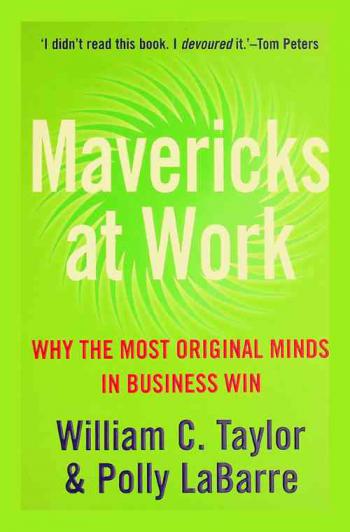
Mavericks at work : why the most original minds in business win
Presenting an incisive look at top business leaders - visionary and creative mavericks who are changing the way we do business, this title is ideal for anyone who wants to succeed in business, from the entry-level employee to the CEO.
Book

Women Entrepreneurs
First Published in 1998.Female entrepreneurs represent a rapidly growing element of corporate America, as evidenced in The National Women's Business Council's 1991 Annual Report to the President of the United States and Congress.
eBook

The working woman's handbook : ideas, insights, and inspiration for a successful, creatve career
\"It's the ultimate guide to job satisfaction, filled with practical advice on developing and driving a working life you love. Bursting with actionable tips, this book outlines an agenda for making and managing money, setting goals, and establishing success-oriented routines, with worksheets, exercises, and fool-proof \"how-to\" sections to help chart your course. From the lowdown on launching your own venture to a bullet-point checklist for an essential self-care regime, it will teach you to manage any dilemmas that crop up, and take the stress out of setting a budget. This no-nonsense manual comes packed with author Phoebe Lovatt's personal insights from her own career as a successful freelance journalist, moderator, and founder of The WW Club, the leading digital resource and global community for working women worldwide. It also includes words of wisdom from various creatives and industry leaders, such as Teen Vogue editor Elaine Welteroth, WAH Nails founder Sharmadean Reid, The Gentlewoman's Editor-in-Chief Penny Martin, and rising fashion designer Sandy Liang.Whether a first-time freelancer, budding businesswoman, or dedicated professional looking to enhance your prospects, The Working Woman's Handbook is a go-to career and lifestyle guide for ambitious young women everywhere.\"--Publisher's description.
Book

Getting to scale : growing your business without selling out
Jill Bamburg presents the first book to deal with a central issue for almost all small businesses: how to preserve one's values while simultaneously maintaining growth and competitiveness in the marketplace.
eBook

Communal Organizational Culture as a Source of Business-Success Sustainability in Kibbutz Industry—Two Case Studies
This article explored the source of the organizational success of two kibbutz factories. This stood in stark contrast with most kibbutz industries, which abandoned their cooperative and communal attributes and became hierarchical and bureaucratic. This movement away from founding principles was the result of the massive privatization process that the kibbutz movement had been undergoing since the 1990s. This research followed the case study approach, with a comparative analysis of the two kibbutz firms. The author interviewed fifty respondents and supplemented the data with document analysis. The findings in the two factories reflected their ability to assimilate capitalist features into their organizational culture while preserving much of their kibbutz nature, expressed in various cultural features. These factories preferred kibbutz members over outsiders and maintained much of the original organizational democracy and equality among managers and workers. In addition, the firms demonstrated concern for the well-being of all the workers. This mixture of expertise and professionalism, along with internal democracy, equity, and communal concern, could be an example for other factories seeking business success. One important theoretical implication of this research is that an organization whose members identify with their organizational roots can better achieve long-term business success. Finally, this article offers practical implications for managers seeking to design a strong organizational culture.
Journal Article

Assessing the role of education and financial literacy in shaping the success of spaza shops: Case study of Gamalakhe Township, KwaZulu-Natal, South Africa
BackgroundThis study examined how education influences financial literacy (FL) and subsequent business success among spaza shop owners in Gamalakhe Township, KwaZulu-Natal.AimThis study aimed to investigate whether the level of education is a significant factor in determining the FL skills needed to run spaza shop businesses by surveying 100 spaza shop owners.SettingThe study setting was Gamalakhe Township, KwaZulu-Natal.MethodsThe quantitative data were analysed via correlations and ordinal logistic regression.ResultsThe findings of descriptive statistics and correlations reveal that education significantly predicts FL levels, which in turn drives improved decision-making and business outcomes.ConclusionThe ordinal logistic regression revealed that education level influences the level of FL.ContributionThe findings emphasise the importance of developing experiential learning and mentorship programmes to address FL gaps among township entrepreneurs.
Journal Article

Balancing Mission and Margins: What Makes Healthy Community Food Stores Successful
Mission-driven, independently-owned community food stores have been identified as a potential solution to improve access to healthy foods, yet to date there is limited information on what factors contribute to these stores’ success and failure. Using a multiple case study approach, this study examined what makes a healthy community food store successful and identified strategies for success in seven community stores in urban areas across the United States. We used Stake’s multiple case study analysis approach to identify the following key aims that contributed to community store success across all cases: (1) making healthy food available, (2) offering healthy foods at affordable prices, and (3) reaching community members with limited economic resources. However, stores differed in terms of their intention, action, and achievement of these aims. Key strategies identified that enabled success included: (1) having a store champion, (2) using nontraditional business strategies, (3) obtaining innovative external funding, (4) using a dynamic sourcing model, (5) implementing healthy food marketing, and (6) engaging the community. Stores did not need to implement all strategies to be successful, however certain strategies, such as having a store champion, emerged as critical for all stores. Retailers, researchers, philanthropy, and policymakers can utilize this definition of success and the identified strategies to improve healthy food access in their communities.
Journal Article

The role of a Proof of Concept Center in a university ecosystem: an exploratory study
The Proof of Concept phase in university technology transfer is considered to be critical for the success of both licensing and the creation of spin-off companies. In the United States, Proof of Concept Centers are emerging as successful structures to address the challenges of this phase. In this paper, we present a framework to assess the role for such a structure in a university ecosystem. The framework is built from previous references that we use to explicitly link the features of Proof of Concept Centers with the challenges of the Proof of Concept phase, and establish their specific contributions to the overall technology commercialization efforts of a university. We illustrate the application of this framework in a case study of the University of Coimbra, in Portugal, and develop a characterization that is representative of the role that a Proof of Concept Center can play in comparable university ecosystems that feature conventional technology commercialization structures, and struggle with the challenges of the Proof of Concept phase. Our study suggests that there is in fact a possible role for a Proof of Concept Center in the regional ecosystem of the University of Coimbra, with a potentially very relevant impact in the technology commercialization process, through networking outside academia and research environments, funding of Proof of Concept activities, and technology entrepreneurship education for the development of entrepreneurial skills for researchers.
Journal Article

An inquiry into born-global firms in Europe and the USA
Companies that internationalise at or near their founding, \"born globals,\" are emerging in great numbers world-wide. Characterised by a specific Gestalt of marketing-related competencies, they are playing an increasing role in international trade. Born globals are investigated using data from case and survey-based studies in Denmark and the USA. First introduces and describes the born-global phenomenon. Then, hypotheses are developed and tested via a structural model that represents key factors in the international success of this important breed of firm. Results suggest that born-global international performance is enhanced in the wake of managerial emphasis on foreign customer focus and marketing competence. Product quality and differentiation strategy also play important roles, particularly in the US firms. These and additional findings are discussed in light of their theoretical and practical implications.
Journal Article

Northeast Florida's Economic Gardening Experiment-JAX Bridges Barriers to Open Innovation in North Florida: A Case Study
The case \"Economic Gardening in North Florida\" was written to help future business and civic leaders in economically challenged areas facilitate the expansion of entrepreneurial capacity and grow jobs. The target audience for this case are faculty and civic organizations. The discussion surrounding this case engages, academic leaders, entrepreneurs and entrepreneurial trainers, corporate entities and their innovation leaders or executives, and government and civic leaders. Government agency personnel and leadership for organizations such as the SBA, SBDC, and SCORE will also be interested the Barriers to Open Innovation in North Florida case. According to the Edward Lowe Foundation (Cities, 2020), economic gardening is often referred to as a \"grow from within\" strategy. In contrast to traditional business assistance which focuses on creating or improving business plans, economic gardening focuses on strategic growth challenges, such as developing new markets, pivoting business models and gaining access to competitive intelligence. The case contains results from the four year pilot of generating jobs and small business growth in Jacksonville Florida.
Journal Article