
Catalogue Search | MBRL


Are you sure you want to remove the book from the shelf?

{{itemTitle}}
992
result(s) for
"Suffragists."
Sort by:

The last suffragist standing : the life and times of Laura Marshall Jamieson
\"Canada's vibrant suffrage movement was a complicated story of achievement and loss. The Last Suffragist Standing is an unprecedented study of a pioneering Canadian suffragist and politician, a New Woman who tested Canadian democracy. A rich product of archival and public sources, this biography of Laura Marshall Jamieson (1882-1964) opens a window into the political and social landscape of the time. Veronica Strong-Boag chronicles Jamieson's life from orphaned child of marginal Ontario farmers to member of British Columbia's Legislative Assembly and Vancouver city councillor. The last suffragist in Canada to be elected to a provincial or federal legislature, Jamieson embraced issues such as factory labour conditions, minimum wage, feminist pacifism, housing, municipal franchise, and employment equality throughout her six decades of activism. Jamieson's political radicalism was forged by the suffragist movement and the Great Depression, whetted by her exposure to mainstream and fringe activist groups, and tempered during her tenures in office. Strong-Boag's meticulous research and deep knowledge of the history of the women's movement and Canadian politics turn this compelling account of a woman's life into an illuminating work on the history of feminism, socialism, internationalism, and activism in Canada.\"-- Provided by publisher.
Book

The Selected Papers of Elizabeth Cady Stanton and Susan B. Anthony
The \"hush\" of the title comes suddenly, when first Elizabeth Cady Stanton dies on October 26, 1902, and three years later Susan B. Anthony dies on March 13, 1906. It is sudden because Stanton, despite near blindness and immobility, wrote so intently right to the end that editors had supplies of her articles on hand to publish several months after her death. It is sudden because Anthony, at the age of eighty-five, set off for one more transcontinental trip, telling a friend on the Pacific Coast, \"it will be just as well if I come to the end on the cars, or anywhere, as to be at home.\"
Volume VI of this extraordinary series of selected papers is inescapably about endings, death, and silence. But death happens here to women still in the fight.An Awful Hushis about reformers trained \"in the school of anti-slavery\" trying to practice their craft in the age of Jim Crow and a new American Empire. It recounts new challenges to \"an aristocracy of sex,\" whether among the bishops of the Episcopal church, the voters of California, or the trustees of the University of Rochester. And it sends last messages about woman suffrage. As Stanton wrote to Theodore Roosevelt on the day before she died, \"Surely there is no greater monopoly than that of all men, in denying to all women a voice in the laws they are compelled to obey.\"
With the publication of Volume VI, this series is now complete.
eBook

Online biographical dictionary of the woman suffrage movement in the United States
The Online Biographical Dictionary of the Woman Suffrage Movement in the United States will eventually offer short biographies of about 3,700 grassroots women suffragists whose activism was concentrated in the period 1890-1920, but also occurred before and after those years. Using the names of suffragists found in contemporary publications and other sources, we have used online databases and newspapers to support biographical sketches of thousands of women heretofore not featured in historical accounts of the movement. In this way we seek to expand historical understanding of the movement and its supporters. Written entirely by volunteers, the sketches include three groups: militants associated with the National Woman's Party, Black suffragists affiliated with a variety of local and national organizations, and mainstream suffragists affiliated with the National American Woman Suffrage Association. The sketches place women's suffrage activism within the frame of women's broader social agenda, before and after the passage of the 19th Amendment in August 1920. For the convenience of scholars and students, we also include previously published biographical sketches of well-known suffragists, such as those found in Notable American Women and Notable Black American Women.
eBook

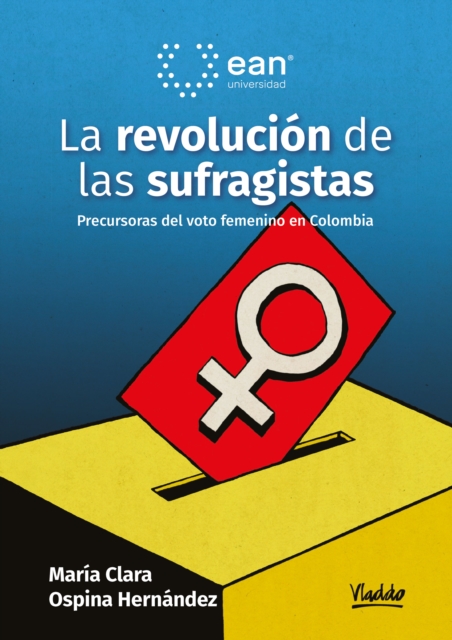
La revolución de las sufragistas
María Clara Ospina, con el rigor de una historiadora, con un estilo ameno y propio y con la sensibilidad política natural de la hija de un expresidente de la República y de una de las grandes e importantes políticas de Colombia, protagonistas de muchas de las páginas de nuestro devenir republicano, desgrana con investigación y compromiso la historia apasionante de cómo fue posible, frente a toda clase de obstáculos, conseguir lo que hoy nos parece natural: el voto de la mujer colombiana.
eBook

Winning the vote for women
\"For years only men were allowed to vote, but women around the world were ready to fight and win their right to vote. Now, you can imagine you were there.\"--Back of book. 505:0 : An example for the world -- Why is voting important? -- Not fair! -- Seneca Falls -- Steps forward and steps back -- People power-for! -- People power-against! -- Early successes -- Winning in Canada -- Women of the Russian Revolution -- British suffragists -- British sufragettes -- Drastic actions -- Women in World War I -- After World War I -- suffrage in the U.S. -- More global success -- Women in World War II -- Opposite sides of the world -- Poet and protester -- From poverty to power -- The lioness of Lasabi -- Recent struggles -- Votes for Women! -- The fight for women's rights -- Towards equality -- Gender equality and you -- Hall of Fame -- Glossary -- Index.
Book

To Be Equals in Our Own Country
To Be Equals in Our Own Country chronicles the bitter struggle for women's suffrage in Quebec, the last province to grant Canadian women this fundamental human right.
eBook

Created equal : women campaign for the right to vote, 1840-1920
A brief history of American women's fight for voting rights.
Book
Essentials. Biography (middle and high school). The pioneers of women's suffrage
In 1919, women in the United States were finally given the right to vote, thanks to the pioneering efforts of suffragists like Harriet Forten Purvis, Susan B. Anthony, and Alice Paul.
Streaming Video