
Catalogue Search | MBRL


Are you sure you want to remove the book from the shelf?

{{itemTitle}}
6
result(s) for
"Sugar trade Indonesia Java History."
Sort by:

Sugar plantation in India and Indonesia : industrial production, 1770-2010
\"European markets almost exclusively relied on Caribbean sugar produced by slave labor until abolitionist campaigns began around 1800. Thereafter, importing Asian sugar and transferring plantation production to Asia became a serious option for the Western world. In this book, Ulbe Bosma details how the British and Dutch introduced the sugar plantation model in Asia and refashioned it over time. Although initial attempts by British planters in India failed, the Dutch colonial administration was far more successful in Java, where it introduced in 1830 a system of forced cultivation that tied local peasant production to industrial manufacturing. A century later, India adopted the Java model in combination with farmers' cooperatives rather than employing coercive measures. Cooperatives did not prevent industrial sugar production from exploiting small farmers and cane cutters, however, and Bosma finds that much of modern sugar production in Asia resembles the abuses of labor by the old plantation systems of the Caribbean\"-- Provided by publisher.
Book

The Sugar Plantation in India and Indonesia
European markets almost exclusively relied on Caribbean sugar produced by slave labor until abolitionist campaigns began around 1800. Thereafter, importing Asian sugar and transferring plantation production to Asia became a serious option for the Western world. In this book, Ulbe Bosma details how the British and Dutch introduced the sugar plantation model in Asia and refashioned it over time. Although initial attempts by British planters in India failed, the Dutch colonial administration was far more successful in Java, where it introduced in 1830 a system of forced cultivation that tied local peasant production to industrial manufacturing. A century later, India adopted the Java model in combination with farmers' cooperatives rather than employing coercive measures. Cooperatives did not prevent industrial sugar production from exploiting small farmers and cane cutters, however, and Bosma finds that much of modern sugar production in Asia resembles the abuses of labor by the old plantation systems of the Caribbean.
eBook

The sugar plantation in India and Indonesia
\"European markets almost exclusively relied on Caribbean sugar produced by slave labor until abolitionist campaigns began around 1800. Thereafter, importing Asian sugar and transferring plantation production to Asia became a serious option for the Western world. In this book, Ulbe Bosma details how the British and Dutch introduced the sugar plantation model in Asia and refashioned it over time. Although initial attempts by British planters in India failed, the Dutch colonial administration was far more successful in Java, where it introduced in 1830 a system of forced cultivation that tied local peasant production to industrial manufacturing. A century later, India adopted the Java model in combination with farmers' cooperatives rather than employing coercive measures. Cooperatives did not prevent industrial sugar production from exploiting small farmers and cane cutters, however, and Bosma finds that much of modern sugar production in Asia resembles the abuses of labor by the old plantation systems of the Caribbean\"--
Book
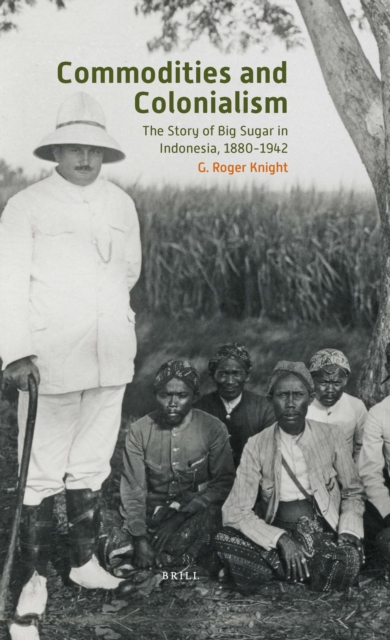
Commodities and Colonialism
Sugar yesterday was what oil is today: a commodity of immense global importance whose tentacles reached deep into politics, society and economy. Indonesia's colonial-era sugar industry is largely forgotten today, except by a small number of regional specialists writing for a specialist audience. During the period 1880-1942 covered by this book, however, the then Netherlands Indies was one of the world's very greatest producer-exporters of the commodity. How it contrived to do so is the story presented in this book.Author G. Roger Knight, associate professor of history in the University of Adelaide, has researched the historyof Indonesia's sugar industry for more than twenty-five years, using unpublished archival sources in both the Netherlands and Indonesia. His search has taken him into government records, family histories and - above all - theextensive surviving papers of the Dutch sugar companies who operated in Indonesia during the late colonial era. The result is a picture of the industry that offers important new insights into its history and its place in the framework of global commodity production over a period extending over three quarters of a century.
eBook

A Precocious Appetite: Industrial Agriculture and the Fertiliser Revolution in Java's Colonial Cane Fields, c. 1880–1914
Late colonial sugar cane production in Java was characterised by the heavy use of (chemical) fertiliser in tandem with labour-intensive techniques and industrial work processes in the field. This article provides a useful corrective to an overemphasis on the extractive nature of the colonial economy of sugar and shows the truly industrial nature of plantation production. For students of colonial science and agriculture, the situation has additional ramifications, relating both to the role and ‘diffusion’ of scientific knowledge and to the historical dimensions of agricultural development in ‘the tropics’.
Journal Article

The Politics of Trade Union Formation in the Java Sugar Industry, 1945–1949
Comparatively little of a scholarly nature has been written about Indonesian trade unions, particularly on the two decades from 1945 to 1965 when, like the political parties to which so many of them were affiliated, the unions had their heyday. This paper focuses on the development of trade unions in one specific industry: refined sugar production. The period to be examined—1945 to 1949—runs from the proclamation of Indonesian independence by Sukarno and Hatta, through the revolution fought against the returning Dutch, to December 1949 when the Netherlands finally acknowledged Indonesian independence. It was during this period that the major post-war sugar industry unions were established. The circumstances surrounding the establishment of these unions will be examined, along with their leaders and members, ideological leanings and political and industrial objectives.
Journal Article