
Catalogue Search | MBRL


Are you sure you want to remove the book from the shelf?

{{itemTitle}}
6,143
result(s) for
"Suicide History."
Sort by:


Sadly Troubled History
In a study of nearly 7000 suicides from 1900 to 1950, John Weaver documents the challenges that ordinary people experienced during turbulent times and, using witnesses' testimony, death bed statements, and suicide notes, reconstructs individuals' thoughts as they decide whether to endure their suffering. Bridging social and medical history, Weaver presents an intellectual and political history of suicide studies, a revealing construction and deconstruction of suicide rates, a discussion of gender, life stages, and socio-economic circumstances in relation to suicide patterns, reflections on reasoning processes and intent, and society's reactions to suicide, including medical intervention.
eBook


After Words
After Words investigates the ways in which the suicide of a writer informs critical interpretations of his or her works. Suicide is a revision as well as a form of authorship, both on the part of the author, who has written his/her final scene and revised the 'natural' course of his/her life, and on the part of the reader, who must make sense of this final act of writing.
Focusing on four twentieth-century Italian writers (Guido Morselli, Amelia Rosselli, Cesare Pavese, and Primo Levi), Elizabeth Leake examines their personal correspondence, diaries, and obituaries as well as popular and academic commemorative writings about them and their works in order to elucidate the ramifications of their suicides for their readership. Arguing that authorial suicide points to the limitations of those critical stances that exclude the author from the practice of reading, Leake's insightful re-reading of these authors and their texts shows that in the aftermath of suicide, an author's life and death themselves become texts to be read.
eBook

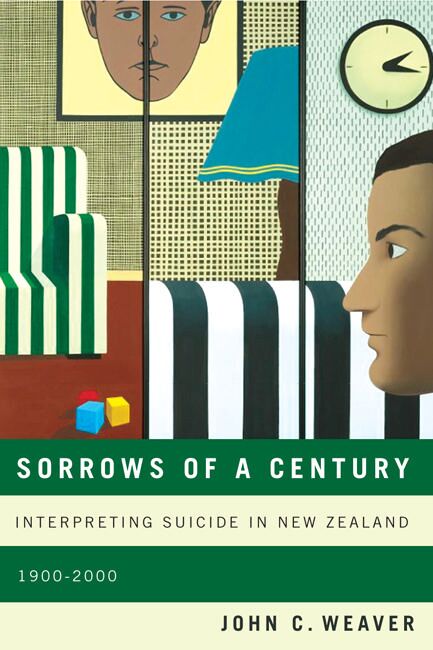
Sorrows of a Century
In Sorrows of a Century, John Weaver describes how personal relationships, work, poverty, war, illness, and legal troubles have driven thousands to despair. His study is set in twentieth-century New Zealand where - in spite of high standards of living and a commitment to social welfare - citizens have experienced the profound losses and stresses of the human condition. Focusing on New Zealand because it has the most comprehensive and accessible coroners' records, Weaver analyzes a staggering amount of information to determine the social and cultural factors that contribute to suicide rates. He examines the country's investigations into sudden deaths, places them within the context of major events and societal changes, and turns to witnesses' statements, suicide notes, and medical records to remark on prevention strategies. His extensive survey of twelve thousand cases also provides an insightful assessment of psychiatry and psychology in the last century. In reviewing the motives and methods of suicide, Weaver points out the complications facing deterrence. Moving beyond the timeless present of the social sciences and the irrationality emphasized in psychology, Sorrows of a Century marshals testimony to highlight the historical context and rational conduct behind suicide.
eBook


The Relationship between Attitudes toward Suicide and Family History of Suicide in Nagano Prefecture, Japan
Certain attitudes toward suicide may be a risk factor for suicide among the bereaved. To explore this possibility, we examined the relationship between attitudes toward suicide and family history of suicide. We focused on two specific attitudes indicating resignation in a survey: #1 “When a person chooses to die by suicide, the suicide is inevitable” (i.e., inevitability belief); and #2 “A suicide cannot be stopped by any person, because suicide is unpreventable” (i.e., unpreventable belief). The data of 5117 fully completed questionnaires were analyzed. Logistic regression analysis revealed that the two attitudes of resignation were significantly associated with a family history of suicide. The adjusted odds ratio for #1 was 1.39 (95% CI, 1.07–1.79) for individuals having experienced suicide by a family member or relative, while that for #2 was 1.57 (95% CI, 1.27–1.95) for experiencing a suicide by a family member or relative and 1.25 (95% CI, 1.05–1.49) for experiencing a suicide by a friend, business associate, partner or other. These two attitudes of resignation toward suicide were significantly associated with a family history of suicide. These attitudes might increase suicide risk among the bereaved.
Journal Article


Conceptualizations of suicide through time and socio-economic factors: a historical mini-review
Suicide is a complex phenomenon determined by the interplay of an articulated network of factors including socio-economic factors which have a decisive role. This paper investigates the development of the modern conceptualization of suicide in Europe, its sociological understandings and its intertwinement with economic cycles throughout time.
MEDLINE, SCHOLAR, EMBASE using the keywords 'socioeconomic factors AND suicide'; 'economic cycles AND suicide'; 'history AND suicide' without timeframe limitations. Moreover, journal-by-journal search in journals of related areas was performed.
In total, 51 historical studies focusing on the subjects in European countries were included. Three main areas arose: (a) development of the conceptualization of suicide over time; (b) sociological understandings of suicide according to the structure of society and its economy of power; (c) economic theories explaining the intertwinement of economic cycles and suicides.
Suicide is a deeply human phenomenon inescapably linked to and grounded in society and economic cycles. Understandings from the past show the importance of accurate analysis of socio-economic contexts that shape societies together with man's own sense of self in order to organize multi-layered tangible and intangible support strategies to better understand and prevent suicide in this day and age.
Journal Article