
Catalogue Search | MBRL


Are you sure you want to remove the book from the shelf?

{{itemTitle}}
160
result(s) for
"Sumptuary laws."
Sort by:

Fighting hydra-like luxury : sumptuary regulation in the Roman Republic
\"From the Old Testament to Elizabethan England, luxury has been morally condemned. In Rome, sumptuary laws (laws controlling consumption) seemed the only weapon to defeat 'hydra-like luxury', the terrible monster that was weakening even the strongest citizens. The first Roman sumptuary law, the Lex Appia, declared that no woman could possess more than a half ounce of gold, wear a dress of different colours, or ride in a carriage in any city unless for a public ceremony. Laws listed how many different colours could be worn by members of different social classes: peasants could wear one colour, soldiers in the army could wear two, army officers could wear three, and members of the royal family could wear seven. A law passed by Emperor Aurelian stated that men couldn't wear shoes that were red, yellow, green, or white, and that only the emperor and his sons could wear red or purple shoes. A variety of other laws limited how much people could spend on parties and how many people they could invite. Here Emanuela Zanda explores the purposes behind the enactment of such legislation in Rome during the Republic. She engages with the historical-literary polemic against luxury and focuses on government intervention in matters of extravagance by taking into consideration not only sumptuary laws but also other measures that dealt with self-indulgence. She addresses and answers a number of questions about what exactly the ruling class was trying to achieve, about its real motivations, and about the significance of the ideological discourse surrounding the enactment of these laws\"--Provided by publisher.
Book
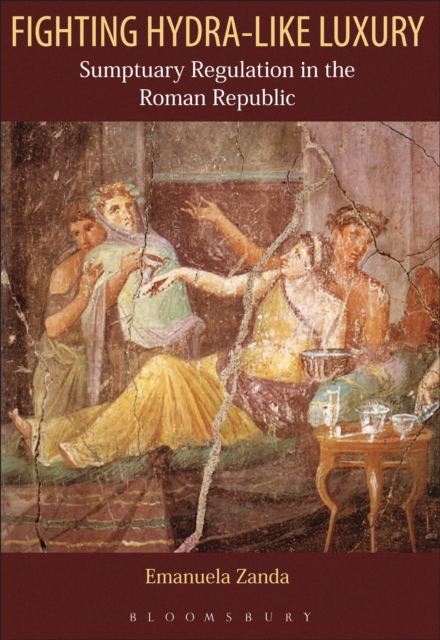
Fighting Hydra-like Luxury
From the Old Testament to Elizabethan England, luxury has been morally condemned.In Rome, sumptuary laws (laws controlling consumption) seemed the only weapon to defeat 'hydra-like luxury', the terrible monster that was weakening even the strongest citizens.The first Roman sumptuary law, the Lex Appia , declared that no woman could possess more.
eBook

Les dépenses funéraires des Grecs à l’époque classique
Cet article montre que les funérailles revêtaient chez les Grecs beaucoup d’importance en raison des dépenses qu’ils y consacraient. Il identifie aussi les différentes sources de financement et les différentes catégories de défunts dont les funérailles furent astreintes aux dépenses. Il prouve que les défunts, en général, obtinrent des funérailles solennelles en raison de leurs relations, de leurs actions ou de leur importance dans la cité. Il expose l’éclat des funérailles et énumère quelques données sur des coûts de funérailles tout en mettant l’accent sur leurs caractères festifs. Il montre également que des lois somptuaires sur les funérailles étaient en vigueur, mais que dans quelque cité ces lois étaient tombées en désuétude. This article shows that the funeral was of great importance to the Greeks because of the expenses devoted to it. It shows the different sources of funeral funding and the different categories of deceased who were the objects of these expenses. It proves that the deceased in general obtained a solemn funeral because of their relationships, their actions or their importance in the city. It outlines the brilliance of funerals organized for these people and lists some data on funeral costs. He shows that sumptuary funeral laws were in force, but that in some city these laws had fallen into disuse. Finally, he points out that the expenses incurred and the ceremonies included therein give the funerals of the persons concerned a festive character.
Journal Article

NE SPADONES FIANT: DOMITIAN'S EMASCULATION BAN
This article questions the prevailing opinion that Domitian's prohibition of castration was intended as a protective measure devised to check masters’ abuses on their slaves, as part of a larger trend towards more enlightened attitudes towards slavery among the Romans. While brutal, castration was the only type of mutilation which increased the monetary value of slaves. Banning it curtailed slaves’ chances of social climbing and narrowed their channels towards positions of power. The emasculation ban is, instead, better understood as one of the many measures directed towards the control of the sexual behaviour and the sumptuary practices of the Roman elite. Introduced as a censorial decree, the ban gave Domitian the opportunity to act as the upholder of Republican traditions at the same time as he impinged on the private lives of his subjects and put senators and equestrians under his thumb. The article also argues that, contrary to what is usually argued, the constant re-enforcement of the prohibition to castrate by Domitian's successors is an indication of the effectiveness of the Roman legal machinery and its capacity to reach the most distant corners of the Roman empire.
Journal Article

The Domestication of Desire
While doing fieldwork in the modernizing Javanese city of Solo during the late 1980s, Suzanne Brenner came upon a neighborhood that seemed like a museum of a bygone era: Laweyan, a once-thriving production center of batik textiles, had embraced modernity under Dutch colonial rule, only to fend off the modernizing forces of the Indonesian state during the late twentieth century. Focusing on this community, Brenner examines what she calls the making of the \"unmodern.\" She portrays a merchant enclave clinging to its distinctive forms of social life and highlights the unique power of women in the marketplace and the home--two domains closely linked to each other through local economies of production and exchange. Against the social, political, and economic developments of late-colonial and postcolonial Java, Brenner describes how an innovative, commercially successful lifestyle became an anachronism in Indonesian society, thereby challenging the idea that tradition invariably gives way to modernity in an evolutionary progression.
Brenner's analysis centers on the importance of gender to processes of social transformation. In Laweyan, the base of economic and social power has shifted from families, in which women were the main producers of wealth and cultural value, to the Indonesian state, which has worked to reorient families toward national political agendas. How such attempts affect women's lives and the meaning of the family itself are key considerations as Brenner questions long-held assumptions about the division between \"domestic\" and \"public\" spheres in modern society.
eBook

Intellectual property law and the sumptuary code
This Article assesses intellectual property law's emerging role as a modern form of sumptuary law. The Article observes that we have begun to rely on certain areas of intellectual property law to provide us with the means to preserve our conventional system of consumption-based social distinction, our sumptuary code, in the face of incipient social and technological conditions that threaten the viability of this code. Through sumptuary intellectual property law, we seek in particular to suppress the revolutionary social and cultural implications of our increasingly powerful copying technology. Sumptuary intellectual property law is thus taking shape as the socially and culturally reactionary antithesis of the more familiar technologically progressive side of intellectual property law. The Article identifies the conditions that are bringing about this peculiar juncture of intellectual property law and sumptuary law and evidences this juncture in various evolving intellectual property law doctrines. The Article further predicts that intellectual property law cannot succeed in sustaining our conventional system of consumption-based social distinction and identifies in this failure the conditions for a different and superior system of social distinction, one characterized more by the production of distinction than by its consumption and one in which intellectual property law promises to play a crucial--and progressive--social role.
Journal Article
Food and norms in 13th–16th century Estonia: meat and meat products
The aim of this article is to give an overview of the norms that determined dietary patterns in medieval and early modern Estonia. The focus is on meat and on the social and cultural norms related to meat-eating. In particular, written sources shed light on what kind of norms and customs shaped the local food culture. The production and selling of groceries was subject to fixed regulations and monitored by officials. Furthermore, control over one’s appetite was imposed by church and public authorities. In one way or another, every person allowed themselves to be guided by those transcultural or local norms and value criteria.
Journal Article

Shakespeare's Brain
Here Mary Thomas Crane considers the brain as a site where body and culture meet to form the subject and its expression in language. Taking Shakespeare as her case study, she boldly demonstrates the explanatory power of cognitive theory--a theory which argues that language is produced by a reciprocal interaction of body and environment, brain and culture, and which refocuses attention on the role of the author in the making of meaning. Crane reveals in Shakespeare's texts a web of structures and categories through which meaning is created. The approach yields fresh insights into a wide range of his plays, includingThe Comedy of Errors, As You Like It, Twelfth Night, Hamlet, Measure for Measure,andThe Tempest.
Crane's cognitive reading traces the complex interactions of cultural and cognitive determinants of meaning as they play themselves out in Shakespeare's texts. She shows how each play centers on a word or words conveying multiple meanings (such as \"act,\" \"pinch,\" \"pregnant,\" \"villain and clown\"), and how each cluster has been shaped by early modern ideological formations. The book also chronicles the playwright's developing response to the material conditions of subject formation in early modern England. Crane reveals that Shakespeare in his comedies first explored the social spaces within which the subject is formed, such as the home, class hierarchy, and romantic courtship. His later plays reveal a greater preoccupation with how the self is formed within the body, as the embodied mind seeks to make sense of and negotiate its physical and social environment.
eBook
Valore economico e sociale dei manufatti tessili: il caso di Siena (1250-330)
L’analisi delle tipologie tessili realizzate in lana e in seta a Siena tra la seconda metà del Duecento e la prima del Trecento consente di verificare l’esistenza di un rapporto tra valore economico e valore sociale degli indumenti. Partendo dallo studio della normativa suntuaria e la sua evoluzione, l’accesso di strati sociali meno agiati a stoffe dapprima di uso esclusivo delle élite viene messo in relazione con l’effettivo valore economico dei tessuti. Ciò consente di dimostrare che fibre comunemente ritenute ‘di lusso’ come la seta furono più economiche di altre considerate solitamente di minor valore. Furono le caratteristiche tecniche dei tessuti a fare la differenza. Per una serie di dinamiche economico-produttive, più o meno protezioniste a seconda delle fasi, la legislazione senese fu molto attenta alla tipologia delle stoffe che era consentito adoperare per la realizzazione di particolari indumenti o manufatti, tanto che ci si preoccupò più di regolamentare la materialità dei tessuti adoperati che la foggia delle vesti.
Journal Article
Les dépenses funéraires des Grecs à l’époque classique
Cet article montre que les funérailles revêtaient chez les Grecs beaucoup d’importance en raison des dépenses qu’ils y consacraient. Il identifie aussi les différentes sources de financement et les différentes catégories de défunts dont les funérailles furent astreintes aux dépenses. Il prouve que les défunts, en général, obtinrent des funérailles solennelles en raison de leurs relations, de leurs actions ou de leur importance dans la cité. Il expose l’éclat des funérailles et énumère quelques données sur des coûts de funérailles tout en mettant l’accent sur leurs caractères festifs. Il montre également que des lois somptuaires sur les funérailles étaient en vigueur, mais que dans quelque cité ces lois étaient tombées en désuétude.
Journal Article