
Catalogue Search | MBRL


Are you sure you want to remove the book from the shelf?

{{itemTitle}}
388
result(s) for
"Sundials."
Sort by:

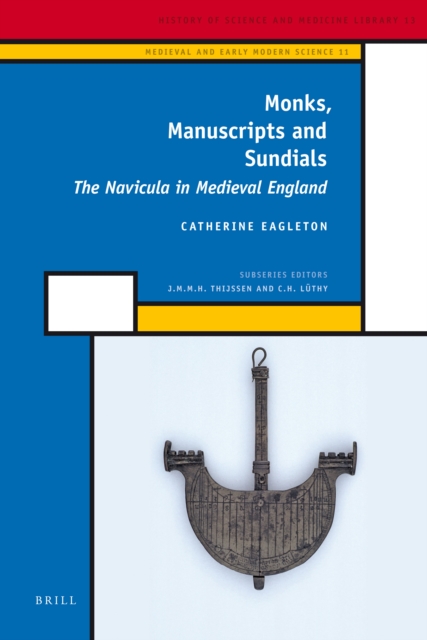
Monks, Manuscripts and Sundials
Bringing together the surviving material and manuscript evidence, this book looks closely at a fascinating medieval sundial in the form of a ship. It considers who made and used the surviving instruments, as well as studying the scholars who wrote about it.
eBook

Time on a Tablet: Early Ivory Sundials Incorporating Wax Writing Tablets
Abstract
This article offers the first comprehensive study of a newly discovered type of medieval sundial made of ivory which might well be the precursor of the well-known diptych dial form made from ivory and wood. These sundials are unique for the combination with a wax writing tablet (tabula cerata) on the reverse side, such as has been deployed as a reusable and portable writing surface in Antiquity and throughout the Middle Ages. Three previously unpublished examples of this type of sundial have been located in Germany, Italy and England. This article gives a detailed analysis of the sundials and the underlying construction principles, including considerations from the history of science, chronology and cultural history in order to answer the questions of where, when and by whom these sundials were made.
Journal Article

A reflecting sundial with cusps of the caustics on a straight line segment
Given a convex mirror curve and a sheaf of parallel incident rays, a caustic curve with at least one cusp appers. This is the principle on which the construction of reflecting sundials is founded. When the sheaf of parallel incident rays changes along the day, the cusp of the caustic curve traces out a new curve. The initial convex mirror curve for which its caustic curves have cusps along a straight line segment is studied. An intrinsic equation is obtained for it and, after numerical integration, the resulting curve is compared with the solution given by C. M. Lowne.
Journal Article

Astronomical explanation of the enigmatic sundial in Agra, India
This study explains the functioning of a sundial in Moti Masjid, a mosque in Red Fort, Agra, India. The instrument, made in Islamic style, had remained enigmatic for a long time. The present study is an effort to resolve this enigma. The gnomon length for the sundial is ascertained and its functioning has been examined using on-site observations as well as computations.
Journal Article

The Konark Temple’s Construction: A Critical Review of the Historical, Cultural, and Scientific Evidence
Drawing from historical accounts, cultural practices, archaeological discoveries, and indigenous technical knowledge, the research presents a critical review of varied aspects of the construction of the Konark temple and provides future research directions. To fulfil the purpose, documents were sourced from Scopus, Google Scholar, and ancient texts and palm leaves. Findings suggest the legacy of Narasimhadeva I, the Hindu monarch who remained undefeated during his reign, safeguarded the kingdom from encroaching Muslim rulers. The narrative highlights the bravery of a faithful elephant that revived the king on the battlefield. The Konark temple was built with the dual purpose of showcasing the glory of his victory and devotion to the Sun God. The ancient artisans’ knowledge, skills, and commitment were crucial in erecting this tallest temple structure. The investigation further illuminates the use of sea routes for transporting monumental stones, the ingenuity in laying the temple’s foundation, the selection of high-grade stones, the monumental task of lifting colossal stones, like the world’s heaviest stone hoisted to a height of about two hundred feet, the use of rust-resistant iron, and the application of advanced astronomical knowledge by ancient artisans. The study provides insights into ancient engineering ingenuity, encouraging further exploration of the enduring legacy of the Konark temple’s construction.
Journal Article

Dispersal, population size, and reproduction in a fire-maintained frosted elfin (Callophrys irus) metapopulation
The frosted elfin (
Callophrys irus
) is imperiled and declining over much of its range with many extant populations separated by large expanses of unsuitable habitat. Demographic information is largely lacking for this species which is necessary for land managers to develop effective management plans. We provide data on dispersal, population size, and reproduction based upon a color-marked population of frosted elfins in the Apalachicola National Forest (Florida, USA; ANF hereafter). Our 78.5 ha study area within the ANF contained 26 distinct patches of the frosted elfin’s host plant (sundial lupine;
Lupinus perennis
) and contained two management units, one > 2 year post-fire and the other < 1 year post-fire. In 2021, we marked 449 unique individuals and resighted 193 of the marked frosted elfins later in the breeding season. Of those resighted, 76 individuals had dispersed to another distinct sundial lupine patch. An inverse power function fitted to the cumulative distance moved by dispersers predicted that 50% disperse at least 263.2 m (95% CI: 112.9–610.1 m). A fully-parametric frailty model indicated females and individuals with less wing wear were more likely to disperse than others. Estimated gross superpopulation size for females and males (POPAN Jolly-Seber model) showed differences between the > 2 year (females: 428.70 [95% CI: 376.78–487.78], males: 478.35 [95% CI: 425.48–537.81]) and the < 1 year since fire management units (females: 41.23 [95%CI: 32.93–51.63], males: 23.49 [95%CI: 15.95–34.62]). Information on reproduction is also important for long-term persistence which may depend on demographic and environmental factors. We used a generalized linear mixed-effects model to evaluate factors influencing the number of eggs found on sundial lupine. The top performing model indicated that egg numbers increased with increases in the number of inflorescences and were higher in the management unit with the longest time since fire. This demographic information is integral to making informed decisions on habitat structure in regards to metapopulation dynamics. Future studies that incorporate multiple years of data and the effects of fire will provide further insight into long-term population persistence.
Journal Article

Metric Properties of Sundials using 3-D Models from Digital Photography
Three-dimensional (3-D) models of archaeological artifacts can be obtained using free or low-cost image-based modeling (IBM) systems. IBM systems generate a 3-D model by processing a set of overlapping digital photographs of an object or scene. Sundials are generally located in inaccessible places, and photography may be the only method to study them. The purpose of this paper is to explore the potential of the 3-D modeling of archaeological objects obtained by IBM systems and embedded in a 3-D interactive portable document format (PDF) file. The process is illustrated by two case studies: a Roman sundial and a historical vertical sundial. The 3-D interactive PDF file allows for measuring some elements in the 3-D model. These measurements can be obtained easily and provide metric information about the sundials without touching them.
Se pueden obtener modelos tridimensionales (3-D) de objetos arqueológicos utilizando sistemas de modelado basados en la imagen (IBM) de bajo coste o gratuitos. Los sistemas IBM generan un modelo 3-D procesando un conjunto de fotografías digitales solapadas de un objeto o escena. Los relojes de sol se sitúan generalmente en lugares inaccesibles y la fotografía puede ser el único método de estudiarlos. El propósito del presente documento es explorar el potencial del modelado 3-D de objetos arqueológicos obtenidos mediante sistemas IBM e incrustados en un formato interactivo 3-D de tipo PDF (formato de documento portátil). El proceso se ilustra mediante dos casos de estudio: un reloj solar romano y un reloj solar vertical histórico. El PDF interactivo 3-D permite medir algunos elementos en el modelo 3-D. Estas mediciones pueden obtenerse fácilmente y pueden proporcionar información métrica sobre los relojes solares sin tocarlos.
Les modèles en trois dimensions (3D) d’artefacts archéologiques peuvent être obtenus en utilisant des systèmes de modélisation à partir d’images gratuits ou à faible coût. Les systèmes de modélisation à partir d’images génèrent un modèle 3D en traitant un ensemble de photographies numériques chevauchantes d’un objet ou d’une scène. Les cadrans solaires sont généralement situés dans des endroits inaccessibles et la photographie peut être le seul moyen de les étudier. Cet article vise à explorer le potentiel de la modélisation 3D d’objets archéologiques obtenus par les systèmes de modélisation à partir d’images et incorporés dans un format de document portable (PDF) interactif 3D. Le processus est illustré par deux études de cas: un cadran solaire romain et un cadran solaire vertical historique. Le PDF 3D interactif permet de mesurer certains éléments dans le modèle 3D. Ces mesures peuvent être obtenues facilement et fournissent des informations métriques sur les cadrans solaires sans les toucher.
Journal Article