
Catalogue Search | MBRL


Are you sure you want to remove the book from the shelf?

{{itemTitle}}
5,599
result(s) for
"Superstition."
Sort by:

Superstition : a very short introduction
Do you touch wood for luck, or avoid the number 13? Despite the dominance of science in today's world, superstitious beliefs - both traditional and new - remain surprisingly popular. From black cats to lucky pennies, Stuart Vyse explores the history of our deepest superstitions, and the psychological reasons behind why they persist today.
BOOK
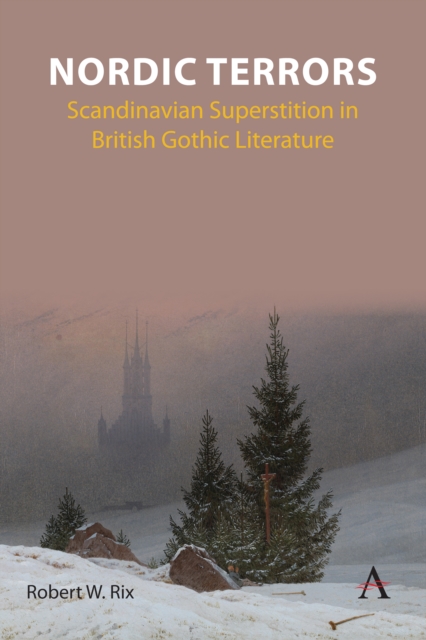
Nordic Terrors
In late eighteenth- and early nineteenth-century British literature, Scandinavia emerged as a setting for Gothic terror. This book explores the extensive use of Nordic superstition as it provided a vocabulary for Gothic texts, examining the cultural significance these references held for writers exploring Britain's northern heritage.
eBook


Fearful Spirits, Reasoned Follies
Superstitions are commonplace in the modern world. Mostly, however, they evoke innocuous images of people reading their horoscopes or avoiding black cats. Certain religious practices might also come to mind—praying to St. Christopher or lighting candles for the dead. Benign as they might seem today, such practices were not always perceived that way. In medieval Europe superstitions were considered serious offenses, violations of essential precepts of Christian doctrine or immutable natural laws. But how and why did this come to be? In Fearful Spirits, Reasoned Follies, Michael D. Bailey explores the thorny concept of superstition as it was understood and debated in the Middle Ages. Bailey begins by tracing Christian thinking about superstition from the patristic period through the early and high Middle Ages. He then turns to the later Middle Ages, a period that witnessed an outpouring of writings devoted to superstition—tracts and treatises with titles such as De superstitionibus and Contra vitia superstitionum. Most were written by theologians and other academics based in Europe's universities and courts, men who were increasingly anxious about the proliferation of suspect beliefs and practices, from elite ritual magic to common healing charms, from astrological divination to the observance of signs and omens. As Bailey shows, however, authorities were far more sophisticated in their reasoning than one might suspect, using accusations of superstition in a calculated way to control the boundaries of legitimate religion and acceptable science. This in turn would lay the conceptual groundwork for future discussions of religion, science, and magic in the early modern world. Indeed, by revealing the extent to which early modern thinkers took up old questions about the operation of natural properties and forces using the vocabulary of science rather than of belief, Bailey exposes the powerful but in many ways false dichotomy between the \"superstitious\" Middle Ages and \"rational\" European modernity.
eBook

Qui a Peur des Chats Noirs ?
Les origines des superstitions les plus repanduesElles font partie integrante de notre quotidien, marquant de leur empreinte mystique certains gestes finalement tres banals. Meme les esprits les plus cartesiens peuvent contourner une echelle, toucher du bois ou chercher un trefle a quatre feuilles ! La question est : pourquoi ? Lorsque l'on cherche l'origine de ces croyances, on decouvre des histoires passionnantes, des explications loufoques ou encore des raisons scientifiques qui eclairent d'un jour completement nouveau ces pensees souvent irrationnelles. Que l'on soit superstitieux ou simplement curieux, ce livre raconte les veritables sources de ces croyances les plus repandues en France. Reste a savoir si apres votre lecture, vous continuerez a jeter de temps en temps du sel par-dessus votre epaule ou a retourner le pain sur la table...Des mysteres inedits a decouvrir que l'on soit superstitieux ou pasEXTRAITMets ta main devant la bouche avant de bailler, regarde-moi dans les yeux en trinquant, ne pointe pas quelqu'un du doigt... Tout le monde a deja entendu ces remarques au moins une fois dans sa vie, le plus souvent des la petite enfance. S'il s'agit au premier abord d'inculquer les bonnes manieres, ces marques de courtoisie cachent egalement des croyances superstitieuses datant pour la plupart du Moyen Age.Pourquoi sinon dirions-nous a tes souhaits a un ami qui vient d'eternuer ? !A PROPOS DE L'AUTEURNee en 1982 a Boulogne Billancourt, Marie-Agnes Moller fait des etudes de droit puis de communication avant de se lancer dans une carriere de journaliste free-lance. Elle travaille dans la presse grand public et redige egalement des guides touristiques. Suite au succes de Paris Horribilis sur les histoires sombres de Paris, elle nous livre dans ce deuxieme ouvrage les secrets des superstitions.
eBook

Enchanted Europe : superstition, reason, and religion, 1250-1750 /
'Enchanted Europe' offers a comprehensive account of Europe's long, complex relationship with its own folklore & popular religion. From debates over the efficacy of charms & spells, to belief in fairies & demons, Euan Cameron constructs a compelling narrative of the rise & fall of 'superstition' in the European mind.
Book

Dreams, nature, and practices as signs of the future in the Middle Ages
Seeking for signs of the future was a basic component of the pre-modern European mindset. The great variety of signs that are reviewed in the set of articles present commentaries on the time of their creation, whereas signs of the future display an ambiguous character.
eBook

The white chip
The Lost Dutchman was the most fabled gold mine of the Old West. Ever since Jacob Walzer struck gold in the Superstition Mountains of southwestern Arizona, hundreds of hopefuls had risked everything to comb the deadly mountains for it--and many never came back. Finally an unlikely caravan made up of a banker, a seasoned miner, two merchants, a butcher, and a smuggler found the exhausted mine--and a cleverly sealed-off entrance to its rich lode. The dizzying wealth was theirs for the taking. If they could retrieve it from the middle of an active volcano.
Book

Keep Your Fingers Crossed! How Superstition Improves Performance
Superstitions are typically seen as inconsequential creations of irrational minds. Nevertheless, many people rely on superstitious thoughts and practices in their daily routines in order to gain good luck. To date, little is known about the consequences and potential benefits of such superstitions. The present research closes this gap by demonstrating performance benefits of superstitions and identifying their underlying psychological mechanisms. Specifically, Experiments I through 4 show that activating good-luck-related superstitions via a common saying or action (e.g., \"break a leg,\" keeping one's fingers crossed) or a lucky charm improves subsequent performance in golfing, motor dexterity, memory, and anagram games. Furthermore, Experiments 3 and 4 demonstrate that these performance benefits are produced by changes in perceived self-efficacy. Activating a superstition boosts participants' confidence in mastering upcoming tasks, which in turn improves performance. Finally, Experiment 4 shows that increased task persistence constitutes one means by which self-efficacy, enhanced by superstition, improves performance.
Journal Article