
Catalogue Search | MBRL


Are you sure you want to remove the book from the shelf?

{{itemTitle}}
23,063
result(s) for
"Surgery History."
Sort by:


William Arbuthnot Lane (1856–1943): Surgical Innovator and His Theory of Autointoxication
William Arbuthnot Lane contributed to the advancement of many fields of orthopedics, otolaryngology, and general surgery. He is credited for his “no-touch technique” and the invention of long-handled instruments, some of which are still in use today, to minimize tissue handling. He is most well known for his hypothesis that slowing of gastric contents could cause a variety of ailments and this became known as Lane's disease. Although his surgical treatment of Lane's disease is now defunct, it advanced the surgical technique in colorectal surgery. It seems likely that some of Lane's “autointoxication” patients would be classified today as patients with colonic inertia, diverticulitis, colonic volvulus, and megacolon or, which are all treated with colectomy. Lane was a pioneer in multiple fields and a true general surgeon. He advanced colorectal surgery immensely and propelled the field of surgery into a new era.
Journal Article

Plastic surgery
\"This book provides a complete history of plastic surgery, a description of the modern techniques and choices available, and an overview of the controversies surrounding the choice to voluntarily change your physical appearance\"--Provided by publisher.
Book

A history of the McGill Department of Surgery: the first 100 years (1923–2023)
SummaryIn 1923, just over 100 years ago, Edward William Archibald was appointed the first chair of surgery in McGill University's Faculty of Medicine. This milestone provides an opportunity to reflect on where the department has come from and how it has progressed to the present day. Although the size, breadth, and diversity of the department members have changed notably over the century, the core values of innovative clinical care, research, and education established a century ago continue to this day. To reflect his values, the Archibald Chair of Surgery was established in 1990 and is today held by the department chair.
Journal Article

The matter of the heart : a history of the heart in eleven operations
\"In eleven landmark operations, Thomas Morris tells us stories of [the] triumph, reckless bravery, swaggering arrogance, jealousy and rivalry, and incredible ingenuity [of cardiac surgeons], including the trail-blazing 'blue baby' procedure that transformed wheezing infants into pink, healthy children [and] the first human heart transplant, which made headline news around the globe\"--Amazon.com.
Book

Suzanne Noël
Working at the forefront of cosmetic surgery at the turn of the twentieth century, Dr Suzanne Noël was both a pioneer in her medical field and a firm believer in the advancement of women. Today her views on the benefits of aesthetic surgery to women may seem at odds with her feminist principles, but by placing Noël in the context of turn-of-the-century French culture, this book is able to demonstrate how these two worldviews were reconciled. Noël was able to combine her intense convictions for gender equality and anti-ageism in the workforce with her underlying compassion and concern for her female patients, during a time when there were no laws in place to protect women from workplace discrimination. She was also responsible for several advances in cosmetic surgery, a thriving industry, and is today best known for her development of the mini facelift. This book, therefore, sheds much valuable light on advances in aesthetic surgery, twentieth-century beauty culture, women and the public sphere, and the 'new woman'.
eBook

Empire of the scalpel : the history of surgery
\"From the sixteenth-century saga of Andreas Vesalius and his crusade to accurately describe human anatomy while appeasing the clergy who clamored for his burning at the stake, to the story of late-nineteenth-century surgeons' apathy to Joseph Lister's innovation f antisepsis and how this indifference led to thousands of unnecessary surgical deaths, Empire of the Scalpel is both a history and a uniquely American tale. Readers will learn how the United States achieved surgical leadership in the twentieth century, heralded by Harvard's Joseph Murray and his Nobel Prize-winning, seemingly impossible feat of transplanting a kidney, which ushered in a new era of transplants that continues to make procedures once thought insurmountable into achievable successes.\"-- Back cover.
Book

The Evolution of Metabolic/Bariatric Surgery
Metabolic surgery is defined as “the operative manipulation of a normal organ or organ system to achieve a biological result for a potential health gain.” The evolution of metabolic/bariatric surgery can be viewed from several perspectives: (1) realization that bariatric surgery has always been and will always be metabolic surgery; (2) lessons to be learned from the six dominant procedures; (3) overview of the other operations that have been proposed; (4) discussion of mechanisms of action; (5) physiology of energy metabolism; and (6) introduction to the emerging concept of inflammation. This review will end with thoughts on the present and future outcomes from the knowledge we have gained from metabolic/bariatric surgery. The author concludes with the statement: Metabolic surgery is cognitive surgery.
Journal Article
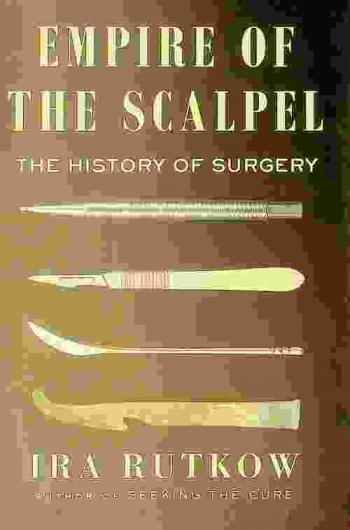
Empire of the scalpel : the history of surgery
\"From a renowned surgeon and historian with five decades of experience comes a remarkable history of surgery's development-spanning the Stone Age to the present day-blending meticulous medical studies with lively and skillful storytelling. There are not many events in life that can be as simultaneously life-frightening and life-saving as a surgical operation. Yet, in America, tens-of-millions of major surgical procedures are performed annually but few of us pause to consider the magnitude of these figures because we have such inherent confidence in surgeons. And, despite passionate debates about healthcare and the endless fascination with surgical procedures, most of us have no idea how surgeons came to be because the story of surgery has never been fully told. Now, 'Empire of the Scalpel' elegantly reveals the fascinating history of surgery's evolution from its earliest roots in Europe through its rise to scientific and social dominance in the United States. From the 16th-century saga of Andreas Vesalius and his crusade to accurately describe human anatomy while appeasing the conservative clergy who clamored for his burning at the stake, to the hard-to-believe story of late-19th century surgeons' apathy to Joseph Lister's innovation of antisepsis and how this indifference led to thousands of unnecessary surgical deaths, 'Empire of the Scalpel' is both a global history and a uniquely American tale. You'll discover how in the 20th century the US achieved surgical world supremacy heralded by the Nobel Prize-winning, seemingly impossible feat of transplanting a kidney and how the heart-lung machine was developed, along with much more. Today, the list of possible operations is almost infinite -- from knee and hip replacement to heart bypass and transplants to fat reduction and rhinoplasty -- and Rutkow draws on his five-decade career to show us how we got here. Authoritative, captivating, and comprehensive, 'Empire of the Scalpel' portrays the evolution of surgery in all its dramatic and life-enhancing complexity and shows that its history is truly one awe-inspiring triumph after another\"-- Provided by publisher.

History of colorectal surgery
Background
Colorectal surgery has its roots in the early civilisations and its development followed a complex pathway never disjoined from the social and cultural environment where it took place.
Method
The most relevant historical sources have been evaluated.
Results
A comprehensive review of the history of colorectal surgery is presented, from the ancient Egyptian culture to the modern achievements. The development of surgery of colon, rectum and anus is reported with particular reference to the social environment and history; as the development of colorectal surgery parallels the occurrence of human historical events, the study of the former cannot be disjoined from the latter.
Conclusion
Study and knowledge of the history of medicine — and, in particular, of colorectal surgery for those interested in this particular subject — is a privileged way to understand who we are nowadays and where we come from.
Journal Article