
Catalogue Search | MBRL


Are you sure you want to remove the book from the shelf?

{{itemTitle}}
13
result(s) for
"Suriname Colonization."
Sort by:

White lies and black markets : evading metropolitan authority in colonial Suriname, 1650-1800
\"In White Lies and Black Markets, Fatah-Black offers a new account of the colonization of Suriname--one of the major European plantation colonies on the Guiana Coast--in the period between 1650-1800. While commonly portrayed as an isolated tropical outpost, this study places the colony in the context of its connections to the rest of the Atlantic world. These economic and migratory links assured the colony's survival, but also created many incentives to evade the mercantilistically inclined metropolitan authorities. By combining the available data on Dutch and North American shipping with accounts of major political and economic developments, the author uncovers a hitherto hidden world of illicit dealings, and convincingly argues that these illegal practices were essential to the development and survival of the colony, and woven into the fabric of the colonial project itself\"--Provided by publisher.
Book

White Lies and Black Markets
\"In White Lies and Black Markets, Fatah-Black offers a new account of the colonization of Suriname--one of the major European plantation colonies on the Guiana Coast--in the period between 1650-1800. While commonly portrayed as an isolated tropical outpost, this study places the colony in the context of its connections to the rest of the Atlantic world. These economic and migratory links assured the colony's survival, but also created many incentives to evade the mercantilistically inclined metropolitan authorities. By combining the available data on Dutch and North American shipping with accounts of major political and economic developments, the author uncovers a hitherto hidden world of illicit dealings, and convincingly argues that these illegal practices were essential to the development and survival of the colony, and woven into the fabric of the colonial project itself\"--Provided by publisher
eBook

Willoughbyland : England's lost colony
\"At the beginning of the 1650s, wrecked by plague and civil war, England was in ruins. Yet shimmering on the horizon was a vision of paradise called Willoughbyland. When Sir Walter Raleigh set out to South America to find the legendary city of El Dorado, he paved the way for an endless series of adventurers who would struggle against the harsh reality of South America's wild jungles. Six decades later, when a group of English gentlemen expelled from England chose to establish a new colony there, they named the settlement in honor of its founder--Sir Francis Willoughby. Located in the lush landscape between the Amazon and Orinoco rivers, in what is now Suriname, Willougbyland experienced one of colonialism's most spectacular rises. But as planters and traders followed explorers, and mercenaries and soldiers followed political dissidents, the one-time paradise became a place of terror and cruelty, of sugar and slavery. A microcosm of the history of empire, this is the hitherto untold story of that fateful colony\"--Provided by publisher.
Book
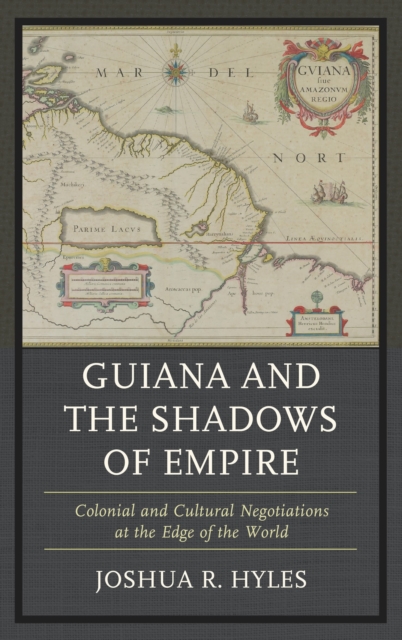
Guiana and the shadows of empire
This book is a history of the three Guianas, now known as Guyana, Suriname, and French Guiana. Though histories of each of the countries exist, this is the first work in a century to consider the three countries as a group, and thus the first to present the history of all three as a comparative and overarching study. Special emphasis has been given to the story of how each colony was administered by Britain, the Netherlands, and France respectively, and how these differing colonial administrative policies have given rise to three vastly different cultures. Because the geographical area of the Guianas is relatively small, the indigenous population at the time of contact was relatively uniform across the area, and the external pressures on the three colonies over their histories exhibited significant similarities, the book presents the Guianas as an ideal laboratory in which to study the effects of imperialism and cultural assimilation practices. The book also briefly considers the present political and cultural status of the three polities and makes some projections about their possible futures. In all, the book presents a complete history from prehistory until the present day covering the entirety of the Guianas region, relating a colorful history from a little-studied corner of the world.
eBook

Postcolonial Netherlands
The Netherlands is home to one million citizens with roots in the former colonies Indonesia, Suriname and the Antilles. Entitlement to Dutch citizenship, pre-migration acculturation in Dutch language and culture as well as a strong rhetorical argument (‘We are here because you were there’) were strong assets of the first generation. This ‘postcolonial bonus’ indeed facilitated their integration. In the process, the initial distance to mainstream Dutch culture diminished. Postwar Dutch society went through serious transformations. Its once lilywhite population now includes two million non-Western migrants and the past decade witnessed heated debates about multiculturalism. The most important debates about the postcolonial migrant communities centered on acknowledgement and the inclusion of colonialism and its legacies in the national memorial culture. This resulted in state-sponsored gestures, ranging from financial compensation to monuments. The ensemble of such gestures reflect a guilt-ridden and inconsistent attempt to ‘do justice’ to the colonial past and to Dutch citizens with colonial roots. Postcolonial Netherlands is the first scholarly monograph to address these themes in an internationally comparative framework. Upon its publication in the Netherlands (2010) the book elicited much praise, but also serious objections to some of the author’s theses, such as his prediction about the diminishing relevance of postcolonial roots.
Nederland telt ruim een miljoen burgers met wortels in de voormalige koloniën, Indonesië, Suriname en de Antillen. Juridisch staatsburgerschap, voorgaande bekendheid met de Nederlandse taal en cultuur en een sterk retorisch argument (‘Wij zijn hier omdat jullie daar waren’) gaven deze migranten een vergelijkenderwijs sterke uitgangspositie. Deze ‘postkoloniale bonus’ bevorderde de integratie, waarbij gaandeweg de verschillen tussen deze gemeenschappen en de bredere samenleving afnamen. Gelijktijdig veranderde die samenleving sterk. In 1945 had Nederland een roomblanke bevolking, vandaag telt twee miljoen niet-westerse migranten en worden heftige debatten gevoerd over multiculturalisme. De belangrijkste ideologische debatten van de afgelopen decennia rond de postkoloniale gemeenschap draaiden om erkenning en het opnemen in de nationale herdenkingscultuur van het kolonialisme en zijn erfenissen. Dit leidde tot een reeks officiële gebaren, variërend van financiële compensatie tot monumenten, waarin op schuldbewuste en vaak weinig consistente wijze ‘recht wordt gedaan’ aan het koloniale verleden en aan de afstammelingen van de koloniale onderdanen. Postcolonial Netherlands is het eerste boek dat deze thematiek systematisch behandeld en in vergelijkend perspectief plaatst. Het boek werd bij publicatie in Nederland (2010) overwegend positief ontvangen, al riepen de uitgesproken stellingen van de auteur over ‘het einde van de postkoloniale geschiedenis’ heftige tegenspraak op.
eBook

On how Cattle Egret (Bubulcus ibis) spread to the Americas: meteorological tools to assess probable colonization trajectories
The Cattle Egret (Bubulcus ibis) is native to the old world. Before 1877 no Cattle Egrets had been sighted in the Americas. There are no written records of this species being transported to or escaping from captivity in South America and there is enough evidence to suggest that individuals are capable of making the crossing from Africa to the Americas unaided. Since long-distance movements of species are partly dependent on meteorological events we analyze the possibility of B. ibis crossing the Atlantic Ocean aided only by wind conditions evaluating existing theories and shedding light on their feasibility through the analysis of weather patterns and atmospheric circulation. Zonal and meridional wind components taken from the Twentieth Century Reanalysis Project were used to calculate trajectories between different points along the West African coast and South America between 1871 and 1920 in two seasons (March–April and September–October). From a total of 192,864 trajectories analyzed, 1,695 with origin in the west coast of Africa reached the NE coast of South America or the Caribbean islands in less than a week (successful trajectories). The probability of these successful trajectories originating in Central Africa was above 0.65 for the majority of the destinations analyzed. Particularly, in Guyana and Suriname where B. ibis was first sighted, the probability of the origin being Central Africa was 0.84, most of them occurring during March. Several weather events favored not only the colonization of the Cattle Egret but also its establishment and spread all throughout the Americas.
Journal Article

Post-colonial immigrants and identity formations in the Netherlands
This book explores the Dutch post-colonial migrant experience within the context of a wider European debate. Over 60 years and three generations of migration history is presented, while also surveying an impressive body of post-colonial literature, much of which has never reached an international audience. While other research focuses on one or, at most, two groups, post-colonial migrants are treated here as a distinct analytical category with a unique relationship to the receiving society. After all, over 90 per cent were Dutch citizens before even reaching the Netherlands, as they did in huge waves between 1945 and 1980. Together they constitute 6 per cent of today's Dutch population. So, how did they form their identities? What were relationships with locals like? How have second and third generations responded? Post-Colonial Immigrants and Identity Formations in the Netherlands offers the germane scholarship on one particular country with a particularly rich history to readers worldwide. This title is available in the OAPEN Library - http://www.oapen.org.
eBook

Science and Whiteness as Property in the Dutch Atlantic World: Maria Sibylla Merian's Metamorphosis Insectorum Surinamensium (1705)
Through rereading the artist, naturalist, and entrepreneur Maria Sibylla Merian's work on nature in Surinam, this article argues that private entrepreneur-naturalists like Merian, both men and women, participated in the capitalist exploitation of colonial natural resources and reinforced the racial ideology that the critical race theorist Cheryl I. Harris has called \"whiteness as property.\" Entrepreneur-naturalists defined whiteness and white privilege through constructing the domestic sphere as a colonial institution for science. By promoting the culture of curiosity at home, Merian's publication increased the gendered racial stratification of intellectual and manual labor, making white labor hypervisible and slave labor invisible. Contrary to leading historians' interpretations that reduce the entrepreneur-naturalists' colonization projects to a sum of private and allegedly apolitical domestic enterprises, this article proves the naturalists constructed key concepts in the development of modern science, such as empiricism, curiosity, the domestic sphere, and the public, as highly political gendered racial ideologies.
Journal Article


Writing maroon culture into nature: On the agency of colonial representations of black and green in Suriname
In this master's thesis, I analyze travel writing about Suriname, from early European colonization until the mid–20th century, to understand how the country's maroon populations were gradually imagined as belonging to the landscape of the rainforest interior. I argue that Suriname travelogues and similar narratives across this time period index and reproduce a colonial gaze of maroons as a natural (and therefore non-historical) component of the rainforest ontology. I trace these representations through the historical contexts and networks in which these travelogues circulate, drawing attention to sedimented narrative tropes about the rainforest and maroons which persevere throughout. Additionally, I argue that representations of maroons-in-nature play important roles as actants in present-day assemblages and networks. My goal in doing so is to demonstrate that post-structural methodologies such as genealogy or discourse analysis can be useful in a `flat ontologies' political ecology framework, despite philosophical differences between the two movements of thought.
Dissertation