
Catalogue Search | MBRL


Are you sure you want to remove the book from the shelf?

{{itemTitle}}
27
result(s) for
"Surjective function"
Sort by:

Self-similar functions, fractals and algebraic genericity
We introduce the class of everywhere like functions, which helps us to recover some known classes (such as that of everywhere surjective ones). We also study the algebraic genericity of this new class together with the class of fractal functions.
Journal Article
Algebrability, non-linear properties, and special functions
We construct uncountably generated algebras inside the following sets of special functions: (i) Sierpiński-Zygmund functions, (ii) perfectly everywhere surjective functions, (iii) nowhere continuous Darboux functions. All conclusions obtained in this paper are improvements of some already known results.
Journal Article

Descent in Buildings (AM-190)
Descent in Buildings begins with the resolution of a major open question about the local structure of Bruhat-Tits buildings. The authors then put their algebraic solution into a geometric context by developing a general fixed point theory for groups acting on buildings of arbitrary type, giving necessary and sufficient conditions for the residues fixed by a group to form a kind of subbuilding or \"form\" of the original building. At the center of this theory is the notion of a Tits index, a combinatorial version of the notion of an index in the relative theory of algebraic groups. These results are combined at the end to show that every exceptional Bruhat-Tits building arises as a form of a \"residually pseudo-split\" Bruhat-Tits building. The book concludes with a display of the Tits indices associated with each of these exceptional forms.This is the third and final volume of a trilogy that began with Richard Weiss' The Structure of Spherical Buildings and The Structure of Affine Buildings.
eBook

Higher topos theory
Higher category theory is generally regarded as technical and forbidding, but part of it is considerably more tractable: the theory of infinity-categories, higher categories in which all higher morphisms are assumed to be invertible. InHigher Topos Theory, Jacob Lurie presents the foundations of this theory, using the language of weak Kan complexes introduced by Boardman and Vogt, and shows how existing theorems in algebraic topology can be reformulated and generalized in the theory's new language. The result is a powerful theory with applications in many areas of mathematics.
The book's first five chapters give an exposition of the theory of infinity-categories that emphasizes their role as a generalization of ordinary categories. Many of the fundamental ideas from classical category theory are generalized to the infinity-categorical setting, such as limits and colimits, adjoint functors, ind-objects and pro-objects, locally accessible and presentable categories, Grothendieck fibrations, presheaves, and Yoneda's lemma. A sixth chapter presents an infinity-categorical version of the theory of Grothendieck topoi, introducing the notion of an infinity-topos, an infinity-category that resembles the infinity-category of topological spaces in the sense that it satisfies certain axioms that codify some of the basic principles of algebraic topology. A seventh and final chapter presents applications that illustrate connections between the theory of higher topoi and ideas from classical topology.
eBook
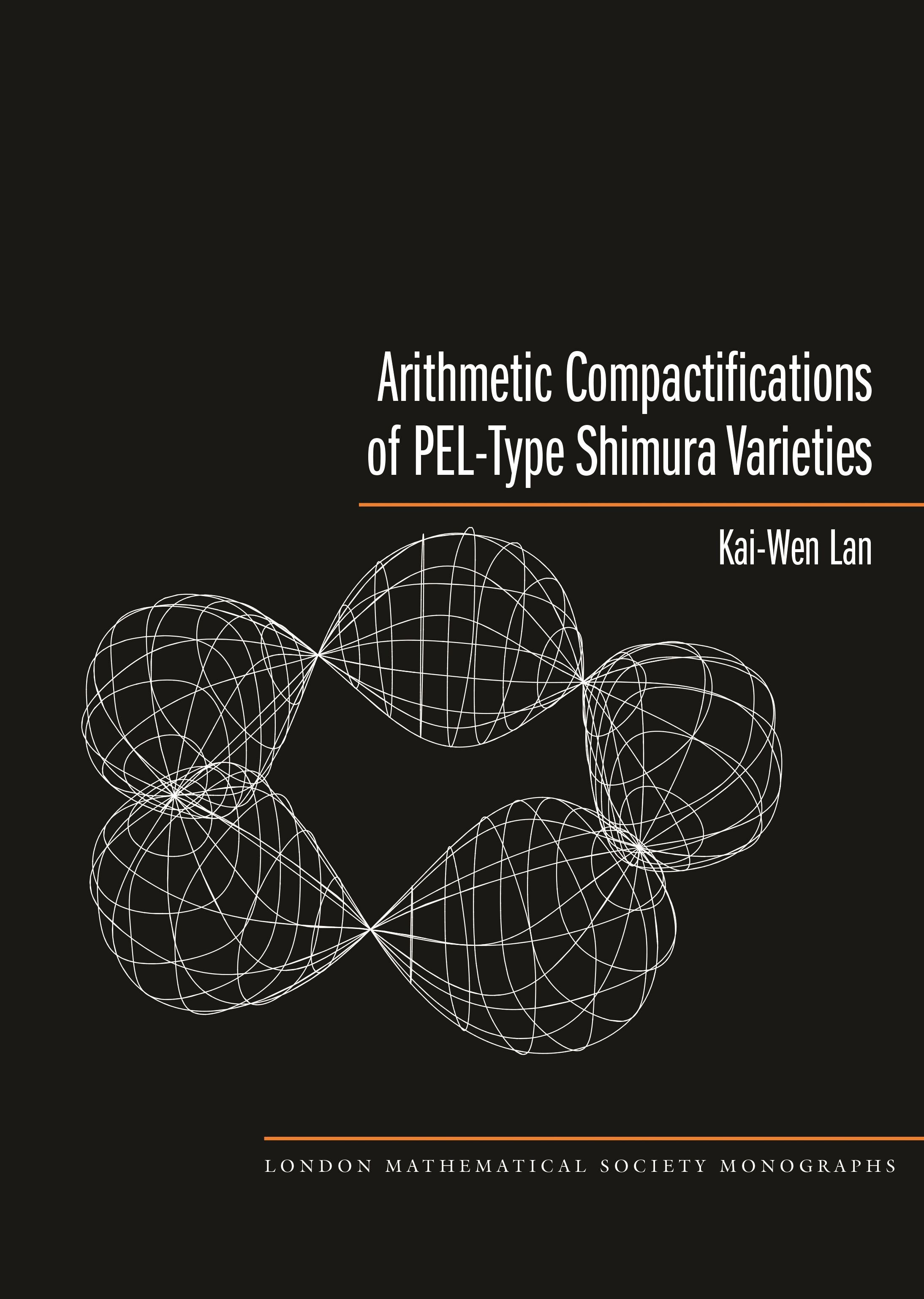
Arithmetic compactifications of PEL-type shimura varieties
By studying the degeneration of abelian varieties with PEL structures, this book explains the compactifications of smooth integral models of all PEL-type Shimura varieties, providing the logical foundation for several exciting recent developments. The book is designed to be accessible to graduate students who have an understanding of schemes and abelian varieties.
PEL-type Shimura varieties, which are natural generalizations of modular curves, are useful for studying the arithmetic properties of automorphic forms and automorphic representations, and they have played important roles in the development of the Langlands program. As with modular curves, it is desirable to have integral models of compactifications of PEL-type Shimura varieties that can be described in sufficient detail near the boundary. This book explains in detail the following topics about PEL-type Shimura varieties and their compactifications:
A construction of smooth integral models of PEL-type Shimura varieties by defining and representing moduli problems of abelian schemes with PEL structuresAn analysis of the degeneration of abelian varieties with PEL structures into semiabelian schemes, over noetherian normal complete adic base ringsA construction of toroidal and minimal compactifications of smooth integral models of PEL-type Shimura varieties, with detailed descriptions of their structure near the boundary
Through these topics, the book generalizes the theory of degenerations of polarized abelian varieties and the application of that theory to the construction of toroidal and minimal compactifications of Siegel moduli schemes over the integers (as developed by Mumford, Faltings, and Chai).
eBook
The Seiberg-Witten equations and applications to the topology of smooth four-manifolds (MN-44)
The recent introduction of the Seiberg-Witten invariants of smooth four-manifolds has revolutionized the study of those manifolds. The invariants are gauge-theoretic in nature and are close cousins of the much-studied SU(2)-invariants defined over fifteen years ago by Donaldson. On a practical level, the new invariants have proved to be more powerful and have led to a vast generalization of earlier results. This book is an introduction to the Seiberg-Witten invariants.
The work begins with a review of the classical material on Spincstructures and their associated Dirac operators. Next comes a discussion of the Seiberg-Witten equations, which is set in the context of nonlinear elliptic operators on an appropriate infinite dimensional space of configurations. It is demonstrated that the space of solutions to these equations, called the Seiberg-Witten moduli space, is finite dimensional, and its dimension is then computed. In contrast to the SU(2)-case, the Seiberg-Witten moduli spaces are shown to be compact. The Seiberg-Witten invariant is then essentially the homology class in the space of configurations represented by the Seiberg-Witten moduli space. The last chapter gives a flavor for the applications of these new invariants by computing the invariants for most Kahler surfaces and then deriving some basic toological consequences for these surfaces.
eBook
Non-Archimedean Tame Topology and Stably Dominated Types (AM-192)
Over the field of real numbers, analytic geometry has long been in deep interaction with algebraic geometry, bringing the latter subject many of its topological insights. In recent decades, model theory has joined this work through the theory of o-minimality, providing finiteness and uniformity statements and new structural tools.For non-archimedean fields, such as the p-adics, the Berkovich analytification provides a connected topology with many thoroughgoing analogies to the real topology on the set of complex points, and it has become an important tool in algebraic dynamics and many other areas of geometry.This book lays down model-theoretic foundations for non-archimedean geometry. The methods combine o-minimality and stability theory. Definable types play a central role, serving first to define the notion of a point and then properties such as definable compactness.Beyond the foundations, the main theorem constructs a deformation retraction from the full non-archimedean space of an algebraic variety to a rational polytope. This generalizes previous results of V. Berkovich, who used resolution of singularities methods.No previous knowledge of non-archimedean geometry is assumed. Model-theoretic prerequisites are reviewed in the first sections.
eBook
Classification of Pseudo-reductive Groups (AM-191)
In the earlier monograph Pseudo-reductive Groups, Brian Conrad, Ofer Gabber, and Gopal Prasad explored the general structure of pseudo-reductive groups. In this new book, Classification of Pseudo-reductive Groups, Conrad and Prasad go further to study the classification over an arbitrary field. An isomorphism theorem proved here determines the automorphism schemes of these groups. The book also gives a Tits-Witt type classification of isotropic groups and displays a cohomological obstruction to the existence of pseudo-split forms. Constructions based on regular degenerate quadratic forms and new techniques with central extensions provide insight into new phenomena in characteristic 2, which also leads to simplifications of the earlier work. A generalized standard construction is shown to account for all possibilities up to mild central extensions.The results and methods developed in Classification of Pseudo-reductive Groups will interest mathematicians and graduate students who work with algebraic groups in number theory and algebraic geometry in positive characteristic.
eBook
Hodge theory (Mathematical notes 49)
This book provides a comprehensive and up-to-date introduction to Hodge theory—one of the central and most vibrant areas of contemporary mathematics—from leading specialists on the subject. The topics range from the basic topology of algebraic varieties to the study of variations of mixed Hodge structure and the Hodge theory of maps. Of particular interest is the study of algebraic cycles, including the Hodge and Bloch-Beilinson Conjectures. Based on lectures delivered at the 2010 Summer School on Hodge Theory at the ICTP in Trieste, Italy, the book is intended for a broad group of students and researchers. The exposition is as accessible as possible and doesn't require a deep background. At the same time, the book presents some topics at the forefront of current research. The book is divided between introductory and advanced lectures. The introductory lectures address Kähler manifolds, variations of Hodge structure, mixed Hodge structures, the Hodge theory of maps, period domains and period mappings, algebraic cycles (up to and including the Bloch-Beilinson conjecture) and Chow groups, sheaf cohomology, and a new treatment of Grothendieck’s algebraic de Rham theorem. The advanced lectures address a Hodge-theoretic perspective on Shimura varieties, the spread philosophy in the study of algebraic cycles, absolute Hodge classes (including a new, self-contained proof of Deligne’s theorem on absolute Hodge cycles), and variation of mixed Hodge structures. The contributors include Patrick Brosnan, James Carlson, Eduardo Cattani, François Charles, Mark Andrea de Cataldo, Fouad El Zein, Mark L. Green, Phillip A. Griffiths, Matt Kerr, Lê Dũng Tráng, Luca Migliorini, Jacob P. Murre, Christian Schnell, and Loring W. Tu.
eBook