
Catalogue Search | MBRL


Are you sure you want to remove the book from the shelf?

{{itemTitle}}
24
result(s) for
"Sustainability Netherlands History."
Sort by:

Well-being, sustainability and social development : the Netherlands 1850-2050
\"This open access book examines more than two centuries of societal development using novel historical and statistical approaches. It applies the well-being monitor developed by Statistics Netherlands that has been endorsed by a significant part of the international, statistical community. It features The Netherlands as a case study, which is an interesting example. Although it was one of the world's richest countries around 1850, extreme poverty and inequality were significant problems of well-being at the time. Monitors of 1850, 1910, 1970 and 2015 depict the changes in three dimensions of well-being: the quality of life 'here and now', 'later' and 'elsewhere'. The analysis of two centuries shows the solutions to the extreme poverty problem and the appearance of new sustainability problems, especially in domestic and foreign ecological systems. The study reveals the importance of natural capital: soil, air, water and subsoil resources, showing their relation with the social structure of the 'here and now'. Treatment and trade of natural resources also impacted on the quality of life 'later' and 'elsewhere.' The book illustrates the role of natural capital by dividing the capital into three types of raw materials and concomitant material flows: bio-raw materials, mineral and fossil subsoil resources. Additionally, the analysis of the institutional context identifies the key roles of social groups in well-being development\"--Back cover.
Book

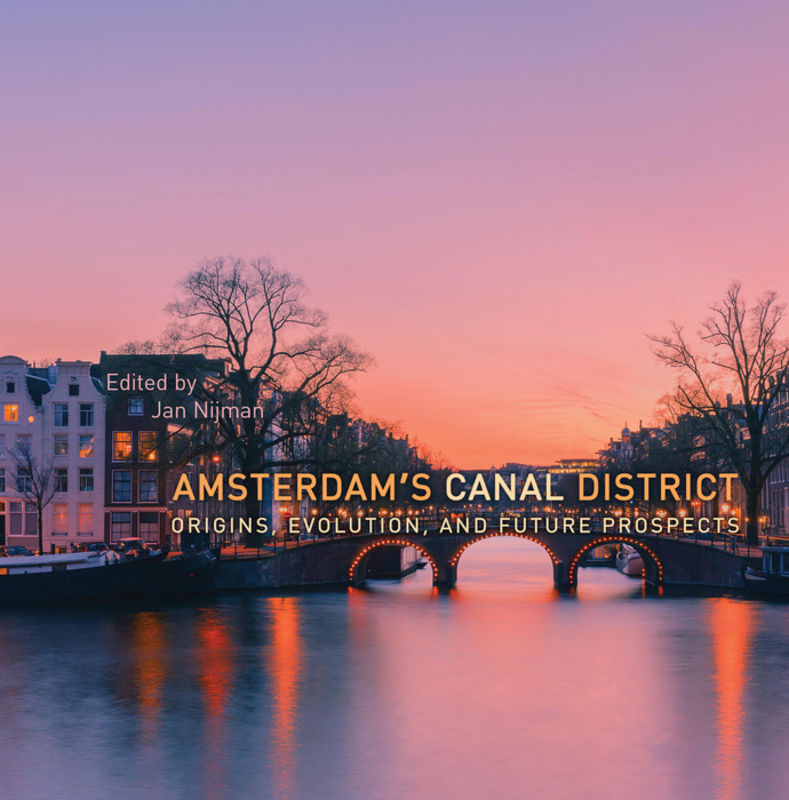
Amsterdam’s Canal District
This book chronicles the Amsterdam's 17th-century Canal District
District's origins and historical evolution over 400 years and
debates its future prospects under pressures of global tourism,
gentrification, and rapid economic change.
eBook

How Multilevel Societal Learning Processes Facilitate Transformative Change
Sustainable resources management requires a major transformation of existing resource governance and management systems. These have evolved over a long time under an unsustainable management paradigm, e.g., the transformation from the traditionally prevailing technocratic flood protection toward the holistic integrated flood management approach. We analyzed such transformative changes using three case studies in Europe with a long history of severe flooding: the Hungarian Tisza and the German and Dutch Rhine. A framework based on societal learning and on an evolutionary understanding of societal change was applied to identify drivers and barriers for change. Results confirmed the importance of informal learning and actor networks and their connection to formal policy processes. Enhancing a society’s capacity to adapt is a long-term process that evolves over decades, and in this case, was punctuated by disastrous flood events that promoted windows of opportunity for change.
Journal Article

Flooded with potential: urban drainage science as seen by early-career researchers
This opinion paper reflects on the current challenges facing urban drainage systems (UDS) research, along with solutions for fostering sustainable development. Over the course of a year-long project involving 92 participants aged 24–38, including PhD candidates, post-doctoral researchers, and early-career academics, we identified critical challenges and opportunities for the sustainable development of UDS. Our exploration highlights four key challenges: limited public visibility leading to resource constraints, insufficient collaboration across subfields, issues with data scarcity and data sharing, and geographical specificities. We emphasise the importance of raising public and political awareness regarding UDS's vital role in climate adaptation and urban resilience, advocating for blue-green infrastructure and open data practices. Additionally, we address systemic academic barriers that hinder innovative research. We call for a shift away from metrics that prioritise quantity over quality. We recommend establishing stable career pathways that empower early-career researchers. This paper aims to catalyse a broader community dialogue about the future of UDS research, uniting voices from various career stages. By presenting actionable recommendations, we aim to inspire fundamental changes in research conduct, evaluation, and sustainability, ensuring the field of UDS is prepared to meet pressing urban water management challenges worldwide.
Journal Article

Between ambitions and actions: how citizens navigate the entrepreneurial process of co-producing sustainable urban food futures
Cities increasingly envision sustainable future food systems. The realization of such futures is often understood from a planning perspective, leaving the role of entrepreneurship out of scope. The city of Almere in the Netherlands provides a telling example. In the neighborhood Almere Oosterwold, residents must use 50% of their plot for urban agriculture. The municipality formulated an ambition that over time, 10% off all food consumed in Almere must be produced in Oosterwold. In this study, we assume the development of urban agriculture in Oosterwold is an entrepreneurial process, i.e. a creative (re)organization that is ongoing and intervenes in daily life. To understand how this entrepreneurial process helps to realize sustainable food futures, this paper explores what futures for urban agriculture residents of Oosterwold prefer and deem possible and how these futures are organized in the present. We use futuring to explore possible and preferable images of the future, and to backcast those images to the present day. Our findings show residents have different perspectives of the future. Furthermore, they are capable in formulating specific actions to obtain the futures they prefer, but have trouble committing to the actions themselves. We argue this is the result of a temporal dissonance, a myopia where residents have trouble looking beyond their own situation. It shows imagined futures must fit with the lived experiences of citizens in order to be realized. We conclude that urban food futures need planning and entrepreneurship to be realized since they are complementary social processes.
Journal Article
Landscape discourses and rural transformations: insights from the Dutch Dune and Flower Bulb Region
Rural landscapes are facing a loss of biodiversity. To deal with this challenge, landscape governance is seen as an alternative and addition to sectoral policies and a potential way of realizing transformative change for biodiversity. To study transformative change in the Bulb Region, the Netherlands, this study uses a discursive-institutional perspective. A mixed methods approach was used including 50 interviews, participant observation and document analysis. The structuration and institutionalization of three competing landscape discourses were analyzed: a hegemonic discourse rejecting any changes in bulb farming; an emerging discourse aiming to enhance sustainability through innovation; and an unstructured discourse questioning the sustainability of bulb farming. The paper shows that the emerging sustainability discourse strengthens the hegemonic discourse by providing an action repertoire for farmers to deal with changing societal demands, while not questioning the hegemonic view on the landscape. Moreover, an institutionalized landscape discourse can be very stable if discursive (relation between naturalized landscape perspectives, identity and the articulated economic interests) and non-discursive factors (natural-spatial conditions, structure of agricultural sector, embeddedness in international trade) are strongly intertwined, leaving little room for alternative discourses. The sustainability discourse was induced by changes outside the Bulb Region (e.g., legislation), thus raising the question whether landscapes are the appropriate level to expect the initiation of transformative change. For rural transformations to come about, solely relying on policies on the landscape level is not sensible. A mix of policies at both the landscape and higher levels offers more perspective for transformative change.
Journal Article

Reinventing a Rural Area: A Case Study into Cultural Festivals in Oldambt, The Netherlands
The Oldambt area, in the northeast of the Netherlands, has recently suffered from depopulation and a negative image. However, four high-quality cultural festivals have been developed in or moved towards the area during the last decade. The festivals have different organisational models. This paper assesses how they contribute to rural regeneration through semi-structured interviews with stakeholders around the festivals and local youth. It adds to the existing literature by introducing the concept of rural regeneration, stemming from neo-endogenous rural development, into festival research and by conducting multiple case studies in one area. The paper investigates the festivals’ local legitimacy, rootedness, and ability to create interconnectedness. The findings suggest that the festivals are locally supported, use local resources, and benefit the area, notwithstanding their organisational model. The festivals also help to establish networks within and outside of Oldambt, and there is thus a positive effect on regeneration. The recent more positive developments in Oldambt may be related to the organisation of the festivals.
Journal Article
Feeding the melting pot: inclusive strategies for the multi-ethnic city
The need for a shift toward healthier and more sustainable diets is evident and is supported by universalized standards for a “planetary health diet” as recommended in the recent EAT-Lancet report. At the same time, differences exist in tastes, preferences and food practices among diverse ethnic groups, which becomes progressively relevant in light of Europe’s increasingly multi-ethnic cities. There is a growing tension between current sustainable diets standards and how diverse ethnic resident groups relate to it within their ‘culturally appropriate’ foodways, raising questions around inclusion. What are dynamics of inclusiveness in migrant food practices? And what does this mean towards the transition to healthy and sustainable food? We study this question among Syrian migrants with different lengths of stay in the Netherlands. Our theoretical framework is based on practice theories, which emphasize the importance of socio-material context and of bodily routines and competences. We use qualitative methods, combining in-depth semi-structured life-history interviews with participant observation. Our findings indicate that inclusiveness takes different forms as migrants’ food practices and the food environment change. Regarding health and sustainability in food practices, understandings and competences around particularly fresh food change over time among both short- and long-term migrants, replacing making things from scratch with seasonal products with buying more processed products and out-of-season vegetables and fruits. We conclude that the performances of food practices and their configurations in food environments and lifestyles are dynamic and cannot unequivocally be interpreted as in- or exclusive, but that a more nuanced understanding is required.
Journal Article

Trustworthiness and Responsible Research and Innovation: The Case of the Bio-Economy
The approach of responsible research and innovation (RRI) has been proposed to support the introduction of technologies that touch upon socially sensitive issues. RRI is intended to help designers and manufacturers of new technologies identify and accommodate public concerns when developing a new technology by engaging with a wide range of relevant actors in an interactive, transparent process. However what this approach amounts to exactly remains elusive as of yet, i.e. it is unclear what its contribution to the societal embedding of new technologies should consists of exactly. The transition to a sustainable bio-economy that uses biomass as its main resource is a complicated trajectory involving many actors and touching upon societally sensitive issues such as the use of genetic modification. In this paper we pose the question in what way RRI can stimulate the development and diffusion of a sustainable bio-economy in The Netherlands and Europe. We claim that for the further development and diffusion of the bio-economy, trust among actors in the relevant value-chain is a prerequisite. RRI can play a pivotal part in the bio-economy by providing conditions for trustworthiness of actors and by enhancing trusting relationships. This can be achieved through instruments such as personal relationships, third person guarantors, institutions and the communication of values. From the application of RRI to the context of the bio-economy, lessons can be drawn for other socially intricate technological trajectories.
Journal Article