
Catalogue Search | MBRL


Are you sure you want to remove the book from the shelf?

{{itemTitle}}
156
result(s) for
"Sustainable buildings United States Design and construction."
Sort by:
ASHRAE greenguide : design, construction, and operation of sustainable buildings
\"Provides information on green-building design. Concerned with sustainable, high-performance projects\"-- Provided by publisher.
Book

Sustainable construction
The leading green building reference, updated with the latest advances in the field Sustainable Construction is the leading reference for the design, construction, and operation of high performance green buildings. With broad coverage including architecture, engineering, and construction, this book nevertheless delivers detailed information on all aspects of the green building process, from materials selection to building systems and more. This new fourth edition has been updated to reflect the latest codes and standards, including LEED v4, and includes new coverage of carbon accounting. The discussion has been updated to align with the current thinking on economics, climate change, net zero buildings, and more, with contributions by leaders in the field that illustrate the most recent shifts in thinking and practice. Ancillary materials including an instructor′s manual and PowerPoint presentations for each chapter help bring this clear and up-to-date information into the classroom, making this book a valuable reference for working construction professionals. Also, Interactive graphics found throughout the course help activate the content and highlight key concepts for students. Sustainable construction has gone mainstream, and will one day be the industry norm. This book provides a comprehensive reference to all aspects of a project to show you how green building concepts and principles apply throughout the design and construction process. Get up to date on the latest green building codes and standards Learn about the newest technology in green building materials Adopt the best practices in procurement and delivery systems Apply sustainability concepts to all aspects of construction and design Green buildings operate at a very high level of efficiency, which is made possible only by careful consideration every step of the way. Appropriate land use, landscaping, construction materials, siting, water use, and more all play a role in a structure′s ultimate carbon footprint. Sustainable Construction provides clear guidance for all aspects of green building, including the most recent advances and the latest technology.
eBook

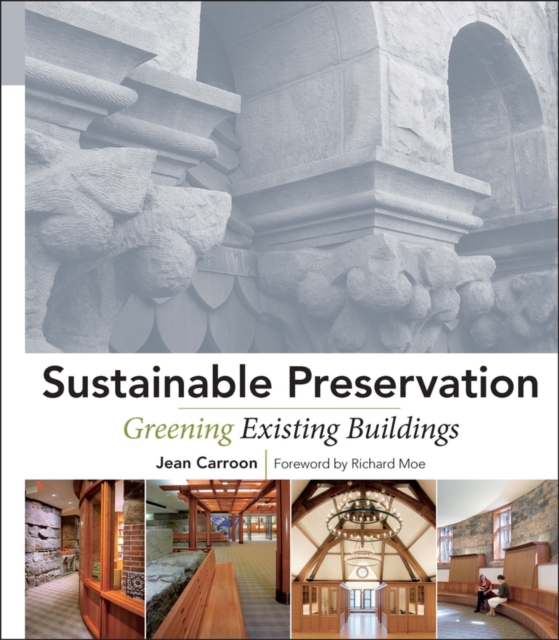
Sustainable preservation
Sustainable Preservation takes a nuanced look at the hundreds of choices that adaptive reuse requires architects to make—from ingenious ways to redeploy existing structural elements to time-honored techniques for natural ventilation to creation of wetlands that restore a site's natural biological functions. In addition, Sustainable Preservation presents 50 case studies of projects—schools, houses, offices, stores, museums, and government buildings—that set new standards for holistic approaches to adaptive reuse and sustainability. The author covers design issues, from building location to lighting systems, renewable power options, stormwater handling, and building envelope protection and integrity. The book also reviews operational issues, including materials choices for low lifetime maintenance, green housekeeping, and indoor air quality.
eBook

Circular Digital Built Environment: An Emerging Framework
Digital technologies are considered to be an essential enabler of the circular economy in various industries. However, to date, very few studies have investigated which digital technologies could enable the circular economy in the built environment. This study specifically focuses on the built environment as one of the largest, most energy- and material-intensive industries globally, and investigates the following question: which digital technologies potentially enable a circular economy in the built environment, and in what ways? The research uses an iterative stepwise method: (1) framework development based on regenerating, narrowing, slowing and closing resource loop principles; (2) expert workshops to understand the usage of digital technologies in a circular built environment; (3) a literature and practice review to further populate the emerging framework with relevant digital technologies; and (4) the final mapping of digital technologies onto the framework. This study develops a novel Circular Digital Built Environment framework. It identifies and maps ten enabling digital technologies to facilitate a circular economy in the built environment. These include: (1) additive/robotic manufacturing, (2) artificial intelligence, (3) big data and analytics, (4) blockchain technology, (5) building information modelling, (6) digital platforms/marketplaces, (7) digital twins, (8) the geographical information system, (9) material passports/databanks, and (10) the internet of things. The framework provides a fruitful starting point for the novel research avenue at the intersection of circular economy, digital technology and the built environment, and gives practitioners inspiration for sustainable innovation in the sector.
Journal Article
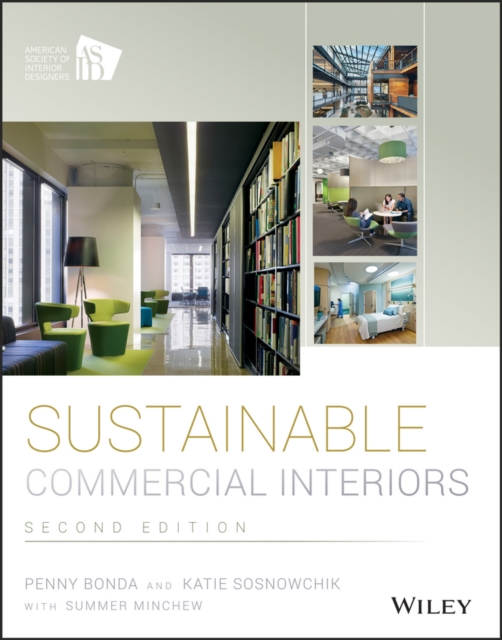
Sustainable commercial interiors
Discover new approaches to green design and sustainable building with this comprehensive guide
There's a substantial amount of information designers and architects need to understand about sustainability and commercial projects, especially as expectations for professionals in the industry become clearer. Luckily, the second edition of Sustainable Commercial Interiors has been revamped to serve as a comprehensive guide for anyone looking to understand the latest in green and sustainable design. Fully revised throughout, this resource now includes frameworks based on the new LEEDv4 rating system, and provides fifteen brand-new case studies that document green design and building strategies for all types of projects. You'll find information on materials, furnishings, finishes, product standards, and certifications, all designed to keep you in the know and prepare you for future ventures in sustainable design.
The ideal professional companion for interior designers, commercial builders and developers, architects, and interior design students, this guide is an all-in-one introduction to the most essential topics in the industry, such as global environmental issues, water and energy usage, and the tools of the trade, to name just a few. The book is illustrated with full color images throughout.
* Fully revised and updated to include information on the new LEEDv4 rating system
* Discusses the past, present, and future of sustainable design
* Considers global environmental issues, such as waste, land use, and bio-inspired design
* Covers water and energy usage and sustainable materials
Discover the benefits of green building and adopt new approaches to sustainable design. Sustainable Commercial Interiors is your go-to resource for navigating new expectations for responsible interior design.
eBook

Concrete Mix Design of Recycled Concrete Aggregate (RCA): Analysis of Review Papers, Characteristics, Research Trends, and Underexplored Topics
Recycled concrete aggregate (RCA) has been widely adopted in construction and emerged as a sustainable alternative to conventional natural aggregates in the construction industry. However, the study of holistic perspectives in recent literature is lacking. This review paper aims to provide a comprehensive analysis of RCA, highlighting its properties, applications, and overall sustainability benefits to facilitate the comprehensive points of view of technology, ecology, and economics. This paper explores the manufacturing process of RCA, examines its mechanical and durability characteristics, and investigates its environmental impacts. Furthermore, it delves into the various applications of RCA, such as road construction materials, pavement bases, and concrete materials, considering their life cycle performance and economic considerations. This review reveals that there is a need for systemic data collection that could enable automated concrete mix design. The findings concerning various mix concrete designs suggest that increasing the 1% replacement level reduces the compressive strength by 0.1913% for coarse RCA and 0.2418% for fine RCA. The current critical research gaps are the durability of RCA concrete, feasibility analyses, and the implementation of treatment methods for RCA improvement. An effective life cycle assessment tool and digitalization technologies can be applied to enhance the circular economy, aligning with the United Nations’ sustainable development goals (UN-SDGs). The equivalent mortar volume method used to calculate the RCA concrete mix design, which can contain chemical additives, metakaolin, and fibers, needs further assessment.
Journal Article

Enhancing Energy Efficiency in Buildings through PCM Integration: A Study across Different Climatic Regions
In the quest for sustainable and energy-efficient building solutions, the incorporation of phase change materials (PCMs) into building envelopes emerges as a groundbreaking strategy. PCMs, renowned for storing and releasing thermal energy during phase transitions, stand as a promising avenue to curtail energy consumption while enhancing thermal performance. This study rigorously explores the potential energy savings and thermal comfort benefits achievable through PCM integration into building envelopes. Multiple energy simulations are conducted on a residential building model in diverse locations, including Irbid, Amman, and Aqaba in Jordan, and the city of Oradea in Romania, utilizing the EnergyPlus simulation tool embedded in DesignBuilder software v7.0.2.006. The results reveal that BioPCM®, derived from renewable biomass, significantly elevates thermal performance owing to its heightened latent heat of fusion. Optimal outcomes materialize with a PCM melting point of 23 °C, a configuration closer to the interior surface, and a thickness of 37.1 mm. The study underscores the superior performance in moderate climates (Irbid and Amman) compared to hot-dry climates (Aqaba) and cold-wet climates (Oradea, Romania). Financially and environmentally, incorporating PCM in Amman demonstrates potential annual energy savings of 5476.14 kWh, translating to a cost reduction of 1150 USD/year, and a decrease in GHG emissions by 2382.31 kgCO2eq. The estimated payback period for PCM incorporation in external walls is four years, robustly emphasizing the feasibility and multifaceted benefits of this energy-efficient solution.
Journal Article
Research Status and Emerging Trends in Green Building Materials Based on Bibliometric Network Analysis
Green building materials refer to environmentally friendly low-consumption construction materials. Their widespread adoption is hindered by high costs, limited technological implementation, and the absence of standardized regulations. This study conducts a bibliometric analysis of 5381 publications from 2003 to 2024, sourced from the Web of Science Core Collection (WoS), applying Sustainability Transitions Theory (STT) to classify research into Niche Innovation (new materials like phase change materials), Regime Adaptation (policies and lifecycle assessments), and Landscape Pressures (climate goals and circular economy integration). The results show rapid growth in research, shifting from basic sustainability concepts to advanced materials, lifecycle analysis, and digital technologies. Key themes include energy conservation, mechanical performance, and environmental impact, with emerging trends like carbon reduction strategies, blockchain applications in circular economies, and the integration of carbon capture and storage (CCS) in construction. Future research should focus on enhancing material durability, standardizing sustainability metrics, and developing cost-effective recycling strategies to promote wider adoption.
Journal Article