
Catalogue Search | MBRL


Are you sure you want to remove the book from the shelf?

{{itemTitle}}
178
result(s) for
"Sustainable development Great Britain."
Sort by:


Building sustainable communities
In 2003 the Labour Government published its ambitious Sustainable Communities Plan. It promised to bring about a 'step change' in the English planning system and a new emphasis on the construction of more balanced, cohesive, and competitive places. This book uses historical and contemporary materials to document the ways in which policy-makers, in different eras, have sought to use state powers and regulations to create better, more balanced, and sustainable communities and citizens. It charts the changes that have take place in community-building policy frameworks, place imaginations, and core spatial policy initiatives in the UK since 1945. In so doing, it examines the tensions that have emerged within spatial policy over the types of places that should be created and the forms of mobility and fixity required to create them. It also shows that there are significant lessons that can be learnt from the experiences of the past. These can be used to inform contemporary policy debates over issues such as migration, uneven development, key worker housing, and sustainability. The book will be an important text for students and researchers in geography, urban studies, planning, and modern social history. It will also be of interest to practitioners working in central and local government, voluntary organisations, community groups, and those involved in the planning and design of sustainable communities.
eBook


Green Business, Green Values, and Sustainability
Today greenness is goodness; non-greenness is not an option. It is therefore critical to advance thinking on why and how business, consumers and policy makers can contribute to the goal of sustainable global wealth creation. This volume analyzes the strategic sustainability issues confronting contemporary business, and explores the transformation in values, strategies, and practices needed by modern businesses to attain sustainable business. It is is developed from a Global Business Symposium organized by the Centre for International Business and Management (CIBAM) at Cambridge University in February 2009, which brought together leading academics, scientists and engineers, government leaders, and business executives to consider the transformation in business values and strategies implicit in sustainability. Green Business, Green Values and Sustainability offers a concise and definitive book on the green transformation of business in major sectors including government, finance, energy, and retail. Different solutions to sustainability are explored including ethical approaches, alternative environmental strategies, corporate responsibility, and carbon reductions.
eBook


The Sustainable University
The direction of higher education is at a crossroads against a background of mounting sustainability-related issues and uncertainties. This book seeks to inspire positive change in higher education by exploring the rich notion of the sustainable university and illustrating pathways through which its potential can be realised. Based on the experience of leading higher education institutions in the UK, the book outlines progress in the realisation of the concept of the 'sustainable university' appropriate to the socioeconomic and ecological conditions facing society and graduates. Written by leading exponents of sustainability and sustainability education, this book brings together examples, insight, reflection and strategies from the experience of ten universities, widely recognised as leaders in developing sustainability in higher education. The book thus draws on a wealth of experience to provide reflective critical analysis of barriers, achievements, strategies and potential. It critically reviews the theory and practice involved in developing the sustainable university in a systemic and whole institutional manner, including the role of organisational learning.While remaining mindful of the challenges of the current climate, The Sustainable University maps out new directions and lines of research as well as offering practical advice for researchers, students and professionals in the fields of management, leadership, organisational change, strategy and curriculum development who wish to take this work further.
eBook

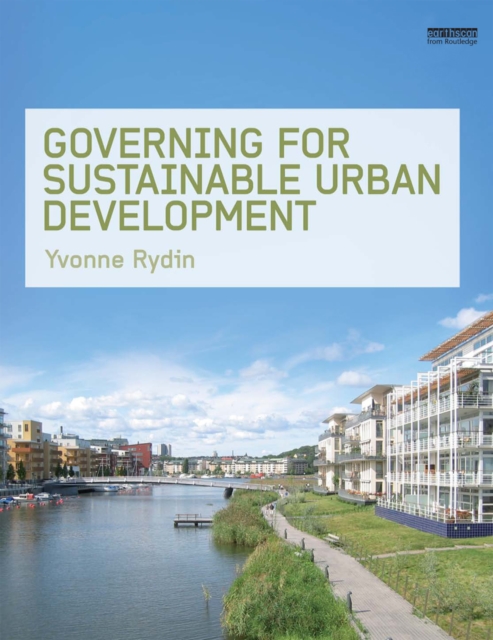
Governing for Sustainable Urban Development
Achieving urban sustainability is amongst the most pressing issues facing planners and governments. This book is the first to provide a cohesive analysis of sustainable urban development and to examine the processes by which change in how urban areas are built can be achieved. The author looks at how sustainable urban development can be delivered on the ground through a comprehensive analysis of the different modes of governing for new urban development.
Governing for Sustainable Urban Development:
considers a range of policy tools that influence urban development and that constitute different modes of governing
provides an innovative conceptual emphasis on learning within governing processes
draws on a wide range of existing research, policy and literature together with case study material focussing on London
is above all concerned with demonstrating how sustainable urban development can be delivered in practice.
This title be essential reading for students, academics and professionals in planning, urban design and architecture world-wide working to achieve sustainability.
eBook

Retrofitting the built environment
\"Retrofitting the Built Environment is an extension of this conference. Contained within is a mix of policy, technical and social science papers, presented by both academic and industry authors, giving a multiple perspective of the issue from both a UK and international perspective\"-- Provided by publisher.
Book
Sustainable Development Law in the UK
Sustainable development is now widely accepted as a political objective in the UK and elsewhere but to what extent has the UK's rhetoric on sustainable development become a reality? The aim of this book is to critically examine the UK's approach to promoting and delivering sustainable development. It begins by providing a detailed account of UK law on sustainable development by reviewing the various policy, institutional and legal mechanisms used by the UK since the 1980s and by devolved administrations since devolution took effect in 1999. Progress has been slow, too slow and, according to the scientists, time is running out. To deal with this lack of progress, the book advocates increasing the status of ecological sustainability and sustainable development through the introduction of a wide range of legal mechanisms which would compel the change needed.
The book calls for ecological sustainability, or respecting the Earth's environmental limits, to be afforded the status of legal principle and argues that with ecological sustainability at its normative core, sustainable development could provide an effective framework for decision making and governance. It argues that to support this approach and ensure consistency, the time has come for sustainable development to receive explicit legal backing. Over and above its symbolic and educational value, legislation can impose mandatory rules on policymakers and decision makers, often with meaningful consequences both inside and outside the courtroom. To this end, the book contributes to the theory on sustainable development governance by suggesting three possible legislative approaches for such intervention. The volume concludes that while a lack of leadership on sustainable development may hinder the introduction of these innovations, once introduced, these innovations would equally provide much needed support for effective leadership towards a sustainable future.
Andrea Ross is a Reader in the School
eBook