
Catalogue Search | MBRL


Are you sure you want to remove the book from the shelf?

{{itemTitle}}
4,387
result(s) for
"Sustainable development India."
Sort by:


Ecologies of urbanism in India : metropolitan civility and sustainability
Essays follow rapidly proliferating and resource-intensive Indian urbanism in everyday environments. Case studies on nature conservation in cities, urban housing and slum development, waste management, urban planning, and contestations over the quality of air, water, and sanitation in Delhi and Mumbai illuminate urban ecology perspectives throughout the twentieth century. The collection highlights how struggles over the environment and one's quality of life in urban centers are increasingly framed in terms of their future place in a landscape of global sustainability. The text brings historical particularity and ethnographic nuance to questions of urban ecology and offers novel insight into theoretical and practical debates on urbanism and sustainability.
eBook

An alternative development agenda for India
\"This book provides a revamped, transformative, and fiscally sustainable developmental agenda for India to radically improve the well-being and livelihoods of its citizens. Grounded in a 'people first' approach, this alternative agenda focuses on seven vital development and inter-connected areas, including health, education, food and nutrition, child development, gender, livelihood and jobs, and urbanization. The volume highlights the systemic issues plaguing these sectors and offers pragmatic and implementable solutions to address them. The author takes cognizance of the COVID-19 pandemic and draws attention to the limitations of the current public policies and suggests cost-effective interventions and strategies that focus on the poor. The volume discusses crucial themes of universalizing healthcare, battling malnutrition and food insecurity, ensuring quality schooling, unshackling gendered mindsets, enhancing livelihoods and improving the urban quality of life to spell out a pragmatic and workable development agenda for India. Accessible and reader-friendly, the book will be an essential read for scholars and researchers of development studies, economics, public policy, governance, development policy, public administration, political studies, South Asia studies. It will also be of interest to professionals in the development sector\"-- Provided by publisher.
BOOK
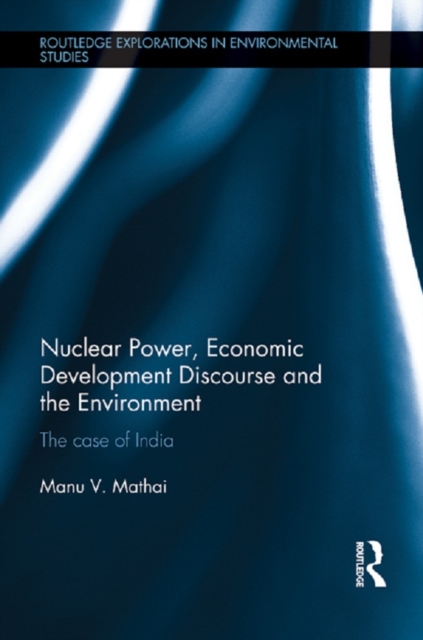
Nuclear Power, Economic Development Discourse and the Environment
Nuclear power is often characterized as a \"green technology.\" Technologies are rarely, if ever, socially isolated artefacts. Instead, they materially represent an embodiment of values and priorities. Nuclear power is no different. It is a product of a particular political economy and the question is whether that political economy can helpfully engage with the challenge of addressing the environmental crisis on a finite, inequitable and shared planet. For developing countries like India, who are presently making infrastructure investments which will have long legacies, it is imperative that these investments wrestle with such questions and prove themselves capable of sufficiency, greater equality and inclusiveness.
This book offers a critique of civilian nuclear power as a green energy strategy for India and develops and proposes an alternative \"synergy for sustainability.\" It situates nuclear power as a socio-technical infrastructure embodying a particular development discourse and practice of energy and economic development. The book reveals the political economy of this arrangement and examines the latter's ability to respond to the environmental crisis.
Manu V. Mathai argues that the existing overwhelmingly growth-focused, highly technology-centric approach for organizing economic activity is unsustainable and needs to be reformed. Within this imperative for change, nuclear power in India is found to be and is characterized as an \"authoritarian technology.\" Based on this political economy critique the book proposes an alternative, a synergy of ideas from the fields of development economics, energy planning and science, technology and society studies.
eBook

Open markets, free trade and sustainable development : perspectives from EU and India
This book explores the dilemmas posed by globalisation in various aspects of law. It covers diverse themes, ranging from the impact of different legislative measures, bilateral and regional agreements in the context of trade, investment and mobility of labour, to concerns about sustainability, equity, regional balance and social security in the light of globalisation. Although it focuses mainly on India and the European Union, the issues raised and challenges discussed are of a general nature, and as such relevant in the broader context. The chapters address contemporary problems in trade, investment and labour mobility, which have emerged through the complex interaction of market, state policies and socio-environmental concerns, and are expressed on national and global platforms in the context of evolving legal system. The book is a valuable resource for students, researchers and academics engaged in comparative legal studies, particularly those interested in studying the interplay of globalisation with various areas and aspects of law at national as well as international levels. It also appeals to anyone interested in law and policy studies.
Book

Are SDGs a myth?
This book discusses the continued emphasis on development gains in India's national policies and its quest to meet sustainable development goals. It offers an analysis of the laws and infrastructure for environmental protection in the country and their ineffectiveness in dealing with water pollution which has had dire consequences on India's ecological landscape.
The book, while highlighting the need and importance of industrial development, argues for sustainable measures to moderate and monitor such developmental efforts in light of severe environmental degradations. Focusing on the state of Gujarat, it looks at published and un-published data on industrial development and water pollution levels and data obtained via applications filed under the Right to Information Act. It also offers a detailed account of the concentration of red industries which release the most hazardous pollutants and their effects on the environment. The authors look at the data from a theoretical and empirical perspective, offering insights into how the checks and balances levied by the state have been violated. They highlight the patterns and trends which emerge from the study of these developmental efforts and underline the need to improve the effectiveness of policy instruments, and the need to diversify the existing mechanisms.
The book will be of great interest to students and researchers of environment and development studies, public policy, sociology, law and governance, human ecology and economics.
eBook


Nuclear Power, Economic Development Discourse and the Environment
Nuclear power is often characterized as a \"green technology.\" Technologies are rarely, if ever, socially isolated artefacts. Instead, they materially represent an embodiment of values and priorities. Nuclear power is no different. It is a product of a particular political economy and the question is whether that political economy can helpfully engage with the challenge of addressing the environmental crisis on a finite, inequitable and shared planet. For developing countries like India, who are presently making infrastructure investments which will have long legacies, it is imperative that the
Book


Unleashing India's innovation : toward sustainable and inclusive growth
Unleashing India's Innovation: Toward Sustainable and Inclusive Growth provides nationaland local policy makers, private sector enterprises, academic and research institutions, internationalorganizations, and civil society with a better understanding of the power of innovation to fueleconomic growth and poverty reduction.
eBook