
Catalogue Search | MBRL


Are you sure you want to remove the book from the shelf?

{{itemTitle}}
125,075
result(s) for
"Sustainable development Management."
Sort by:

Sustainable futures in the built environment to 2050 : a foresight approach to construction and development
\"Brings together leading thinking on issues of new professional practice and on the future of a sustainable built environment This book focuses on both construction and development issues, and examines how we can transition to a sustainable future by the year 2050bringing together leading research and practice at building, neighbourhood, and city levels. It deftly analyses how emerging socio-economic, technological, and environmental trends will influence the built environment of the future. The book covers a broad spectrum of interests across the scales of buildings, communities and cities, including how professional practice will need to adapt to these trends. The broader context is provided by an analysis of emergent business models and the changing requirements for expert advice from clients. Sustainable Futures in the Built Environment to 2050: A Foresight Approach to Construction and Development features chapters covering: data and trends, including historical data and UK and international case studies; policies and practice related to the field; current state of scientific understanding; key challenges; key technological advances (including disruptive and systemic technological innovations); change issues and critical uncertainties; and future visions. It provides: A strong conceptual framework based on a Foresight' approach Discussion of the key data and trends that underpin each chapter, Coverage of both construction and property development Specially commissioned chapters by academics, and practitioners, A synthesis of the main findings in the book and key insights for the future to 2050 Sustainable Futures in the Built Environment to 2050: A Foresight Approach to Construction and Development is an important book for postgraduate students and researchers, construction, real estate and property development specialists, engineers, planners, architects, foresight and futures studies specialists, and anyone involved in sustainable buildings\"-- Provided by publisher.
Book

Digitalization of Government Management Processes in the Context of Sustainable Development
This study examines how integrating digital technologies into government operations can enhance urban governance in smart cities. It specifically looks at how these advancements can contribute to the development of sustainable smart cities in alignment with the Sustainable Development Goals (SDGs). The research employs two analytical frameworks to assess how advanced technologies impact and integrate with government functions. The first framework examines the effects of digitalization on sustainable smart cities, while the second offers a holistic approach to optimizing government processes through digital transformation. The research demonstrates the various advantages of digitalization, such as enhanced public services, advanced infrastructure, and greater transparency and accountability. Nevertheless, obstacles like data security, privacy issues, and disparities in digital access are recognized, requiring cautious handling. The research affirms that while integrating digital technologies in government operations can significantly support urban sustainability, the strategy is crucial to manage potential threats and foster inclusivity and environmental responsibility. These models provide practical recommendations for governments to responsibly and effectively utilize digital tools, ultimately fostering the development of resilient, efficient, and inclusive smart cities.
Journal Article

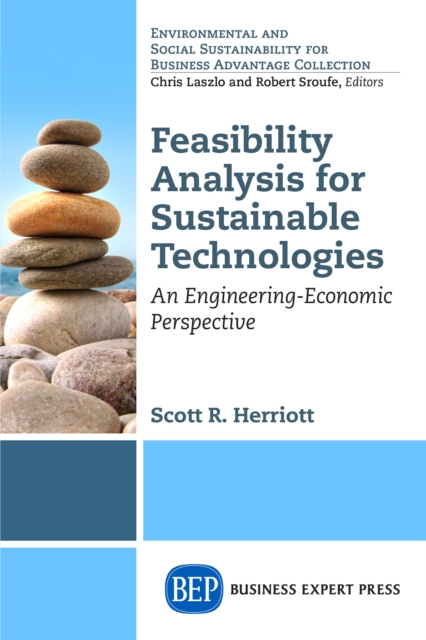
Feasibility analysis for sustainable technologies
This book leads the reader into a professional feasibility analysis for a renewable energy or energy efficiency project. The analysis begins with an understanding of the basic engineering description of technology in terms of capacity, efficiency, constraints, and dependability. It continues in modeling the cash flow of a project, which is affected by the installed cost, the revenues or expenses avoided by using the technology, the operating expenses of the technology, available tax credits and rebates, and laws regarding depreciation and income tax. The feasibility study is completed by discounted cash flow analysis, using an appropriate discount rate and a proper accounting for inflation, to evaluate the financial viability of the project. The elements of this analysis are illustrated using numerous examples of solar, wind, and hydroelectric power, biogas digestion, energy storage, biofuels, and energy-efficient appliances and buildings.
eBook

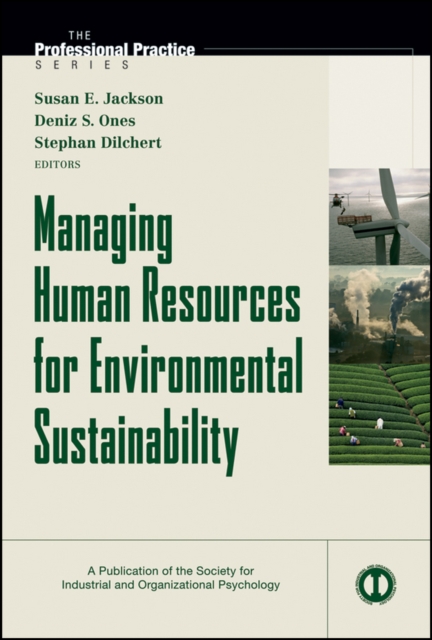
Managing human resources for environmental sustainability
Managing Human Resources for Environmental Sustainability The Society for Industrial and Organizational Psychology (SIOP) is the premier membership organization for those practicing industrial and organizational psychology. The Society's mission is to enhance human well-being and performance in organizational and work settings by promoting the science, practice, and teaching of industrial and organizational (I-O) psychology. I-O psychologists apply research that improves the well-being and performance of people and the organizations that employ them. This involves everything from workforce planning, employee selection, and leader development to studying job attitudes and job motivation, implementing work teams, and facilitating organizational change. SIOP is a nonprofit organization with more than 6,000 members. While an independent organization with its own governance, SIOP is also a division within the American Psychological Association and an organizational affiliate of the Association for Psychological Science.
eBook


Challenges and opportunities in sustainability reporting: a focus on small and medium enterprises (SMEs)
The purpose of the study was to observe how Small and Medium-sized Enterprises (SMEs) struggle to develop the sustainability reports that are today important and required by consumers. The rationale is that the sustainability report is influenced by governance practices, social responsibility, and environmental impact. The research successfully summarizes the barriers from 37 influential sustainability report papers by employing a thorough systematic literature review. It was based on 6 well-known databases with the limitation of exclusion criteria such as 11 years of research (2012–2023), used English, and more than 4 pages articles. According to the findings of this literature review approach, SMEs encounter six different sorts of barriers while trying to develop a sustainable report: financial, general attitude, knowledge and technology, organizational, policies and regulations as well as socio-environmental barriers. Based on this result, the top management of SMEs will be able to determine how to prioritize removing the biggest obstacles of their reporting task.
Journal Article


Moving beyond water centricity? Conceptualizing integrated water resources management for implementing sustainable development goals
While the UN’s 2030 Agenda for Sustainable Development, adopted in 2015, establishes an ambitious set of goals, targets and indicators for supporting global sustainability, greater conceptual clarity is required to measure implementation. A key UN Target (6.5) for implementing sustainable development goal (SDG) 6 is to ‘implement integrated water resources management (IWRM) at all levels’. However, we argue that the current UN emphasis on measuring its implementation through institutional indicators limits our understanding of effectiveness, while ignoring links to other SDGs. While IWRM is often interpreted to mean the integration of water-related management components at the river basin scale, conceptualizations differ significantly. Specifying the critical normative principles of IWRM, therefore, becomes important for measuring its implementation. Drawing upon pre-existing conceptualizations, we consequently identify seven core principles or dimensions (integration; scale; institutions; participation; economic valuation; equity; and, environmental/ecological protection) to re-conceptualize IWRM after the adoption of agenda 2030. These dimensions, we argue, allow more objective measurement of IWRM implementation through the development of Target 6.5 sub-indicators. They also help shift IWRM beyond its current ‘water centric’ emphasis to enhance its contribution to achieving other SDGs such as those for ending poverty, providing clean and affordable energy, achieving gender equality, protecting terrestrial ecosystems, promoting sustainable cities, combatting hunger and climate change, and strengthening the Global Partnership for Sustainable Development.
Journal Article