
Catalogue Search | MBRL


Are you sure you want to remove the book from the shelf?

{{itemTitle}}
439
result(s) for
"Sustainable development Middle East."
Sort by:


Sustainable Development
With growing evidence of unsustainable use of the world's resources, such as hydrocarbon reserves, and related environmental pollution, as in alarming climate change predictions, sustainable development is arguablytheprominent issue of the 21st century. This volume gives a wide ranging introduction focusing on the arid Gulf region, where the challenges of sustainable development are starkly evident. The Gulf relies on non-renewable oil and gas exports to supply the world's insatiable CO2 emitting energy demands, and has built unsustainable conurbations with water supplies dependent on energy hungry desalination plants and deep aquifers pumped beyond natural replenishment rates.Sustainable Developmenthas an interdisciplinary focus, bringing together university faculty and government personnel from the Gulf, Europe, and North America -- including social and natural scientists, environmentalists and economists, architects and planners -- to discuss topics such as sustainable natural resource use and urbanization, industrial and technological development, economy and politics, history and geography.
eBook

Climate change and water scarcity in the Middle East : a transitional approach
\"This book considers what is needed for water, sanitation, and hygiene services (WASH) in the Middle East to adapt to the growing challenges of climate change. Looking across the region's humanitarian and development sectors, the authors advocate for a transformative approach towards more innovative, integrated, and localized programming. COVID-19 was a wake-up call, exposing how quickly global humanitarian needs can change. Climate change is already causing devastation around the world, and the impacts are often most particularly felt through water, which is linked to drought, famine, and conflict, amongst other problems. This book argues that there is currently a window of opportunity for WASH practitioners to develop broader, multi-sectoral experience, and new hard and soft skills to meet these challenges. Bringing together a comprehensive set of clear, modern case studies from Iraq, Yemen and Palestine, this book considers the potential of new innovations and technologies, and analyzes the institutional, financial, technical, environmental, and socio-cultural considerations for creating sustainable WASH services in transition. The book concludes by outlining practical actions for both humanitarian and development organizations at the national, regional, and global level, to support effective integrated and transitional WASH programming in the future. Emphasizing the urgent need for a Humanitarian-Development-Peace nexus approach, this book will be perfect for WASH practitioners looking for examples of best practice, as well as for researchers and students across international development and humanitarian studies courses as they discuss the future of the WASH field\"-- Provided by publisher.
BOOK

Water as a Renewable Energy Storage Medium for Water-Scarce Countries
This study introduces an innovative strategy to simultaneously address two pressing global challenges: renewable energy’s intermittency and freshwater scarcity in arid regions. By redirecting surplus energy from renewable sources such as solar and wind into water desalination processes, energy is effectively stored in the form of freshwater. This approach leverages the water-energy nexus to offer a low-cost, sustainable alternative to traditional energy storage methods like batteries or pumped hydro systems, which often involve high infrastructure and environmental costs. The proposed method is particularly relevant for regions with abundant but inconsistent renewable energy supplies. By converting excess electricity into desalinated water, the system enhances both energy efficiency and water security, especially in arid and semi-arid areas. The research demonstrates that reverse osmosis powered by surplus renewable energy can produce freshwater at a significantly lower cost ($1.27/m³ and 3.5 kWh/m³) compared to conventional methods ($3.00/m³ and 5 kWh/m³). The study reinforces the value of this dual-purpose strategy as a practical, environmentally beneficial solution that strengthens the resilience of energy and water systems within the broader food-energy-water nexus.
Journal Article
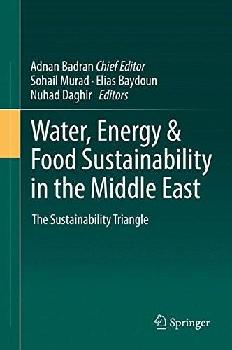
Water, energy & food sustainability in the Middle East : the sustainability triangle
This book provides a survey of technologies available to tackle the problems associated with climate change in the energy, water and food security nexus with a special focus on the Middle East. It is divided into three main sections. The energy Section consists of six chapters, the water section of seven chapters and finally the food security section has six chapters. The individual chapters are authored by experts and provide discussions and in-depth views on the current status of each topic.
Book

Water Wisdom
Israel and Palestine are water scarce. As the peace process continues amidst ongoing violence, water remains a political and environmental issue. Water Wisdom is model for those who believe that water conflict can be an opportunity for cooperation rather than violence. Thirty leading Palestinian and Israeli activists, water scientists, politicians, and others met to develop a future vision for the sustainable shared management of water resources. Their work explores the full range of scientific, political, social, and economic issues related to water use in the region; acknowledges areas of continuing controversy; and identifies areas of agreement.
eBook


Opening doors
Since the early 1990s, countries in the Middle East and North Africa (MENA) Region have made admirable progress in reducing the gap between girls and boys in areas such as access to education and health care. Indeed, almost all young girls in the Region attend school, and more women than men are enrolled in university. Over the past two decades, maternal mortality declined 60 percent, the largest decrease in the world. Women in MENA are more educated than ever before. It is not only in the protest squares that have seen women whose aspirations are changing rapidly but increasingly unmet. The worldwide average for the participation of women in the workforce is approximately 50 percent. In MENA, their participation is half that at 25 percent. Facing popular pressure to be more open and inclusive, some governments in the region are considering and implementing electoral and constitutional reforms to deepen democracy. These reforms present an opportunity to enhance economic, social, and political inclusion for all, including women, who make up half the population. However, the outlook remains uncertain. Finally, there are limited private sector and entrepreneurial prospects not only for jobs but also for those women who aspire to create and run a business. These constraints present multiple challenges for reform. Each country in MENA will, of course, confront these constraints in different contexts. However, inherent in many of these challenges are rich opportunities as reforms unleash new economic actors. For the private sector, the challenge is to create more jobs for young women and men. The World Bank has been pursuing an exciting pilot program in Jordan to assist young women graduates in preparing to face the work environment.
eBook

Urban resilience and climate change in the MENA region
\"This book provides an overview of the geopolitical context and climate change risk profile of the Middle East and North Africa (MENA) Region. Mapping existing scientific literature and key reports on MENA climate change impacts and future projections, Charles Egbu and Nuha Eltinay establish links between the COP26 regional climate adaptation financing targets, national government investments and local case-studies. They also address gaps in Disaster Risk Reduction institutional governance in the region. The authors move beyond the existing theoretical understanding of urban resilience to investigate how it is being measured and assessed in MENA in alignment with the IPCC's climate change adaptation indicators. Finally, they explore how the vulnerabilities of the communities most in need are being measured and integrated into cities' resilience action plans and national disaster risk policies. Providing guidance and policy recommendations based on empirical research and key stakeholder engagement observations, this book will be of great interest to students, scholars and professionals who are researching and working in the areas of climate change, urban planning and environmental policy and governance\"-- Provided by publisher.
BOOK

Impacts of the Russia-Ukraine War on Global Food Security: Towards More Sustainable and Resilient Food Systems?
As a conflict between two major agricultural powers, the Russia–Ukraine war has various negative socioeconomic impacts that are now being felt internationally and might worsen, notably, for global food security. If the war deepens, the food crisis will worsen, posing a challenge to many countries, especially those that rely on food imports, such as those in the Middle East and North Africa (MENA) region. Simultaneously, the war came at a bad time for global food markets because food prices were already high due to disruptions in the supply chain caused by the COVID-19 pandemic, strong global demand, and poor harvests in some countries. Understanding how conflict-related disruptions in global food and fertilizer markets might affect price and availability is critical for understanding the overall impact on global food security. Further, four months into the war, its implications for food security suggest that this review is timely, urgent, and highly needed. Accordingly, this paper aims to investigate the Russia–Ukraine war’s direct and indirect impact on global food security. The paper highlights that the war resulted in immediate and far-reaching cascading consequences on global food security: Ukrainian exports have stopped, conscription and population displacement have caused labor shortages, access to fertilizers is restricted, and future harvests are uncertain. First, Ukraine’s export capacity has been hampered. Secondly, conscription and population displacement caused labor shortages. Thirdly, access to vital agricultural products such as fertilizers is also constrained. The war may delay spring planting and winter crop harvesting. Further, the war has indirect and cascading effects. Indeed, rising fertilizer costs may reduce their use and crop yields. Moreover, as seen during the 2007–2008 food crisis, export restrictions and speculation are driving up international prices and worsening the situation. Furthermore, the war triggered a panic buying movement at country and individual levels. Finally, the war may jeopardize the implementation of the Sustainable Development Goals (SDGs), notably SDG 1 (No poverty), SDG 2 (Zero hunger), and DG 12 (Responsible consumption and production). However, the consequences of the war on food security are being exacerbated by a variety of underlying rigidities, vulnerabilities, and inefficiencies in global food systems. Accordingly, the transition toward healthy, equitable, and ecologically sustainable food systems must be strengthened by adopting urgent and long-term reforms and policies.
Journal Article