
Catalogue Search | MBRL


Are you sure you want to remove the book from the shelf?

{{itemTitle}}
973
result(s) for
"Svalbard"
Sort by:

Magnetic north : sea voyage to Svalbard
A sea voyage to the environmentally threatened Svalbard archipelago that traces the impacts of climate change on those northern lands.
Book
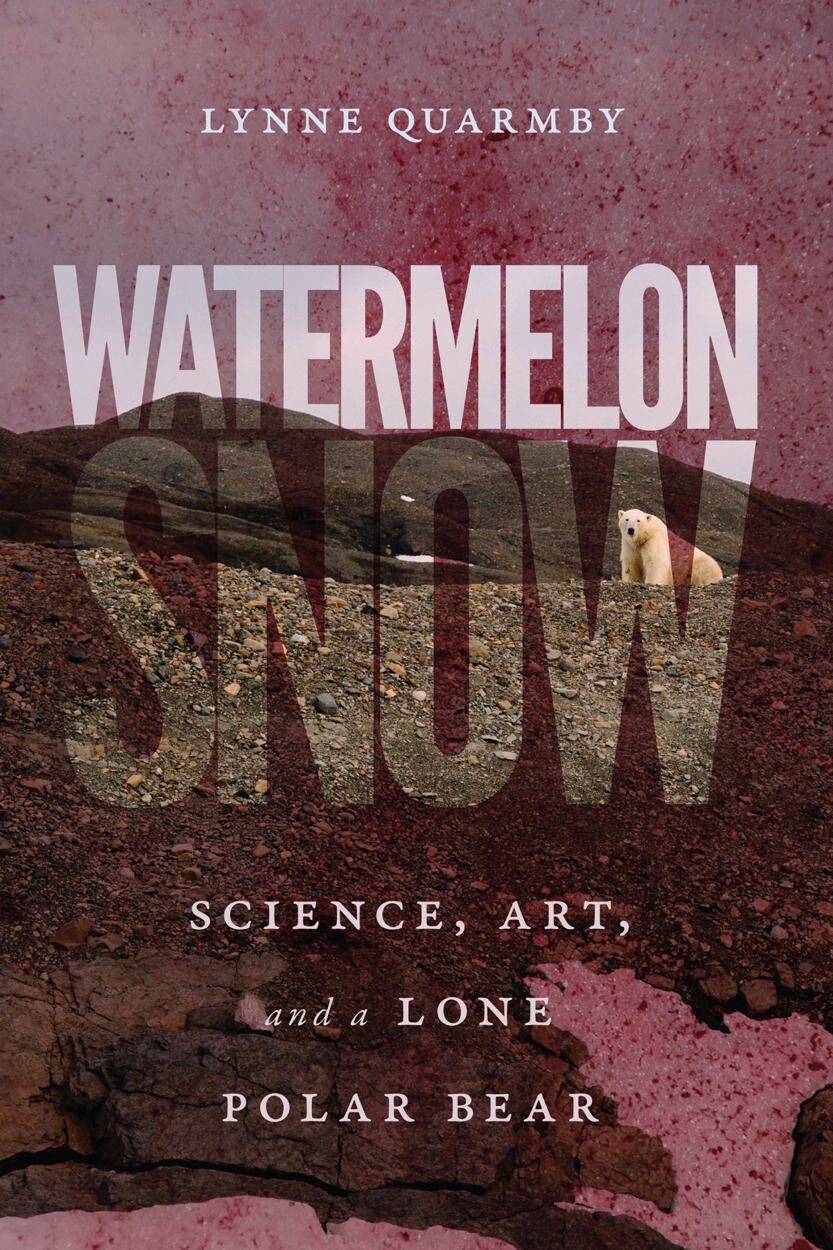
Watermelon Snow
Concern about the climate crisis is widespread as humans struggle to navigate life in uncertain times. From the vantage of a schooner full of artists on an adventure in the high Arctic, biologist Lynne Quarmby explains the science that convinced her of an urgent need to act on climate change and recounts how this knowledge - and the fear and panic it elicited - plunged her into unsustainable action, ending in arrests, lawsuits, and a failed electoral campaign on behalf of the Green Party of Canada.
Watermelon Snow weaves memoir, microbiology, and artistic antics together with descriptions of a sublime Arctic landscape. At the top of the warming world, Quarmby struggles with burnout and grief while an aerial artist twirls high in the ship's rigging, bearded seals sing mournfully, polar bears prowl, and glaciers crumble into the sea. In a compelling narrative, sorrow and fear are balanced by beauty and wonder. The author's journey back from a life out of balance includes excursions into evolutionary history where her discoveries reveal the heart of human existence. The climate realities are as dark as the Arctic winter, yet this is a book of lightness and generosity. Quarmby's voice, intimate and original, illuminates the science while offering a reminder that much about the human experience is beyond reason.
Inspiring and deeply personal, Watermelon Snow is the story of one scientist's rediscovery of what it means to live a good life at a time of increasing desperation about the future.
eBook

Svalbard : Spitsbergen, Jan Mayen, Franz Josef Land
'Svalbard' offers advice and expert tips, from Longyearbyen hotels and activities, expeditions and cruises, to wildlife and island flora. It also includes suggested itineraries, what to bring, Arctic exploration, Franz Josef Land, Jan Mayen, Hornsund, Pyramiden, treks, kayaking, whalewatching, polar bears, and dog sledding.
Book

Academia in Svalbard: an increasingly important role for research and education as tools for Norwegian policy
Svalbard, a High-Arctic archipelago over which Norway practises sovereignty in accordance with the terms of the Svalbard Treaty, has become an increasingly important area for Arctic research and higher education. There are four more or less permanent settlements with substantial research infrastructure, and a few manned observatories for special purposes. Several Norwegian and foreign research institutions have established stations and installations in the archipelago. With coal mining activity scaling down because of economic difficulties and lack of political support for subsidies, Norwegian policy will prioritize research and higher education as a way of maintaining Norwegian settlements in Svalbard. I give an overview of the institutions, organizations and facilities for research and higher education in Svalbard, and discuss the increasingly important role of research and education in Norwegian Svalbard policy.
Journal Article

Revisiting the extended Svalbard Airport monthly temperature series, and the compiled corresponding daily series 1898–2018
The Svalbard Airport composite series spanning the period from 1898 to the present represents one of very few long-term instrumental temperature series from the High Arctic. A homogenized monthly temperature series is available since 2014. Here we increase the resolution from a monthly to daily basis, and further digitization of historical data has reduced the uncertainty of the series. The most pronounced changes in the 120-year record occur during the last three decades. For the 1991–2018 period the number of days warmer than 0 and 5 °C has increased by 25 (21%) and 22 (59%), respectively, per year compared to the 1961–1990 standard normal. Likewise, comparing the same periods, the number of days colder than −10 and −20 °C has decreased by 42 (32%) and 27 (62%), respectively. During the entire time span of the series, the western Spitsbergen climate has gone through stepwise changes, alternating between cold and warm regimes: 1899–1929 was cold, 1930–1961 warm, 1962–1998 cold and 1999–2018 warm. The latest cold regime was 1.0 °C warmer than the first cold one, and the latest warm regime was 1.7 °C warmer than the previous warm one. For the whole series the linear trend for annual means amounts to 0.32°C/decade, which is about 3.5 times the increase of the global mean temperature for the same period. Since 1991, the rate of warming at Svalbard Airport is 1.7 °C/decade, which is more than twice the Arctic average (0.8 °C/decade, north of 66 °N) and about seven times the global average for the same period.
Journal Article
Temperature (latitude) and nutrient (seabird guano) effects on limno-terrestrial Tardigrada (Testechiniscus spitsbergensis and Pilatobius recamieri) body size
Surveys of terrestrial microinvertebrate morphometry, especially spatial patterns of body size at wider geographical scales, including the polar regions, are very scarce. In this study, we focused on Tardigrada, common limno-terrestrial microinvertebrates. Considering Bergmann's rule, originally formulated for endothermic animals, we tested the hypothesis that body length of limno-terrestrial tardigrades augments with increasing latitude and decreasing temperature. Since some of our sampling areas adjoined seabird colonies, we also explored the effects of nutrients from seabird guano deposits. Individual body length of Testechiniscus spitsbergensis was measured in populations obtained from seven localities distributed along a latitudinal gradient extending from 45°N (northern Italy) to 80°N (northern Svalbard), and for Pilatobius recamieri from three localities in Svalbard (77°N-80°N). Considering both latitude and proximity to a seabird colony there were significant effects of locality on the body length of T. spitsbergensis; however, no clear pattern of increasing individual body size with increasing latitude could be detected. Immense differences in body size may be a signal for cryptic species diversity within this genus. No effect of latitude, or proximity to a seabird colony, on the body length of Arctic populations of P. recamieri was documented. Evidently, there is no tendency towards body size increase along the latitudinal gradient in either T. spitsbergensis or P. recamieri. Our study, and recent literature, indicates that larger body size in polar regions reported for several groups of micro-fauna may be a taxon-dependent response, and cannot be taken as a universally applicable rule for limno-terrestrial animals.
Journal Article

Microplastics in Arctic polar waters: the first reported values of particles in surface and sub-surface samples
Plastic, as a form of marine litter, is found in varying quantities and sizes around the globe from surface waters to deep-sea sediments. Identifying patterns of microplastic distribution will benefit an understanding of the scale of their potential effect on the environment and organisms. As sea ice extent is reducing in the Arctic, heightened shipping and fishing activity may increase marine pollution in the area. Microplastics may enter the region following ocean transport and local input, although baseline contamination measurements are still required. Here we present the first study of microplastics in Arctic waters, south and southwest of Svalbard, Norway. Microplastics were found in surface (top 16 cm) and sub-surface (6 m depth) samples using two independent techniques. Origins and pathways bringing microplastic to the Arctic remain unclear. Particle composition (95% fibres) suggests they may either result from the breakdown of larger items (transported over large distances by prevailing currents, or derived from local vessel activity), or input in sewage and wastewater from coastal areas. Concurrent observations of high zooplankton abundance suggest a high probability for marine biota to encounter microplastics and a potential for trophic interactions. Further research is required to understand the effects of microplastic-biota interaction within this productive environment.
Journal Article

The unquantified mass loss of Northern Hemisphere marine-terminating glaciers from 2000–2020
In the Northern Hemisphere, ~1500 glaciers, accounting for 28% of glacierized area outside the Greenland Ice Sheet, terminate in the ocean. Glacier mass loss at their ice-ocean interface, known as frontal ablation, has not yet been comprehensively quantified. Here, we estimate decadal frontal ablation from measurements of ice discharge and terminus position change from 2000 to 2020. We bias-correct and cross-validate estimates and uncertainties using independent sources. Frontal ablation of marine-terminating glaciers contributed an average of 44.47 ± 6.23 Gt a
−1
of ice to the ocean from 2000 to 2010, and 51.98 ± 4.62 Gt a
−1
from 2010 to 2020. Ice discharge from 2000 to 2020 was equivalent to 2.10 ± 0.22 mm of sea-level rise and comprised approximately 79% of frontal ablation, with the remainder from terminus retreat. Near-coastal areas most impacted include Austfonna, Svalbard, and central Severnaya Zemlya, the Russian Arctic, and a few Alaskan fjords.
As glaciers terminate into the ocean, mass is lost through frontal ablation where the ice meets the ocean. Here the authors estimate decadal frontal ablation from 2000 to 2020 of 1496 glaciers in the Northern Hemisphere, and find that frontal ablation makes up 79% of ice discharge to the ocean.
Journal Article

State of the Climate in 2013
In 2013, the vast majority of the monitored climate variables reported here maintained trends established in recent decades. ENSO was in a neutral state during the entire year, remaining mostly on the cool side of neutral with modest impacts on regional weather patterns around the world. This follows several years dominated by the effects of either La Nina or El Nino events.
Journal Article

Calls of the little auk (Alle alle) chicks reflect their behavioural contexts
Animal vocalisations can often inform conspecifics about the behavioural context of production and the underlying affective states, hence revealing whether a situation should be approached or avoided. While this is particularly important for socially complex species, little is known about affective expression in wild colonial animals, and even less to about their young. We studied vocalisations of the little auk ( Alle alle ) chicks in the Hornsund breeding colony, Svalbard. Little auks are highly colonial seabirds, and adults convey complex behavioural contexts through their calls. We recorded chick calls during two contexts of opposite affective valence: handing by a human, and while they interact with their parents inside the nest. Using permuted discriminant function analysis and a series of linear mixed models, we examined the effect of the production context/associated affective valence on the acoustic parameters of those calls. Calls were reliably classified to their context, with over 97% accuracy. Calls uttered during handling had higher mean entropy, fundamental frequency, as well as lower spectral centre of gravity and a less steep spectral slope compared to calls produced during interactions with a parent inside the nest. The individuality of handling calls, assessed by information content, was lower than the individuality of calls uttered in the nest. These findings suggest that seabird chicks can effectively communicate behavioural/affective contexts through calls, conveying socially important messages early in development. Our results are mostly in line with emotional expression patterns observed across taxa, supporting their evolutionary continuity.
Journal Article