
Catalogue Search | MBRL


Are you sure you want to remove the book from the shelf?

{{itemTitle}}
909
result(s) for
"Sweatshops."
Sort by:


Shaming the Corporation: The Social Production of Targets and the Anti-Sweatshop Movement
As social movements co-evolve with changes in states and markets, it is crucial to examine how they make particular kinds of actors into focal points for the expression of grievances and the demand for rights. But researchers often bracket the question of why some kinds of organizations are more likely than others to become targets of social movement pressure. We theorize the \"social production of targets\" by social movements, rejecting a simple \"reflection\" model to focus on configurations of power and vulnerability that shape repertoires of contention. Empirically, we extend structural accounts of global commodity chains and cultural accounts of markets to analyze the production of targets in the case of the anti-sweatshop movement of the 1990s. Using a longitudinal, firm-level dataset and unique data on anti-sweatshop activism, we identify factors that attracted social movement pressure to particular companies. Firms' power and positions strongly shaped their likelihood of becoming targets of anti-sweatshop activism. But the likelihood of being a target also depended on the cultural organization of markets, which made some firms more \"shamable\" than others. Contrary to suggestions of an anti-globalization backlash, globalization on its own, and related predictions about protectionism, cannot explain the pattern of activism.
Journal Article

Circle of cranes
Taken from her small, impoverished Chinese village and forced to sew in a New York City sweatshop, thirteen-year-old Suyin is visited by the cranes with which she has a strange connection and learns she is the daughter of the Crane Queen, who needs her help.
Book

Sweatshop
Arguing that the sweatshop is as American as apple pie, Laura Hapke surveys over a century and a half of the language, verbal and pictorial, in which the sweatshop has been imagined and its stories told. Not seeking a formal definition of the sort that policymakers are concerned with, nor intending to provide a strict historical chronology, this unique book shows, rather, how the \"real\" sweatshop has become intertwined with the \"invented\" sweatshop of our national imagination, and how this mixture of rhetoric and myth has endowed American sweatshops with rich and complex cultural meaning. Hapke uncovers a wide variety of tales and images that writers, artists, social scientists, reformers, and workers themselves have told about \"the shop.\" Adding an important perspective to historical and economic approaches,Sweatshopdraws on sources from antebellum journalism, Progressive era surveys, modern movies, and anti-sweatshop websites. Illustrated chapters detail how the shop has been a facilitator of assimilation, a promoter of upward mobility, the epitome of exploitation, a site of ethnic memory, a venue for political protest, and an expression of twentieth-century managerial narratives. An important contribution to the real and imagined history of garment industry exploitation, this book provides a valuable new context for understanding contemporary sweatshops that now represent the worst expression of an unregulated global economy.
eBook

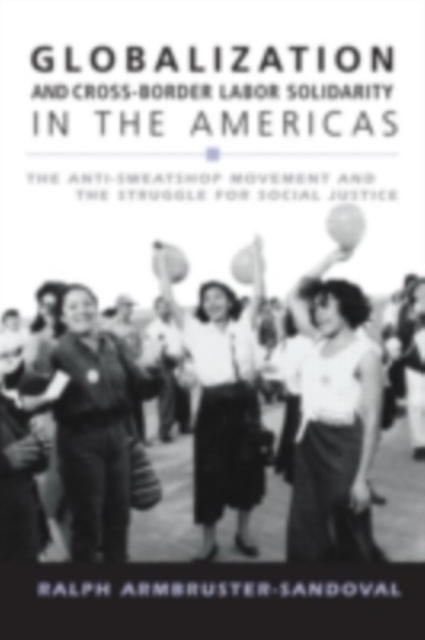
Globalization and Cross-Border Labor Solidarity in the Americas
First published in 2005. Routledge is an imprint of Taylor & Francis, an informa company.
Ralph Armbruster-Sandoval teaches in the Chicana/o Studies department at the University of California, Santa Barbara.
eBook

Who Says There is an Intention–Behaviour Gap? Assessing the Empirical Evidence of an Intention–Behaviour Gap in Ethical Consumption
The theories of reasoned action and planned behaviour (TRA/TPB) have fundamentally changed the view that attitudes directly translate into behaviour by introducing intentions as a crucial intervening stage. Much research across numerous ethical contexts has drawn on these theories to offer a better understanding of how consumers form intentions to act in an ethical way. Persistently, researchers have suggested and discussed the existence of an intention–behaviour gap in ethical consumption. Yet, the factors that influence the extent of this gap and its magnitude have not been systematically examined. We, therefore, contribute to the debate on the intention–behaviour gap by reviewing the empirical TRA/TPB studies that have assessed both intention and behaviour in ethical contexts. The findings from our review show that few studies assessed the intention–behaviour relationship and as a result, there is limited empirical evidence to date to quantify more accurately the intention–behaviour gap in ethical consumption. Our second contribution aims to provide an empirical case study which assesses the magnitude of the intention–behaviour gap in the context of avoidance of sweatshop clothing and to assess the roles of planning and actual behavioural control in potentially reducing the intention–behaviour gap. The findings of our case study suggest that there is indeed a large gap between intention and behaviour, and we conclude by calling for more empirical longitudinal studies to assess the complex nature of the relationship between intention and behaviour.
Journal Article

Behind the Label
In a study crucial to our understanding of American social inequality, Edna Bonacich and Richard Appelbaum investigate the return of sweatshops to the apparel industry, especially in Los Angeles. The \"new\" sweatshops, they say, need to be understood in terms of the decline in the American welfare state and its strong unions and the rise in global and flexible production. Apparel manufacturers now have the incentive to move production to wherever low-wage labor can be found, while maintaining arm's-length contractual relations that protect them from responsibility. The flight of the industry has led to a huge rise in apparel imports to the United States and to a decline in employment.Los Angeles, however, remains a puzzling exception in that its industry employment has continued to grow, to the point where L.A. is the largest center of apparel production in the nation. Not only the availability of low-wage immigrant (often undocumented) workers but also the focus on moderately priced, fashion-sensitive women's wear makes this possible. Behind the Label examines the players in the L.A. apparel industry, including manufacturers, retailers, contractors, and workers, evaluating the maldistribution of wealth and power. The authors explore government and union efforts to eradicate sweatshops while limiting the flight to Mexico and elsewhere, and they conclude with a description of the growing antisweatshop movement.Los Angeles Times Best Nonfiction Book of 2000
eBook

Wall Street vs. Main Street: Firm Strategies for Defending Legitimacy and Their Impact on Different Stakeholders
We assess the effect of firm strategies to defend legitimacy on two different stakeholder groups—the public (“Main Street”) and the investment community (“Wall Street”). We identify four types of firm strategies in response to challenges to their legitimacy—
denial
,
defiance
,
decoupling
, and
accommodation
— drawing from theory and from case studies of international outsourcing. We then develop and test hypotheses on the effectiveness of these strategies in defending legitimacy across these two stakeholder groups, using data from media reports and press releases on all 126 distinct accusations of the use of international sweatshops by U.S. firms from 1990 through 2002. We find that denial and defiance responses hinder the recovery of legitimacy on Main Street, and none of the responses has a positive effect on public perception, whereas Wall Street is unaffected by denial and defiance but views decoupling favorably. Main Street and Wall Street thus perceive firm actions to defend its legitimacy quite differently, suggesting that these worlds operate by separate moralities in which Main Street appears to privilege fairness as a core value, whereas Wall Street privileges profit.
Journal Article
Sweatshops, Structural Injustice, and the Wrong of Exploitation: Why Multinational Corporations Have Positive Duties to the Global Poor
It is widely thought that firms that employ workers in \"sweatshop\" conditions wrongfully exploit those workers. This claim has been challenged by those who argue that because companies are not obligated to hire their workers in the first place, employing them cannot be wrong so long as they voluntarily accept their jobs and genuinely benefit from them. In this article, I argue that we can maintain that at least many sweatshop employees are wrongfully exploited, while accepting the plausible claim at the core of many defenses of sweatshops, namely that engaging in a voluntary and mutually beneficial transaction with a person in need cannot constitute morally worse treatment of that person than doing nothing at all to benefit her. We can do this, I claim, by accepting that wealthy multinational corporations have positive duties to employ or otherwise benefit the global poor. I argue that these duties can be plausibly grounded in the fact that potential sweatshop workers are victims of global structural injustice, from which multinational corporations typically benefit.
Journal Article