
Catalogue Search | MBRL


Are you sure you want to remove the book from the shelf?

{{itemTitle}}
28
result(s) for
"Swedish fiction Translations into English."
Sort by:

The 100-year-old man who climbed out the window and disappeared
Confined to a nursing home and about to turn 100, Allan Karlsson, who has a larger-than-life back story as an explosives expert, climbs out the window in his slippers and embarks on an unforgettable adventure involving thugs, a murderous elephant and a very friendly hot dog stand operator.
Book

The function of recurrent word-combinations in English translations from three different languages
This article compares phraseological tendencies in translated vs. non-translated English through functionally classified 3-word sequences. The study builds on previous research that compared 3-grams in fiction texts originally written in English with fiction texts translated from Norwegian. The current investigation adds English translations from two additional languages – German and Swedish – with the aim of establishing to what extent the tendencies noted for English translations from Norwegian extend to English translations from other languages. Thus the study contributes to the discussion of translation universals and translation as a third code. At the level of 3-gram functions, it has been uncovered that English originals and translations share similar functional characteristics in eight of the fourteen categories identified. Of the remaining six, four show statistically significant differences between originals and translations, regardless of source language. Based on a more qualitative study of four specific 3-grams from two of these categories, it is concluded, in line with the previous studies, that the most likely explanations are source language(s) shining through and the (potentially universal) tendency for translators to use a smaller and more fixed set of expressions in their translations.
Journal Article

I am behind you
\"A compelling, eerie new novel from the internationally bestselling author of Let the Right One In. \"Sweden's Stephen King.\" --The Washington Post \"One of the hottest writers in the horror genre.\" --Mystery Scene \"At the top of his game, Lindqvist gives Stephen King and John Saul at their best a run for the money.\" --Library Journal (starred) \"Dubbed the Stephen King of Sweden, Lindqvist lives up to the billing.\" --New York Post Four families wake up one morning in their trailer on an ordinary campsite. However, during the night something strange has happened. Everything outside the camping grounds has disappeared, and the world has been transformed into an endless expanse of grass. The sky is blue, but there is no sign of the sun; there are no trees, no flowers, no birds. And every radio plays nothing but the songs of sixties pop icon Peter Himmelstrand. As the holiday-makers try to come to terms with what has happened, they are forced to confront their deepest fears and secret desires. Past events that each of them has tried to bury rise to the surface and take on terrifying physical forms. Can any of them find a way back to reality?\"-- Provided by publisher.

The Obama presidency , the Macintosh keyboard and the Norway fiasco : English proper noun modifiers and their German and Swedish correspondences
This article concerns English proper noun modifiers denoting organizations, people and places and their German and Swedish correspondences. It supplements previous studies touching upon contrastive comparisons by providing large-scale systematic findings on the translation correspondences of the three aforementioned semantic types. The data are drawn from the Linnaeus University English–German–Swedish Corpus (LEGS), which contains popular non-fiction, a genre previously not studied in connection with proper noun modifiers. The results show that organization-based modifiers are the most common and person-based ones the rarest in English originals. Compounds are the most frequent correspondences in German and Swedish translations and originals with genitives and prepositional phrases as other common options. The preference for compounds is stronger in German, while it is stronger for prepositional phrases in Swedish translations, reflecting earlier findings on language-specific tendencies. Organization-based modifiers tend to be translated into compounds, and place-based modifiers into prepositional phrases. German and Swedish translators relatively often opt for similar target-language structures. Two important target-language differences emerge: (i) compounds with complex heads are dispreferred in Swedish ( US news show > * USA-nyhetsprogram ) but unproblematic in German ( US-Nachrichtensendung ), and (ii) compounds with acronyms ( WTO ruling > WTO-Entscheidung ) are more frequent in German.
Journal Article


A comparative study of information change in translation of nonfiction literature
The present paper compares translations from Russian into Finnish, Swedish, and English of a work of political non-fiction, Всякремлевскаярать: КраткаяисториясовременнойРоссии(lit. All the Kremlin men: A short history of contemporary Russia) by Mikhail Zygar (2016a) and investigates the use of information change as a translation strategy. Information change covers addition and omission of non-inferable content, used either separately or sequentially (i.e. addition following omission resulting in substitution). De Metsenaere’s and Vandepitte’s (2017) notions of addition and omission are applied. The study shows that the translations into Finnish and Swedish exhibit similarly infrequent use of information changing strategies while the English translation appears more liberal in their use. Possible reasons for the additions, omissions, substitutions, and their effects are discussed, as is the potential impact of the English translations on translation norms
Journal Article

Us against you
Can a broken town survive a second tragedy? By the time the last goal is scored, someone in Beartown will be dead . . . Us Against You is the story of two towns, two teams and what it means to believe in something bigger than yourself. It's about how people come together - sometimes in anger, often in sorrow, but also through love. And how, when we stand together, we can bring a town back to life -- Cover.

A Darker Shade of Sweden
Ever since Stieg Larsson shone a light on the brilliance of Swedish crime writing with his acclaimed and bestselling Girl With the Dragon Tattoo trilogy, readers around the world have devoured fiction by some of the greatest masters of the genre. In this landmark and unique publication, Sweden's most distinguished and best-loved crime writers have contributed stories to an anthology that promises to sate the desire to read about the dark side of Sweden. Containing seventeen stories, never before published in English, A Darker Shade of Sweden illuminates this beguiling country and its inhabitants as never before. Included are stories from such Swedish literary luminaries as: * Stieg Larsson * Henning Mankell * #65533;sa Larsson * Eva Gabrielsson.
eBook
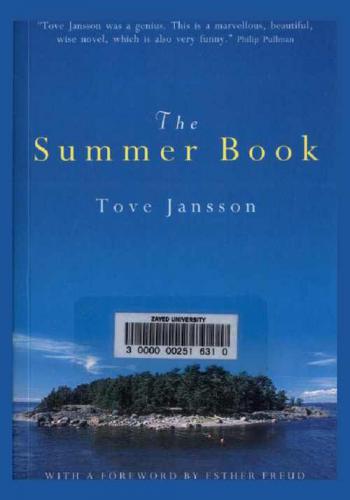
The summer book
An elderly artist and her six-year-old granddaughter while away a summer together on a tiny island in the gulf of Finland. Gradually, the two learn to adjust to each other's fears, whims and yearnings for independence, and a fierce yet understated love emerges - one that encompasses not only the summer inhabitants but the island itself.

The Geography of Prestige: Prizes, Nigerian Writers, and World Literature
\"1 In his account, the power of national cultural fields, especially, has declined since the mid-twentieth-century heyday of anticolonial cultural nationalism. Since awarding the Nobel Prize in Literature to Nigerian writer and activist Wole Soyinka in 1986, the Swedish Academy has been at the forefront of defining a \"global\" or \"world\" literature—for English, the terms are interchangeable—that inevitably alters or even undermines \"national literary hierarchies and systems of value,\" the ways in which writers are appraised by their compatriots (EP, 304). Named for Sir Michael Caine, who helped establish the Booker (now Man Booker) Prize for Fiction while an executive at Booker plc, the Caine Prize is based in London and presented at a ceremony in Oxford. Since 2000, it has awarded £10,000 each year \"to a short story by an African writer published in English. According to Bánjọ, the openness of the competition \"to all Nigerians,\" regardless of place of residence, \"does not mean that writing about other peoples and cultures in a foreign setting is acceptable. \"90 Evidently, then, \"excellence\" is conceived of not only as aesthetic re-presentation, but also as the worthy representation of Nigerian society—and perhaps even \"the African continent\"—including through the physical form of the book. Since 2013, the Nigeria Prize for Literature has become even more explicit in its claims to be developing a national literature by encouraging high-quality publishing within Nigeria: \"Too often, authors feel that their main options are either to self-publish, which means bringing out unassessed and usually improvable books, or to publish abroad, relinquishing what should be their primary audience.
Journal Article