
Catalogue Search | MBRL


Are you sure you want to remove the book from the shelf?

{{itemTitle}}
30
result(s) for
"Swift, Kay"
Sort by:
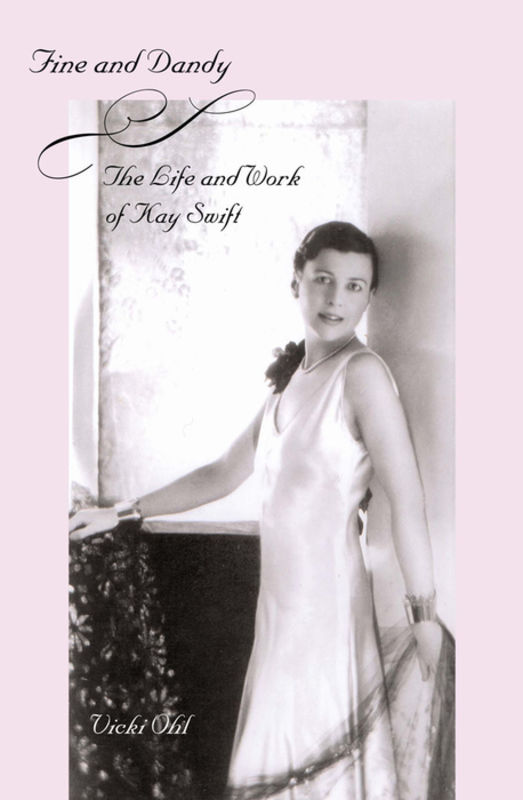
Fine and Dandy
Kay Swift (1897-1993) was one of the few women composers active on Broadway in the first half of the twentieth century. Best known as George Gershwin's assistant, musical adviser, and intimate friend, Swift was in fact an accomplished musician herself, a pianist and composer whoseFine and Dandy(1930) was the first complete Broadway musical written by a woman. This fascinating book-the first biography of Swift-discusses her music and her extraordinary life.Vicki Ohl describes Swift's work for musical theater, the ballet, Radio City Music Hall's Rockettes, and commercial shows. She also tells how Swift served as director of light music for the 1939 World's Fair, eloped with a cowboy from the rodeo at the fair, and abandoned her native New York for Oregon, later fashioning her experiences into an autobiographical novel,Who Could Ask for Anything More?Informed by rich material, including Swift's unpublished memoirs and extensive interviews with her family members and friends, this book captures the essence and spirit of a remarkable woman.
eBook

Women composers and the American musical: the early years
Snyder and Mantel present an overview of American music history focusing on women composers working in musical theater in the early 20th century. Among the composers profiled are Kay Swift, Mary Rodgers and Micki Grant.
Journal Article

GERSHWIN LOVER'S TALE IS A RHAPSODY IN BLUE
Kay Swift is best known as the composer of the popular standards \"Can't We Be Friends?\" and \"Fine and Dandy\" and as the woman George Gershwin came closest to marrying. Her role as Gershwin's helpmate, lover, and keeper of his musical legacy has overshadowed her own formidable talents and unusual career, now brought to light in Vicki Ohl's new biography, \"Fine and Dandy.\" Influenced by Gershwin, Swift took up popular songwriting and became his musical adviser; a powerful creative and romantic partnership developed. The bond came at a price, destroying her marriage, straining her already distant relationship with her children, and hindering her own career. Had he lived, it is far from clear whether Gershwin, a noted ladies' man, would have married Swift. (Observing the couple, pianist Oscar Levant remarked, \"Here comes George Gershwin with the future Miss Kay Swift!\") Whatever hurt it brought her, Swift treasured the relationship. Ohl lets Swift have her say. She alludes to, but does not pursue, the question of whether discrimination limited the careers of Swift and her female peers. In Swift's case, Ohl's approach seems appropriate. Swift enjoyed many advantages, created her own opportunities, and did as she pleased. If she suffered any conflict, it was within herself: the promise of a great talent versus an irrepressible desire for an abundant life.
Newspaper Article
K. SWIFT, WROTE MUSIC FOR STANDARDS
Katharine Faulkner Swift was born on April 19, 1897, in New York City, where she grew up and studied piano, composition and orchestration. After playing in a classical trio, she was a rehearsal pianist for the 1927 show A Connecticut Yankee. Two years later, she cracked Broadway as a composer with Can`t We Be Friends? In 1930, Fine and Dandy opened on Broadway, where it ran for 236 performances.
Newspaper Article

Woman bites off fingers of 89-year-old man
[Linda Kay Swift] tore a large portion of the man's flesh from his hand with her teeth, police said. The report said he is permanently disfigured and lost a significant amount of blood. Swift's booking mugshot shows a significant amount of bruising on her face, as well as what appears to be blood spattered on her nose.
Newspaper Article

Woman bites off fingers of 89-year-old man
[Linda Kay Swift] tore a large portion of the man's flesh from his hand with her teeth, police said. The report said he is permanently disfigured and lost a significant amount of blood. Swift's booking mugshot shows a significant amount of bruising on her face, as well as what appears to be blood spattered on her nose.
Newspaper Article

DEATHS ELSEWHERE
* Baron Axel von dem Bussche, 73, the last member of a group of German Army officers who tried to assassinate Adolf Hitler in World War II, died Tuesday of natural causes. Born into an old Saxon family, he was 23 and an officer in the 9th Infantry Regiment when he witnessed the systematic killing of Jews by the SS near the village of Dudno in Ukraine in 1942. * Edward P. Morgan, 82, a broadcast journalist and writer who reported for ABC, CBS and public television, died Wednesday of cancer at his home in suburban McLean, Va. From 1955 to 1967, Mr. Morgan broadcast an evening radio program of news and commentary, \"Edward P. Morgan and the News,\" that won him the George Foster Peabody Award, broadcasting's top honor, in 1956. Also in 1956, he broadcast a memorable account of the collision of the ocean liners Andrea Doria and Stockholm off the Massachusetts coast, not telling listeners that his 14-year-old daughter had been aboard the Andrea Doria and was believed to have been killed. The girl was discovered alive the next day, having been catapulted to a deck of the Stockholm when its bow knifed into her cabin. He retired as an ABC commentator in 1975.
Newspaper Article

Prelude
This chapter provides background information on Kay Swift's family and childhood. It explains that the Swift family originated in the British Isles but had lived in America for several generations and that music was an important component in the lives of the Swift children. Swift was raised by serious amateur and professional musicians. This chapter also discusses Swift's education, values and her music lessons.
Book Chapter

When her heart belonged to Daddy
By all descriptions, the 1926 musical \"Oh, Kay!\" qualifies as light entertainment. But when the novelist [Katharine Weber] saw a 1989 revival, at the Goodspeed Opera House in Connecticut, the show came with weight attached. Its music was written by [George Gershwin], who had been the lover of [Kay Swift], Ms. Weber's maternal grandmother, who may have inspired the show's title character. In any case, one of Ms. Weber's theatergoing companions, an old friend of the family, told her that Ms. Weber's father had once been a beau of Ms. Swift, who had subsequently introduced him to her daughter, who became Ms. Weber's mother. If that were true, then her father would have been her grandmother's lover. The first 126 pages of \"The Memory of All That\" reaffirm the publishing creed that bad parents make good memoirs. Ms. Weber's account of her relationship with her manipulative fabulist of a father brings to mind classic autobiographies of unmoored childhoods, like Mary Karr's \"Liars' Club\" and those companion volumes from the brothers Wolff, \"This Boy's Life\" (Tobias) and \"The Duke of Deception\" (Geoffrey). Once the book shifts its attention to Ms. Weber's grandmother, it becomes more diffuse. The effect is of sitting with someone inspired to colorful but scattershot recollection by one helluva family photo album. It's when Ms. Weber remembers Papa that her considerable skills as a writer are most seductively on display. It's not just because the exasperating [Sidney Kaufman] is such a good subject. It's that Ms. Weber is able to arrange words musically, so that they capture the elusive, unfinished melodies that haunt our memories of childhood. As her grandmother's lover might have put it, she's got rhythm.
Newspaper Article

Kay Swift, a pioneer female songwriter
Swift and [James Paul Warburg] collaborated in 1929 to write \"The First Little Show,\" a lavish musical with a score that includes \"Can't We Be Friends,\"...
Newspaper Article